Europe Is Rearming — Why Serbia and Bosnia Are Financing Everyone Else’s Defence Innovation
As Europe re-arms and defense capital floods Western hubs, Bosnia and Serbia remain absent from the defense-tech map—pushed into a low-margin subcontractor role despite strong industrial and engineering foundations.

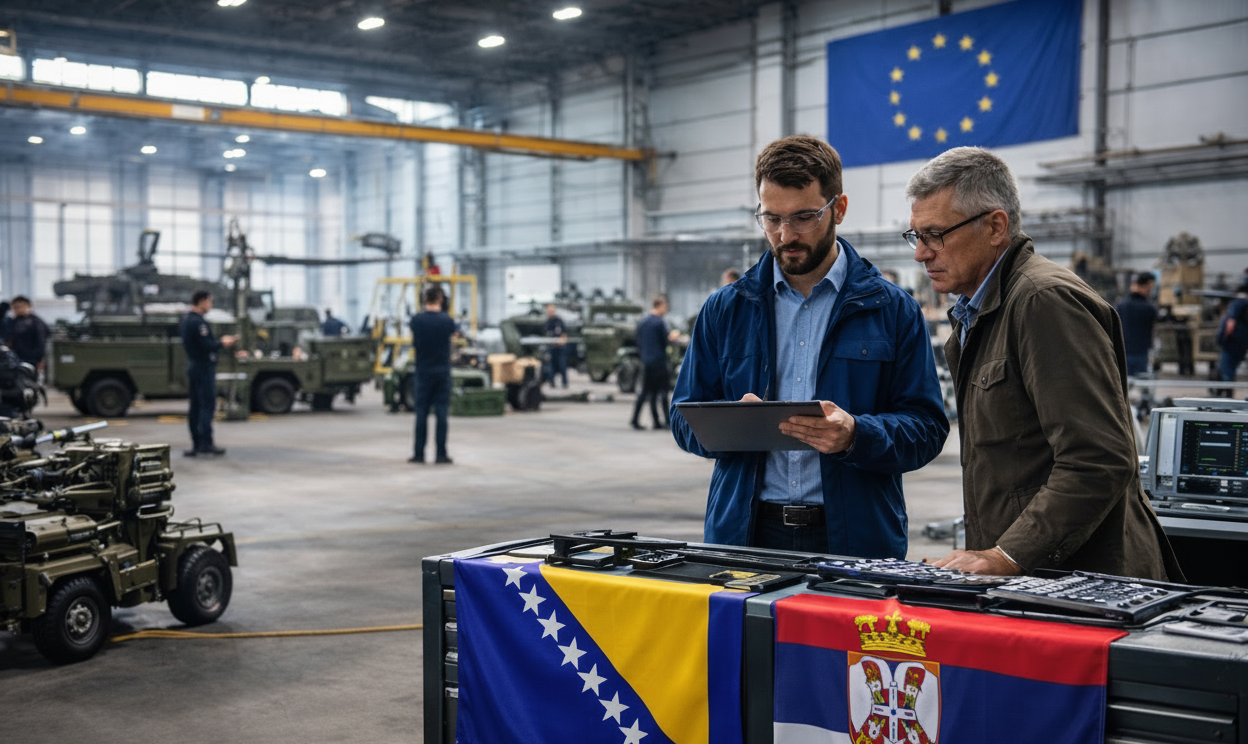
By the standards of recent European history, 2025 should be remembered as a watershed year for defence innovation. Venture capital is no longer shying away from military and dual-use technologies. Governments are openly prioritizing readiness. Security, once a political liability, has become an economic and strategic imperative.
And yet, beneath the record figures and confident rhetoric, Europe’s defence-tech renaissance remains deeply uneven.
While Western Europe attracts billions in venture funding and builds new generations of defence startups, much of Southeast Europe—particularly non-EU states such as Bosnia and Serbia—remains structurally excluded from this transformation. The region is not failing to innovate. It is failing to finance innovation at home.
A Boom With Narrow Geography
According to Dealroom data, European defence and dual-use startups raised roughly $1.5 billion in 2025, making defence the fastest-growing venture capital vertical on the continent. Since 2019, Europe’s share of NATO defence-tech investment has climbed from under 1 percent to just over 6 percent. The shift reflects the shock of Russia’s war in Ukraine, growing doubts about long-term transatlantic security guarantees, and a broader reassessment of defence as a legitimate and necessary field for private capital.
But this growth is concentrated. Germany, the United Kingdom, and France account for the overwhelming majority of investment. Central and Eastern Europe receives only a marginal share, and non-EU Southeast Europe is nearly invisible in the data.
This imbalance is often misread as a lack of startups or ideas. In reality, it reflects a far more consequential constraint: access to capital.
Engineers Without Investors
Bosnia and Serbia, like much of Southeast Europe, bring together assets that should make them natural participants in Europe’s defence-tech expansion. The region has decades of experience in ammunition, explosives, armored vehicles, and mechanical systems. Its universities continue to produce highly skilled engineers, software developers, and robotics specialists. Costs of development and prototyping remain significantly lower than in Western Europe.
What is missing is a functioning defence-venture ecosystem.
Domestic banks will not finance defence projects. Local venture capital is scarce and largely oriented toward consumer technology or outsourcing. European Union defence instruments remain inaccessible or administratively blocked for non-member states. Meanwhile, many Western European funds continue to exclude defence entirely, citing ESG concerns or regulatory uncertainty.
The result is a quiet but persistent drain. Promising teams relocate to Berlin, London, or Paris. Early intellectual property is sold abroad. Local firms remain locked into subcontracting roles—manufacturing components or providing services for foreign primes while capturing little strategic value.
In effect, Bosnia and Serbia help finance defence innovation elsewhere, through exported talent and discounted industrial capacity, while importing finished technology at higher cost.
The American Contrast
The gap becomes clearer when Europe is compared with the United States. Since 2019, the US has captured roughly 85 percent of all NATO defence-tech venture capital. In 2025 alone, American defence startups raised tens of billions of dollars—an order of magnitude beyond European totals.
This dominance is not simply a matter of money. It reflects an ecosystem in which defence innovation is structurally enabled. Venture-backed “neoprimes” operate with speed, scale, and a software-first mindset, challenging traditional defence contractors. Companies such as Anduril Industries and Palantir Technologies exemplify this model: rapid iteration, deep integration with government customers, and procurement systems designed to absorb innovation rather than resist it.
Europe has begun to respond, with the emergence of specialized defence funds and initiatives like the NATO Innovation Fund. But these mechanisms largely reinforce existing geographic patterns. Non-EU Southeast Europe remains peripheral—visible as a supply base, but absent as a source of venture-backed innovation.
A Strategic Blind Spot
This exclusion is more than an economic inconvenience. It is a strategic risk.
Bosnia and Serbia sit on Europe’s immediate security periphery. Their industries are already embedded in European defence supply chains. Their societies are exposed to hybrid threats, disinformation, and regional instability. Yet without access to capital, the region cannot move up the value chain—from manufacturing and maintenance to systems integration, autonomy, artificial intelligence, and next-generation production methods.
In a decade defined by rearmament, dependence is quietly deepening where resilience should be built.
Europe’s ambition of strategic autonomy cannot be reconciled with an internal innovation gap that leaves entire regions technologically undercapitalized.
What Must Change
Markets alone will not correct this imbalance. Defence venture capital does not emerge spontaneously—especially in politically sensitive environments. Government action is indispensable.
First, Bosnia and Serbia need state-anchored defence venture funds, even at modest scale. A €50–150 million fund, co-investing alongside private capital, would signal seriousness and unlock deal flow that currently never reaches the market.
Second, procurement must be treated as a venture instrument. Pilot programs, fast-track testing, and limited early contracts can validate startups far more effectively than grants or strategy documents. In defence, early customers matter as much as early investors.
Third, regional cooperation is unavoidable. No single Southeast European state can sustain a full defence-innovation ecosystem on its own. Cross-border SEE defence platforms—aligned with NATO standards and jointly funded—offer the only realistic path to scale.
A Choice, Not a Fate
Europe’s defence-tech boom is real. But its geography is incomplete.
Bosnia and Serbia do not need symbolic inclusion or rhetorical support. They need capital, credible investors, and political backing equal to the security responsibilities they already bear. Without that, the region will remain what it is today: a capable industrial base financing innovation elsewhere.
In an era where security is once again defined by technology and speed, that is not a neutral position. It is a strategic decision—whether made consciously or not.
This article was originally published by AdriaDefense. Republishing is permitted with attribution and an active backlink to the original article.