Europe’s Defense Industry Has a Financing Crisis — Not Just a Production Gap
Europe urges defense suppliers to boost production, but many are already burdened by legacy debt and lack access to affordable capital. Until financing mechanisms catch up with strategic demand, Europe’s industrial base remains constrained and vulnerable.

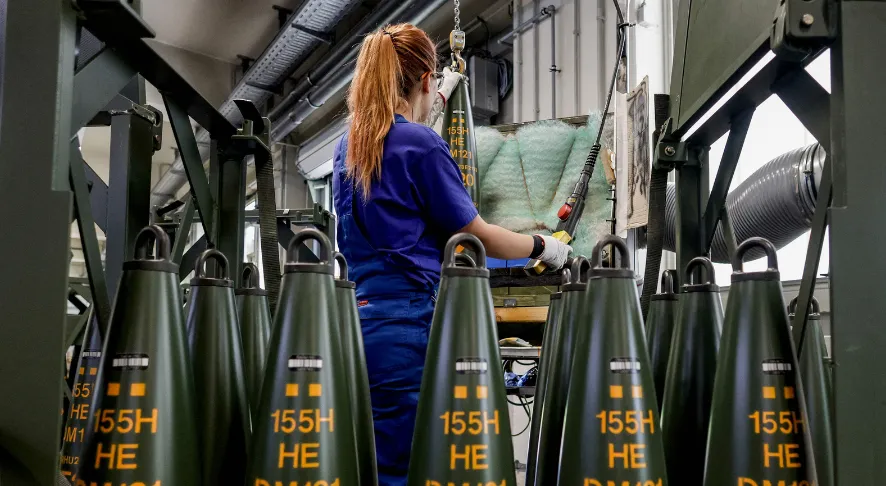
Europe wants its defense manufacturers to ramp up production as if the continent were already mobilized industrially for conflict. Politicians call for more ammunition, faster delivery cycles, and expanded manufacturing lines. The expectation is wartime output — but the financial system supporting the industry remains firmly peacetime.
The uncomfortable fact is this: many European defense suppliers are already heavily leveraged. Throughout the previous decade, defense spending was depressed, orders were sporadic, and uncertainty shaped the sector. To stay alive, companies borrowed — not to expand, but simply to survive. That debt now constrains every move they make.
Today they are told to scale: hire staff, purchase machines, increase production lines, operate overtime. But with what money?
Banks still categorize defense as a “high-risk” industry. Financing remains tight or punitive. Equity investment is minimal — heavy-industry defense suppliers are not viewed as venture-scalable. And payment models lag behind industrial requirements: most defense contracts settle upon delivery, not before. Suppliers are expected to finance production upfront — an absurd premise for firms already carrying legacy debt.
The result is a strategic weakness: Europe’s industrial potential exists — but it is financially immobilized.
This problem has solutions:
- Pre-financing and milestone-based government payments so suppliers aren’t forced to conjure capital from nothing.
- Defense-specific banking, guarantees, or state-backed lending facilities to lower borrowing costs and unlock working capital.
- Transparent, multi-year procurement planning so companies have justified confidence to invest in infrastructure and workforce.
- A procurement penalty system for late payments by government agencies, ensuring suppliers aren’t left waiting months for cash flow due to bureaucratic delay.
Europe does not merely lack production capacity — it lacks a financing architecture aligned with geopolitical reality.
Fix the capital model and industry expansion follows. Leave financing constrained and Europe remains strategically exposed, regardless of political rhetoric or procurement ambition.