US Import Barriers Rise for UAS: How CEE/SEE Firms Can Keep a Path to US Contracts
New US measures are tightening access to the American drone market by restricting imports of foreign-made unmanned aircraft systems and key components while raising domestic-content expectations for federal procurement.

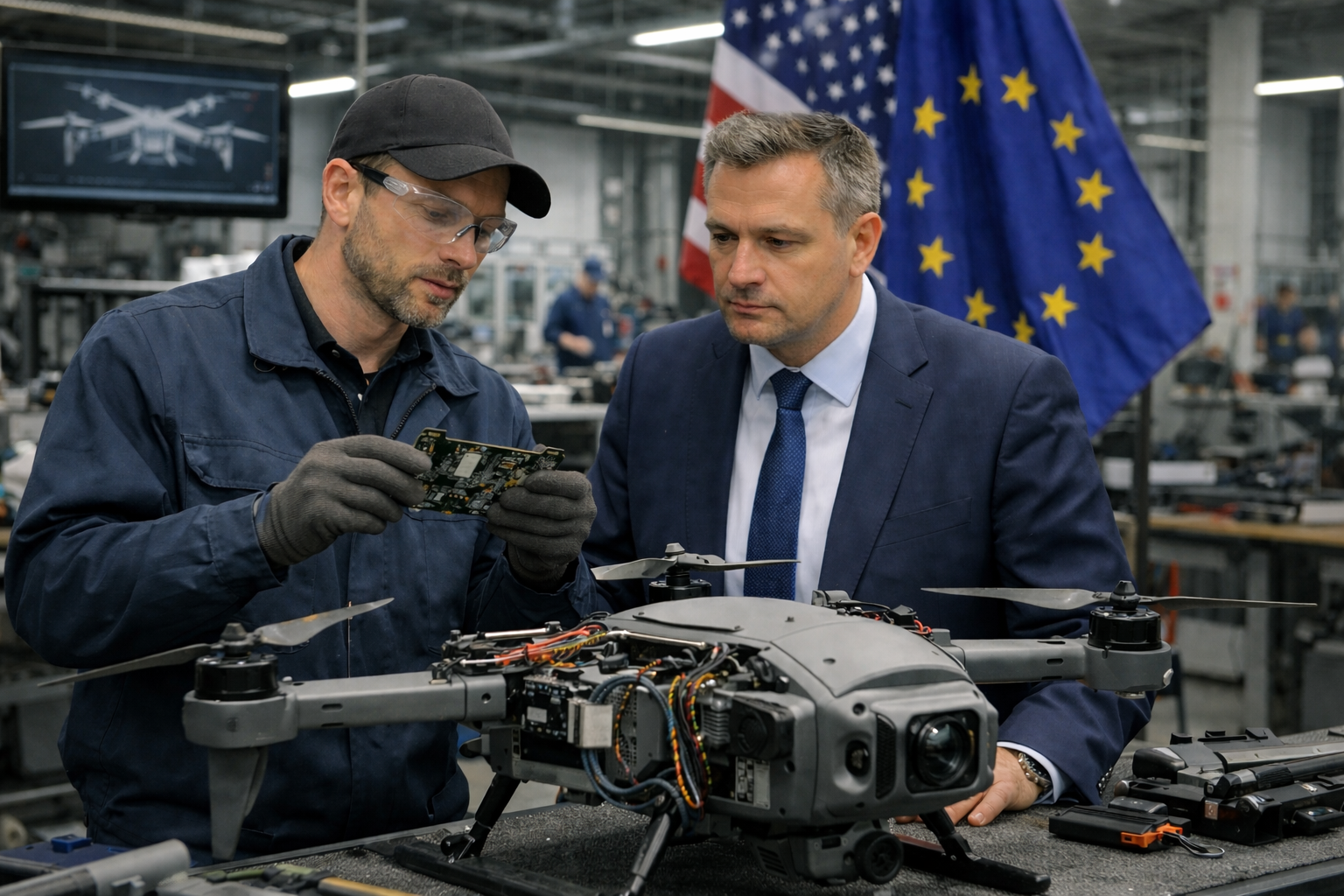
Foreign defense companies have spent decades building access to the US market, often through local subsidiaries that can bid on programs, integrate with US primes, and keep sensitive work inside the United States. That playbook is now being tested in the drone sector, where Washington is using both telecom regulation and procurement policy to push more of the supply chain onshore.
FCC action targets drones and critical components
On December 22, 2025, the Federal Communications Commission Public Safety and Homeland Security Bureau added foreign-made unmanned aircraft systems and foreign-produced UAS critical components to the FCC Covered List, following an executive-branch national security determination. The FCC document references risks such as unauthorized surveillance, sensitive data exfiltration, and supply-chain vulnerabilities, and it explicitly names categories including communications systems, flight controllers, ground control stations, navigation systems, batteries and motors when discussing UAS-critical components.
Practically, the step matters because most drones and their radio-linked subsystems require FCC equipment authorization to be imported and marketed in the US. Legal analyses of the FCC action describe it as a functional market-entry barrier for new foreign-made drone models and covered components, even where final assembly occurs in the United States.
The FCC action is not a blanket shutdown of all currently fielded systems. Commentary on the decision indicates the restrictions are focused on new models seeking authorizations, while existing authorizations were not broadly rescinded at the time of the decision.
Transitional relief, but not a reversal
In early January 2026, the FCC said it would exempt imports of some new models of foreign-made drones and critical components through the end of 2026, following a Pentagon recommendation. The reporting also noted concerns about downstream impacts on sectors such as agriculture and industry that rely on drones.
For non-US suppliers, the near-term message is that compliance pathways may exist for specific items, but the default direction is toward tighter screening and a higher burden of proof for foreign-origin hardware entering US supply chains.
Buy American thresholds raise the bar deeper in the bill of materials
Separately from the FCC’s equipment-authorization gate, Buy American rules in federal procurement continue to push domestic content higher. FAR language sets the domestic component cost threshold at 65 percent for items delivered in calendar years 2024 through 2028, rising to 75 percent for items delivered starting in 2029.
For drones and counter-UAS systems, that matters because the highest-risk and highest-value subsystems are often component-heavy: radios, navigation, flight-control electronics, batteries, motors, and payload sensors. As US authorities scrutinize not only the air vehicle but the electronics and communications stack around it, foreign companies face pressure to localize more than final assembly. The result is a shift from a factory-footprint problem to a supplier-network problem.
The Blue UAS pathway is evolving
The Pentagon’s Blue UAS cleared list has been used as a procurement shortcut for vetted systems, but the governance model is changing. The Defense Innovation Unit says the Blue UAS Cleared List is transitioning to the Defense Contract Management Agency, citing a July 10, 2025 Secretary of War memo.
For suppliers, that transition signals that access to US programs will increasingly run through formal compliance and sustainment structures, not just rapid adoption channels.
Industrial implications: capacity, acquisitions, and US-based production assets
As import pathways tighten and domestic-content expectations rise, manufacturing capacity inside the United States becomes a strategic asset, not just a cost center. That dynamic is showing up in corporate behavior around distressed industrial platforms that already have plants, workforce, and qualified production processes.
First Brands Group, a US automotive aftermarket manufacturer in Chapter 11, has launched a marketing and sale process intended to conclude in the first quarter of 2026, according to court-process reporting. While not a defense business, its existing plants and industrial footprint illustrate the type of asset base that could be repurposed or absorbed by buyers seeking US production capacity.
Capital follows the supply-chain bottleneck
Investment trends are also shifting toward production depth and “picks-and-shovels” industrial capability, alongside software and autonomy. Examples from January 2026 include Onebrief’s $200 million Series D at a valuation above $2 billion, paired with an acquisition to expand into wargaming and simulation.
Similarly, manufacturing-focused funding has continued for firms positioning themselves as scaled US suppliers for aerospace and defense production.
Market pull: defense top-line ambitions add urgency
The strategic calculus is amplified by expectations of higher US defense spending. Reuters reported in early January 2026 that President Donald Trump called for a $1.5 trillion military budget in 2027.
For foreign defense companies, the implication is straightforward: the addressable US market may grow, but the compliance and localization cost to participate is rising at the same time.
What it means for European and regional suppliers
For European primes and the emerging drone and component ecosystem in Central, Eastern, and South-Eastern Europe, the US shift increases the premium on three levers:
- US-incorporated production and testing that can satisfy FCC authorization requirements and mitigate national-security screening risk for new models.
- Supply-chain localization that goes beyond final integration to include trusted US sources for communications, navigation, flight-control electronics, and energy storage where feasible.
- Partnerships, licensing, and M&A aimed at acquiring US capacity and qualifying a domestic supplier base faster than greenfield expansion allows.
The near-term effect is likely a more segmented transatlantic drone market: US procurement and many federal-use cases skewing toward domestically sourced stacks, while European demand continues to expand under separate industrial policies and war-driven rearmament requirements.