
Father-and-Son Team Sets World Record With 3D-Printed High-Speed Drone, Highlighting Defense-Relevant UAV Technologies
A South African father-and-son engineering team has reclaimed the Guinness World Record for the world’s fastest drone using a largely 3D-printed quadcopter design. The platform reached a verified speed of 657 km/h in December 2025.

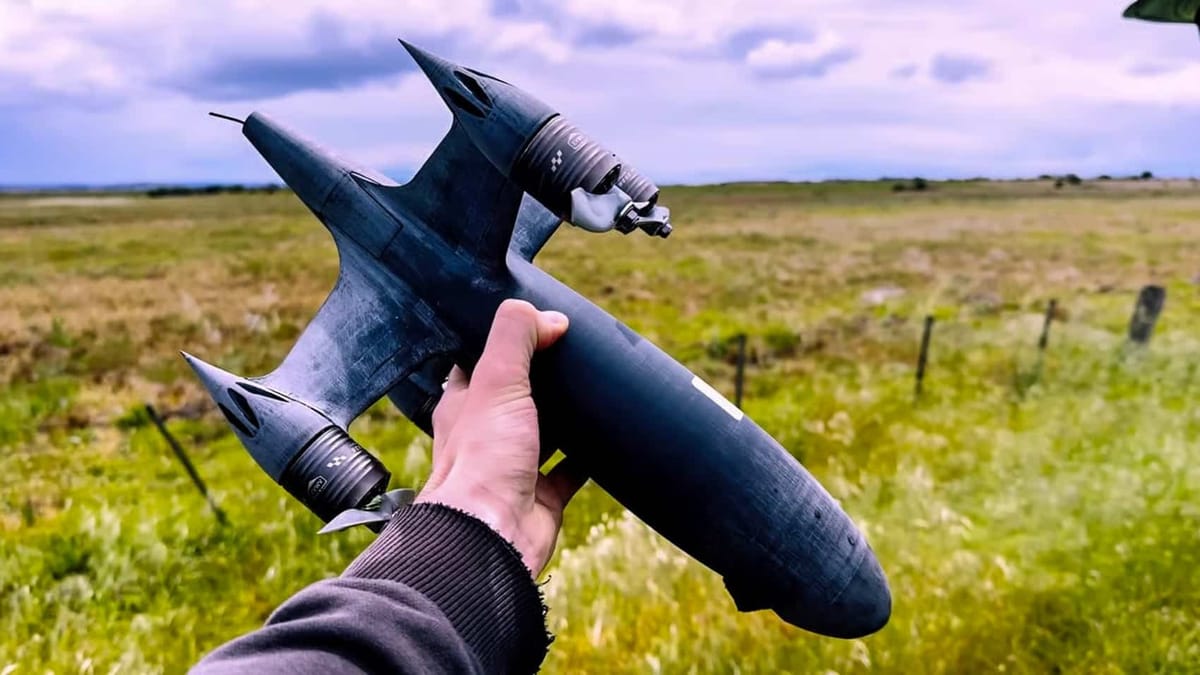
A South African engineering duo, Luke Bell and his father Mike Bell, has reclaimed the Guinness World Records title for the world’s fastest battery-powered remote-controlled quadcopter, following a successful test conducted in December 2025 near Cape Town.
Their latest platform, the Peregreen V4, achieved a verified top speed of 657 km/h, surpassing the previous benchmark and marking the third time the team has held the record in less than two years. The drone incorporates extensive use of 3D-printed components, enabling rapid iteration of aerodynamic shapes and structural elements during development.
The Bells first set the record in April 2024 at 480.23 km/h before being overtaken by Swiss engineer Samuele Gobbi, who reached 557.64 km/h. The South African team responded with an upgraded design that pushed the record to 585 km/h. In October 2025, the title shifted again when Australian aerospace engineer Benjamin Biggs achieved 626 km/h with his Blackbird quadcopter during testing in Melbourne.
Following that result, the Bells undertook a five-month redesign effort focused on propulsion efficiency, aerodynamic refinement, and structural optimization. According to information released by the team, multiple electric motor configurations were evaluated, while airframe geometry was refined using simulation tools and then produced through additive manufacturing. Components were repeatedly printed, assembled, and manually finished to reduce drag and vibration.
Although the project is civilian and experimental in nature, the technologies demonstrated have clear dual-use relevance for the defense industry. High-speed electric propulsion, lightweight structures, and rapid prototyping are increasingly relevant for military unmanned aerial systems, including interceptor drones, loitering munitions, and high-survivability reconnaissance platforms.
The Peregreen V4 remains fully battery-powered and remotely operated, in line with Guinness World Records classification requirements. However, its performance highlights how commercially accessible manufacturing techniques such as 3D printing are accelerating innovation cycles in unmanned aviation, a trend closely watched by defense manufacturers and procurement authorities.
Competition in the category remains active. Biggs has indicated interest in another record attempt, potentially targeting speeds approaching 700 km/h, suggesting further advances in performance are likely. Such iterative development cycles mirror those seen in defense UAV programs, where rapid testing and incremental improvements are increasingly prioritized.