Helsing and Kongsberg team up on sovereign European defense satellite network
German AI defense startup Helsing and Norway’s Kongsberg Defence & Aerospace are joining forces to build a sovereign European satellite constellation for intelligence, surveillance, targeting and secure communications by 2029.

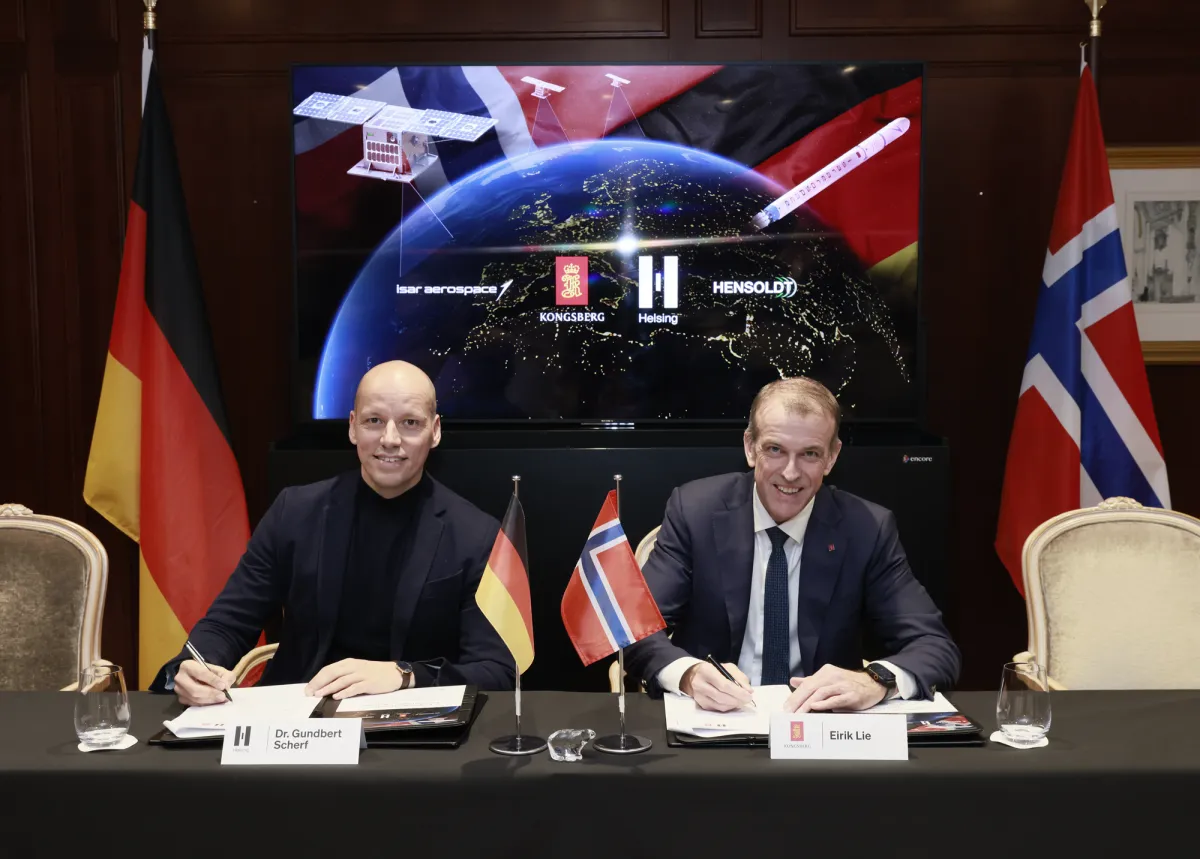
Berlin / Oslo – German defence AI company Helsing and Norway’s Kongsberg Defence & Aerospace (KDA) have announced a strategic partnership to develop a multi-mission European defense space network, aiming to field a sovereign constellation for intelligence, surveillance, targeting (IST) and secure communications within the next three years.
The move reflects Europe’s growing urgency to strengthen autonomous space-based intelligence and reduce reliance on non-European providers. The war in Ukraine has shown that persistent, resilient ISR in orbit is now a central pillar of deterrence and modern targeting cycles.
Multi-mission constellation driven by on-board AI
The cooperation merges Kongsberg’s strengths in small satellite manufacturing, operations and KSAT’s global ground station network with Helsing’s AI-driven software, capable of fusing data from:
- Synthetic aperture radar (SAR)
- Electro-optical/infrared (EO/IR) sensors
- Radio-frequency (RF) emissions
Helsing’s algorithms will run directly on-board the satellites, enabling edge processing, faster insights and reduced downlink bottlenecks. The constellation is designed as a multi-purpose network supporting:
- Persistent IST/ISR
- Secure satellite communications
- Space situational awareness (SSA)
KDA’s leadership describes the project not as a single program but as a strategic, long-term framework capable of addressing a wide range of European defence requirements.
Hensoldt sensors and European launch capability
German defense electronics company Hensoldt will supply advanced payloads, including SAR and electro-optical sensors, reinforcing the system’s multi-sensor approach.
Launches are planned through German startup Isar Aerospace, using its facility at Andøya Space in northern Norway—further anchoring the project inside a European industrial footprint.
The partnership also includes plans to build satellite production facilities in Germany, highlighting the initiative’s focus on increasing European defense industrial sovereignty.
Scale, timeline and market positioning
While financial details and customer commitments were not disclosed, the architecture envisions deploying a substantial number of low Earth orbit satellites starting around 2028–2029. The partners say early investments are being made to stay ahead of anticipated demand from European defence ministries and NATO.
The new constellation positions itself as a cornerstone for future European defence space needs—providing sovereign sensing, resilient targeting chains, and secure communications independent of non-European sources.
Strategic significance
Hensoldt’s CEO underscored that Europe’s security depends on sovereign sensing and intelligence, arguing that combining Norway’s satellite expertise with Germany’s AI and sensor ecosystem is essential for maintaining a technological edge.
If fully built out, this Helsing–Kongsberg–Hensoldt–Isar ecosystem could become Europe’s first integrated defense space architecture, supporting both national and EU-level defense initiatives and reshaping how Europe collects, processes and distributes time-critical intelligence.