Nearly EUR 210 Million Injected into PGZ Under Poland’s NAREW Air Defense Program
Poland has allocated nearly EUR 210 million in 2025 to PGZ companies under the NAREW program, boosting domestic CAMM-ER missile production and air-defense industrial capacity.

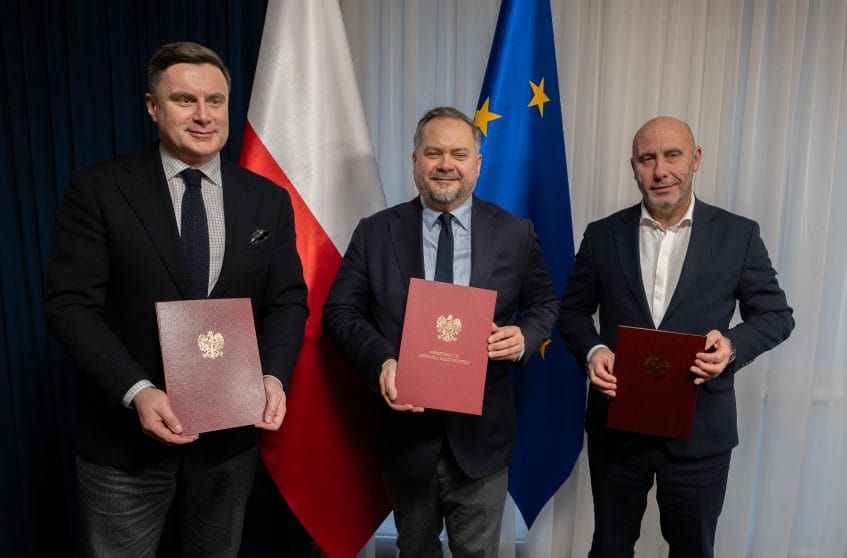
Poland has taken another decisive step in strengthening its short-range air defense capabilities under the NAREW program. On 29 December, the final investment agreements for 2025 were signed at the Ministry of State Assets, completing this year’s capital injections financed through the Capital Investment Fund (FIK).
The total value of capitalisation for companies forming the PGZ NAREW Consortium in 2025 amounts to PLN 930.17 million, underlining the scale and pace at which Warsaw is building domestic missile and air-defence industrial capacity.
Key beneficiaries of the 2025 tranche
The agreements signed with the State Treasury cover investments carried out by:
- Wojskowe Zakłady Elektroniczne S.A. (WZE)
- Mesko S.A.
- OBR CTM S.A.
These contracts conclude the investment phase planned for 2025 within the programme.
Building Poland’s missile-defence industrial backbone
The NAREW program is designed to deliver fully integrated short-range air defense components to the Polish Armed Forces, including training, logistics support, and—crucially—the long-term establishment of domestic industrial capabilities. This covers missile technologies, life-cycle sustainment of systems, and future product development.
According to Adam Leszkiewicz, the signing of the agreements marks a milestone for the Polish defense group, enabling full execution of the financial plan for 2025 and providing predictability for further investments amid accelerating defense-industrial demand.
Deputy Minister of State Assets Konrad Gołota emphasised that the funding strengthens production capacity and infrastructure, supporting Poland’s drive for technological and industrial sovereignty while maximising local content in defence procurement.
Detailed investment breakdown
Wojskowe Zakłady Elektroniczne S.A. (WZE)
- Project: CAMM-ER missile production line and new manufacturing hall
- Total funding: PLN 102 million (project value: PLN 129.44 million)
- First tranche: PLN 34.37 million
- Completion target: 2028
The investment significantly expands WZE’s capabilities in missile production, assembly, and servicing—including CAMM-ER missiles and command cabins—directly supporting the NAREW system.
Mesko S.A.
- Project: Establishment of production capacity for rocket motors and fragmentation warheads
- Total funding: PLN 304.44 million (project value: PLN 360.3 million)
- First tranche: PLN 19 million
- Implementation period: 2025–2030
The project enables technology transfer for CAMM-ER rocket motors and development of a new warhead, backed by dedicated infrastructure—positioning Mesko as a core missile-manufacturing hub within PGZ.
OBR CTM S.A.
- Project: Construction of an armament and systems integration centre
- Total funding: PLN 8.65 million (project value: PLN 16.65 million)
- Implementation period: 2025–2027
The new facility will modernise CTM’s infrastructure, enabling integration of complex, large-scale defence systems and supporting future high-technology projects.
A long-term, multi-year programme
Under the Council of Ministers’ Resolution No. 68 of 25 June 2024, total capitalisation for the PGZ NAREW Consortium will reach approximately PLN 3.89 billion between 2024 and 2030, spread across seven annual tranches:
- 2024: PLN 478.67 million
- 2025: PLN 930.17 million
- 2026: PLN 1.247 billion
- 2027: PLN 863.03 million
- 2028: PLN 233.13 million
- 2029: PLN 46.27 million
- 2030: PLN 89.8 million
Strategic impact
The NAREW programme brings together 11 PGZ-owned companies, with Polska Grupa Zbrojeniowa (PGZ) acting as consortium leader. Through structured technology transfer (ToT) and knowledge transfer (ToK), the initiative is creating a coherent national ecosystem for air-defence systems—reducing reliance on foreign suppliers and anchoring critical missile technologies inside Poland.
For Warsaw, this is not just procurement—it is industrial statecraft at scale.