SAFE Deadlines Redefine Expectations for Polish and European Defense Industry
The EU’s EUR 150 billion SAFE financing framework offers a major boost to European rearmament but ties funding to strict delivery deadlines. With equipment required by 2030, defense manufacturers face unprecedented pressure to expand capacity and stabilize supply chains.


The adoption of the EU’s Security Action for Europe framework has introduced a new operating reality for European defense manufacturers. SAFE, structured as an emergency instrument under Article 122 of the Treaty on the Functioning of the European Union, makes up to EUR 150 billion in loans available to member states, but only if funded equipment is delivered by 2030.
This deadline aligns with the EU’s Readiness 2030 policy objectives and reflects the assessment that Europe faces an exceptional and deteriorating security environment. Officials in Poland and other member states have indicated that, despite discussions about flexibility, 2030 remains the binding delivery horizon under the current regulation.
For industry, the implications are substantial. European and North American defense companies have long operated on the basis of limited production runs and extended delivery schedules, shaped by decades of reduced force structures, consolidated industrial bases, and predictable procurement cycles. SAFE effectively compresses these timelines at a moment when capacity expansion is still governed largely by peacetime regulatory and investment processes.
Poland illustrates both the opportunity and the constraint. Warsaw is expected to be among the largest beneficiaries of SAFE financing, yet its requests have already been shaped by delivery feasibility. In the case of the Airbus A330 MRTT multirole tanker-transport aircraft, only platforms that can be delivered before 2030 are planned for SAFE-backed contracts, with additional aircraft deferred to post-2030 national funding.
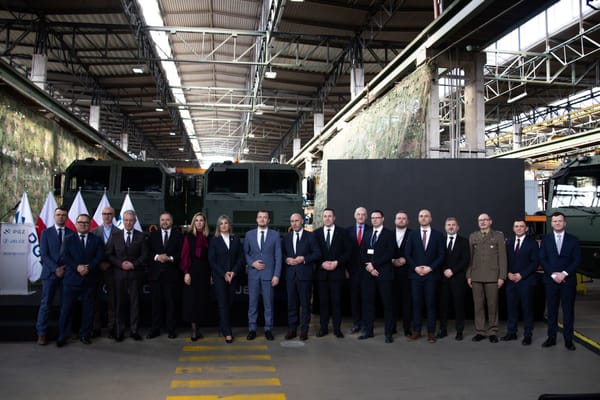
Manufacturers are responding by reinforcing supply chains and industrial depth. The recent licensed cooperation between Patria and Polska Grupa Zbrojeniowa for AMV-based armored vehicles includes mechanisms to improve spare parts availability and explicitly enables exports within SAFE-funded programs. Similar requirements apply to domestically led programs such as the Borsuk infantry fighting vehicle, where production tempo and supplier reliability are becoming central evaluation criteria.
These pressures extend beyond national borders. Key subsuppliers, including MTU, which provides propulsion systems for multiple European land platforms, face parallel demands to scale output. Electronics, logistics, and engineering suppliers are likewise exposed to schedule risk, making early capacity investment increasingly critical.
From an industrial perspective, SAFE represents both incentive and test. Prime contractors generally retain sufficient financial strength to absorb near-term investment risk, but regulatory hurdles and permitting timelines remain a limiting factor. Failure to meet delivery milestones could have consequences not only for revenue but also for credibility in future European and NATO procurement cycles.
Looking beyond 2030, additional national and EU-level financing instruments are likely to emerge. However, SAFE marks the first time since the Cold War that urgency in European rearmament has been matched by a centralized EU financial mechanism with enforceable deadlines. The framework also raises unresolved questions, including the extent to which Ukrainian defense technologies and production can be integrated, given national content requirements and Poland’s stated intention to allocate a portion of SAFE funding to Ukrainian solutions.
As 2026 begins, with Russia operating on a war-economy footing and accelerating the fielding of unmanned and other combat systems, European defense industry timelines are no longer abstract planning assumptions. Under SAFE, delivery speed has become a strategic variable. The ability to produce at scale, on schedule, is now a defining measure of industrial relevance.