Serbia's Chinese Arsenal: A Guide to Belgrade's Defense Partnership With Beijing
Serbia is the only country in Europe operating Chinese FK-3 missiles, CH-92 drones, and CM-400AKG ballistic missiles. Here is what Belgrade has bought, why, and what it means for the region.

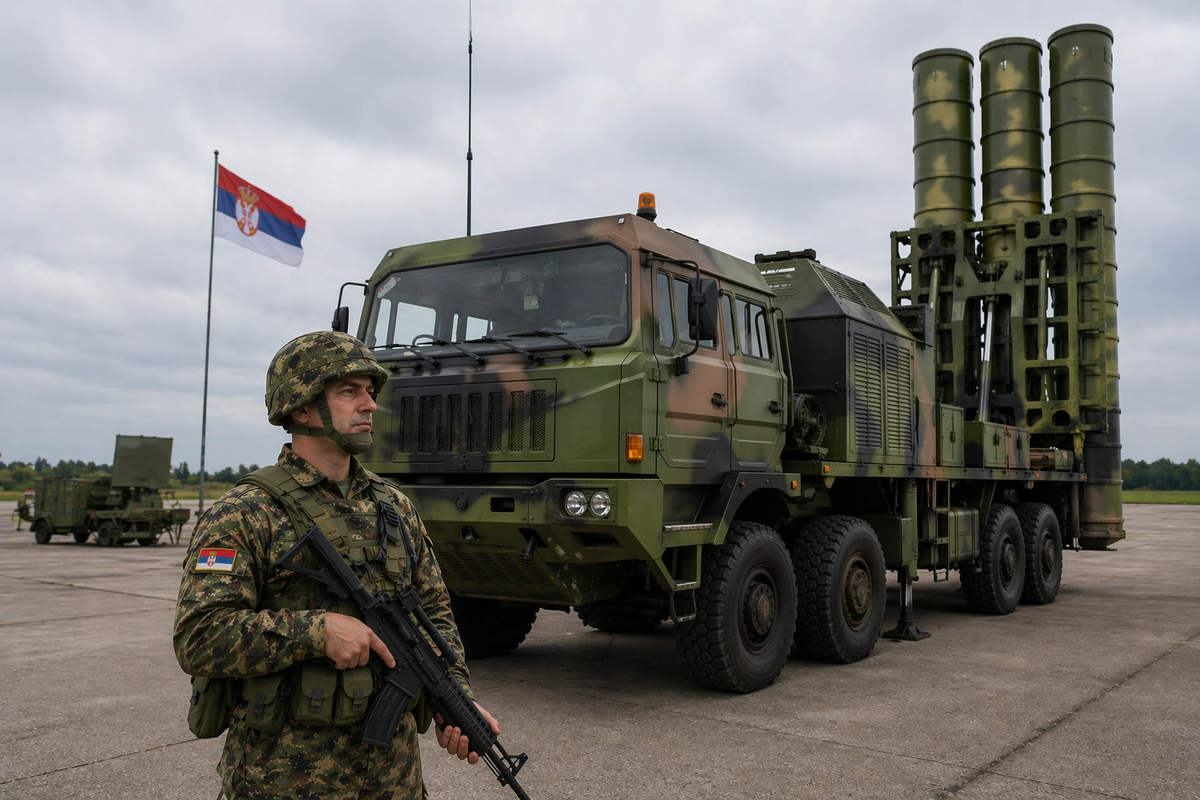
Serbia occupies a singular position in European security: it is the only country on the continent that operates Chinese-made air defense missile systems, strike-capable drones, and, most recently, air-launched ballistic missiles. While the debate over Serbian alignment with the West dominates political headlines, the operational reality on the ground tells a more precise story. Belgrade has spent the better part of six years assembling a Chinese-supplied force layer that sits uneasily alongside its stated EU membership ambitions and its parallel acquisitions of French Rafale jets and Israeli artillery systems.
This is a primer on what Serbia has, how it got there, and why it matters for the security architecture of the Western Balkans.
From Drones to Missiles: What Serbia Has Acquired
The foundation of Serbia's Chinese defense relationship was laid in 2019, when Belgrade signed contracts for the CH-92A armed unmanned aerial vehicle (UAV) developed by China Aerospace Science and Technology Corporation (CASC) and the FK-3 surface-to-air missile (SAM) system, the export variant of China's HQ-22, manufactured by Jiangnan Space Industry, a subsidiary of China Aerospace Science and Industry Corporation (CASIC).
The six CH-92A drones were delivered in June 2020, making Serbia the first European country to receive Chinese military aviation equipment. President Aleksandar Vučić publicly displayed the systems at Batajnica air base, framing the acquisition as a response to a modernisation gap: Serbia's existing military hardware was largely of Yugoslav and Soviet origin. In 2022, ten CH-95 reconnaissance-strike drones followed, becoming operational the following year. Collaboration with Chinese engineers on the CH-92 programme also contributed directly to Serbia's domestically developed Pegaz drone, unveiled in 2022, a technology transfer outcome that Belgrade explicitly sought.
The FK-3 delivery in April 2022 was more geopolitically charged. China flew the system into Batajnica aboard Y-20 heavy transport aircraft, an unusually public transfer that drew immediate attention from NATO allies and EU officials. Serbia now operates four FK-3 batteries alongside two batteries of the HQ-17AE, a short-range air defence system. A typical FK-3 battery comprises one radar vehicle and three launcher vehicles, each carrying four missiles, for 12 ready-to-fire rounds per battery with the claimed ability to engage six targets simultaneously. The 250th Air Defence Missile Brigade is the primary operational unit, and as recently as February 2026 the brigade conducted intensive training cycles with the FK-3.
The most recent and arguably most significant addition came in early 2026, when Vučić confirmed that the Serbian Air Force had acquired CM-400AKG air-to-surface ballistic missiles, integrating them onto its Soviet-era MiG-29 fighter jets. Serbia is the first European operator of the system. Vučić declined to disclose the contract value, noting only that Belgrade received a "slight discount." Chinese analysts highlighted the CM-400AKG's plug-and-play integration capability, the necessary software and hardware adaptations are built into the launch rack, requiring minimal modification to the host aircraft.
Why China? The Logic Behind the Partnership
The drivers behind Serbia's Chinese procurement are not difficult to understand, though they are frequently oversimplified in Western commentary.
Cost and capability are the most straightforward factors. Serbia's defense budget, while growing, it reached approximately €2.2 billion in 2025, representing roughly 2.5 percent of GDP, remains modest by regional standards. Chinese systems are priced below Western equivalents with comparable performance in the categories Belgrade prioritised: medium-range air defence, armed UAVs, and precision strike. According to analyst Jelena Dokić of the Belgrade Centre for Security Policy, cited in RFE/RL's January 2026 investigation, costs play a decisive role in Belgrade's procurement calculus.
Technical compatibility is a secondary but important factor. China's FK-3 and HQ-17 systems are derived from Soviet and Russian design lineages, making them architecturally compatible with Serbia's existing inventory. The CM-400AKG integration onto MiG-29s follows the same logic.
Strategic hedging is the third and most consequential factor. Serbia maintains formal military neutrality, declining NATO membership while pursuing EU accession. This position requires Belgrade to maintain credible deterrence without triggering a full rupture with Western partners. The Chinese relationship provides Belgrade with leverage, a demonstrated ability to source capability outside Western supply chains, while stopping short of formal alignment with Beijing or Moscow. Customs data reviewed by RFE/RL showed that Serbia's state-owned defence industry imported approximately $280 million in goods from China over the two years to January 2026, though the specific system mix was not disclosed.
The partnership also carries a political dimension for China. Serbia represents Beijing's most significant military foothold in Europe, functioning as a demonstration of China's capacity to form defence partnerships with European-adjacent states despite the EU's 1989 arms embargo on China, which does not apply to non-EU countries like Serbia.
A Multi-Vector Arsenal and Its Tensions
What makes Serbia's procurement strategy genuinely complex is that the Chinese layer sits alongside, not instead of, Western acquisitions. Belgrade has contracted 12 Rafale multirole aircraft from France, acquired Israeli-made PULS multiple-launch rocket systems, and continues to operate Airbus transport aircraft. The result is what Army Recognition described in April 2026 as a "hybrid integrated air defence system" combining Chinese missile systems with European early-warning and surveillance layers, a non-NATO-aligned architecture that mixes technological standards across a single operational framework.
This is not unprecedented, several non-NATO states maintain mixed inventories — but it creates specific friction points. NATO interoperability is structurally complicated by the presence of Chinese command-and-control architecture. EU member states have raised concerns about the security implications of Chinese sensor systems operating in proximity to EU and NATO infrastructure. Washington has issued warnings about the risks of Chinese military cooperation, and the combination of Chinese systems with Rafale jets — built by France, an EU and NATO member — is a source of ongoing diplomatic tension.
What Comes Next
In April 2026, Vučić announced that Serbia would sign "very important contracts for weapons and military equipment in the coming days," citing what he described as a more complex security environment driven by the deepening alignment between Zagreb, Tirana, and Priština. He did not identify suppliers or system types. Logistics tracking documented by the open-source intelligence outlet Dunav Intel suggests repeated flights of an Egyptian Air Force Il-76MF transport between Egypt, Urumqi in western China, the UAE, and Batajnica air base, a routing pattern consistent with military cargo movements and distinct from commercial logistics flows.
Whether the next procurement tranche involves additional Chinese air defence layers, further joint production arrangements, or a different supplier mix entirely remains to be seen. What is clear is that Serbia's Chinese arsenal is not a legacy anomaly or a single transaction of convenience. It is the operational expression of a deliberate strategic posture, one that Belgrade intends to maintain, and one that will continue to define the security calculus of the Western Balkans for years to come.