120 mm Ammunition in Europe: Tanks, Mortars and War
Europe relies on two distinct 120 mm ammunition families for tanks and mortars. Ukraine has reinforced demand, while new 130 mm and 140 mm guns remain developmental.

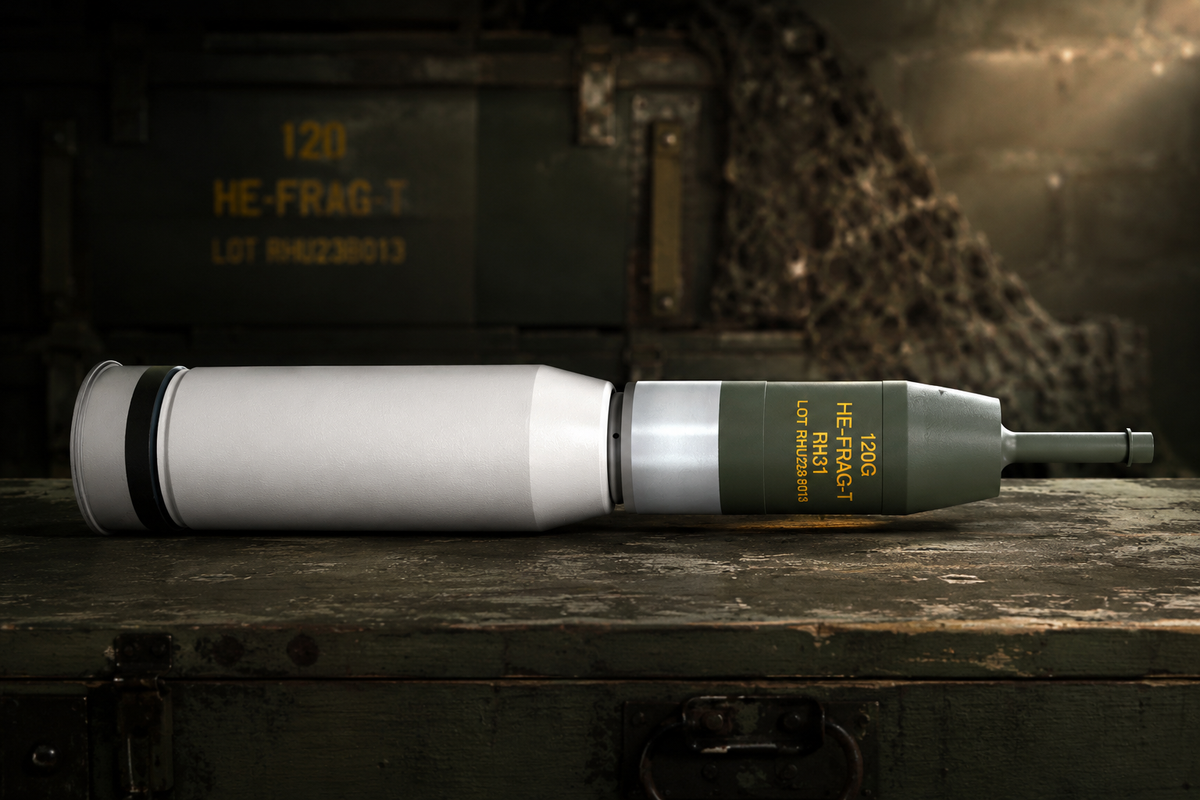
Europe uses 120 mm ammunition in two separate weapon categories: high-velocity tank guns and heavy mortars. The rounds share a nominal diameter, but they differ completely in construction, pressure, range, ammunition handling and battlefield role.
The war in Ukraine has increased the operational importance of both families. Western 120 mm tank ammunition entered Ukrainian service with Leopard 2 and M1A1 Abrams tanks, while 120 mm mortar ammunition became part of the larger effort to sustain infantry units with mobile indirect fire.
The caliber will remain central to European land forces even as Rheinmetall develops a 130 mm tank gun and KNDS tests scalable 120 mm to 140 mm armament concepts. Existing tank fleets, mortar inventories, industrial capacity and ammunition stockpiles make a rapid transition away from 120 mm unlikely.
One caliber serves two different battlefield roles
The label 120 mm ammunition can describe products with little beyond their diameter in common.
A modern 120 mm tank round is a high-pressure cartridge fired directly at an observed target. It combines the projectile, combustible cartridge case, propellant and primer in a single round designed for a tank gun.
A 120 mm mortar bomb is a lower-pressure fin-stabilized projectile fired on a high trajectory. Its primary role is indirect fire against troops, positions, buildings and other targets that may be hidden from the mortar crew.
The distinction matters for procurement and industrial analysis. A company that manufactures 120 mm mortar bombs does not necessarily possess the tooling, metallurgy, propellant expertise or qualification infrastructure required to produce NATO-standard 120 x 570 mm tank ammunition.
The 120 mm tank gun replaced the Western 105 mm standard
Western armies entered the early Cold War with 90 mm and later 105 mm tank guns. The British-designed 105 mm L7 became one of the most widely adopted Western tank weapons and equipped platforms including the Centurion, Leopard 1 and early versions of the M1 Abrams.
Advances in Soviet armor created demand for a larger weapon with greater growth potential. Rheinmetall developed the Rh-120 smoothbore gun in West Germany, and the Leopard 2 entered service with the 120 mm L/44 version.
The United States later adopted a licensed derivative, designated M256, for the M1A1 Abrams. Rheinmetall describes the L/44 as the standard NATO smoothbore weapon used by the Leopard 2 and M1A1 Abrams families.
Longer L/55 variants increased available muzzle velocity and became associated with later Leopard 2 models. The smoothbore 120 mm family also spread to other tanks, including the South Korean K2 Black Panther.
The United Kingdom followed a different path. Challenger 2 retained the 120 mm L30 rifled gun, which used ammunition incompatible with the common NATO smoothbore family despite sharing the same nominal caliber. Challenger 3 will move to a NATO-standard smoothbore gun, reducing that logistical distinction.
Tank ammunition includes kinetic and multipurpose rounds
The principal anti-armor round for modern Western tanks is the armor-piercing fin-stabilized discarding sabot, commonly abbreviated as APFSDS.
An APFSDS round uses a long, dense penetrator carried in a lightweight sabot. After leaving the barrel, the sabot separates and the penetrator continues toward the target at high velocity.
European manufacturers generally use tungsten-alloy penetrators. The United States also fields depleted uranium penetrators in selected Abrams ammunition.
Chemical-energy and multipurpose rounds address targets that do not require a long-rod penetrator. These include light vehicles, structures, field positions and dismounted personnel.
Programmable ammunition allows a crew to select the point or mode of detonation before firing. Depending on the round, available functions can include impact, delayed impact or airburst.
Rheinmetall markets a broad 120 x 570 mm family covering kinetic-energy, multipurpose and training ammunition. Its system documentation lists cartridges such as the DM63 kinetic-energy round, the DM11 programmable high-explosive round and several training types.
KNDS offers the 120 mm SHARD APFSDS round for NATO smoothbore guns. The company states that SHARD complies with NATO requirements and has been qualified for use with Leclerc and Leopard 2 tanks.
Nammo also lists 120 mm high-explosive, kinetic armor-piercing, canister and training products in its large-caliber portfolio.
Heavy mortars evolved into mobile fire-support systems
The 120 mm mortar developed into one of the standard heavy indirect-fire weapons used at battalion and brigade level.
Compared with 60 mm and 81 mm mortars, a 120 mm system fires a heavier projectile with a larger explosive payload. The additional weight often leads armies to mount the weapon in a vehicle or transport it with a dedicated crew and ammunition carrier.
Traditional systems remain muzzle-loaded and can operate from a ground-mounted baseplate or vehicle mount. Newer turreted and breech-loaded designs improve crew protection, firing speed and integration with digital fire-control systems.
European examples include the Finnish Patria NEMO turreted mortar, the twin-barrel Patria AMOS, the Polish M120K Rak and vehicle-mounted conventional mortars used by numerous NATO armies.
The role differs from tube artillery. A 120 mm mortar generally offers shorter range than a 155 mm howitzer, but it can respond quickly, operate from smaller platforms and deliver steep-angle fire in urban, forested or mountainous terrain.
Modern mortar ammunition includes high-explosive, smoke, illumination, practice, extended-range and increasingly guided or course-corrected projectiles. Hirtenberger Defence Systems markets a complete 120 mm system that includes a mortar, ammunition family, sights and digital fire control.
Ukraine brought both 120 mm families into the same war
Ukraine entered the full-scale war in February 2022 with a large inventory of Soviet-designed 120 mm mortars and 125 mm tank guns.
Western aid later introduced NATO-standard 120 mm tank ammunition through Leopard 2 and M1A1 Abrams deliveries. Germany supplied 18 Leopard 2A6 tanks with ammunition and spare parts, while other European countries contributed additional Leopard 2 variants.
The United States delivered 31 M1A1 Abrams tanks and associated 120 mm ammunition. The aid package included depleted uranium armor-piercing rounds for the Abrams fleet.
These deliveries created a new ammunition requirement inside a force that had previously depended mainly on Soviet-standard 125 mm tank ammunition. Ukraine therefore had to sustain several incompatible tank ammunition chains at the same time.
The scale of tank ammunition use remains less publicly documented than the expenditure of artillery shells. Governments frequently disclose that tank ammunition has been delivered without publishing quantities or specific variants.
Mortar ammunition support has been more visible in selected announcements. A United States aid package announced in August 2022 included 65,000 rounds of 120 mm mortar ammunition.
Germany later placed an order with Rheinmetall for approximately 100,000 rounds of 120 mm mortar ammunition for Ukraine, with deliveries planned across a two-year period.
United States Army budget documents also show funding to replace 120 mm high-explosive mortar ammunition transferred in support of Ukraine. The documents identify $134.5 million in fiscal 2023 supplemental funding connected to replacement procurement for the M933-series 120 mm mortar cartridge.
Ukraine has also received or ordered new mobile 120 mm mortar platforms. Poland agreed to supply M120K Rak self-propelled mortars, combining a turreted weapon with an armored wheeled chassis and digital fire-control architecture.
The war has therefore demonstrated two separate forms of 120 mm demand. Tank ammunition supports a relatively small number of high-value armored platforms, while mortar ammunition sustains a wider network of infantry and mechanized formations.
Europe is rebuilding stocks and production capacity
European ammunition policy after 2022 initially focused on 155 mm artillery shells because of their extraordinary consumption in Ukraine. The same security environment has also increased demand for mortar and tank ammunition.
Finland announced investments covering heavy ammunition, including 81 mm and 120 mm mortar rounds, alongside 155 mm artillery ammunition. The planned work included propellant, charge and explosive-filling capacity.
Denmark placed a 2026 order covering 120 mm mortar and 155 mm artillery ammunition for its Cardom 10 and ATMOS systems. The reported contract value reached €213.7 million.
Denmark also ordered more than 1,000 rounds of Rheinmetall 120 mm kinetic-energy tank ammunition under a separate framework arrangement.
Germany continued purchasing 120 mm tank ammunition to replenish and expand Bundeswehr stocks. Rheinmetall announced another Bundeswehr order in December 2025 and identified itself as a major supplier to Leopard 2 users.
The market is not limited to replacing donated rounds. European armies are also buying new Leopard 2 tanks, upgrading existing fleets, adding vehicle-mounted mortars and rebuilding war reserves for sustained high-intensity operations.
Bosnia and Herzegovina retains 120 mm mortar capacity
Bosnia and Herzegovina does not publicly advertise production of NATO-standard 120 x 570 mm tank ammunition. Its established role in the 120 mm market centers on mortar ammunition.
Pretis in Vogošća is the principal Bosnian producer associated with large-caliber ammunition. Product material distributed through Bosnia and Herzegovina’s UNIS Group lists several 120 mm mortar bombs, including the M62P3, M91, M93LR and M15 LR high-explosive variants.
The listed products cover conventional and longer-range designs. Public catalog data confirms production capability but does not establish current annual output, customer identities or available surge capacity.
Pretis forms part of a broader Bosnian ammunition industry that also includes companies specializing in small-caliber ammunition, primers, fuzes, explosives and metal components.
That ecosystem gives Bosnia and Herzegovina regional relevance in mortar ammunition supply. It does not place the country in the same industrial category as Rheinmetall or KNDS for complete NATO smoothbore tank cartridges.
Serbia produces a broad family of 120 mm mortar bombs
Serbia also maintains 120 mm mortar ammunition capacity, led by Krušik in Valjevo.
Krušik’s official product portfolio lists numerous 120 mm high-explosive variants, including the M62P8, M62P9, M62P10, M62P11, M62P13 and Mk12 families. The company also lists smoke and illuminating ammunition.
The breadth of the catalog indicates experience across different projectile bodies, explosive effects, range configurations and fuze arrangements.
Sloboda Čačak has confirmed expertise in fuzes and components compatible with 120 mm mortar ammunition. Its catalog describes a mechanical fuze designed for standard 60 mm, 81/82 mm and 120 mm mortar bombs, including an adapter for a 120 mm shell.
Available public documentation does not support describing Sloboda as a confirmed producer of a complete current 120 mm mortar ammunition family on the same basis as Krušik. Its documented role includes fuzes, components and related ammunition engineering.
No major Serbian manufacturer publicly markets a complete NATO-standard 120 x 570 mm smoothbore tank ammunition portfolio comparable to those of Rheinmetall, KNDS or Nammo.
Serbia’s armored forces primarily use tanks armed with 125 mm guns, including the M-84 family. That domestic requirement has historically favored Soviet-derived tank ammunition dimensions rather than NATO 120 mm cartridges.
Balkan producers occupy a different tier of the supply chain
Pretis and Krušik give the Western Balkans an industrial foothold in a caliber that has regained strategic importance.
Their relevance comes primarily from conventional mortar ammunition, where European users need large quantities of high-explosive, smoke, illumination and training rounds. These products can support both legacy ground-mounted mortars and newer vehicle-based systems when properly qualified.
However, catalog availability does not automatically equal NATO qualification or interchangeability with every 120 mm mortar.
Mortar chambers, pressure limits, ignition systems, projectile length, propelling charges and fire-control data can vary. Buyers must qualify ammunition for the specific weapon and operating conditions.
The same caution applies to production claims. Public product catalogs show what a company offers, but they do not reveal current output, stock availability, export approvals or the condition of individual production lines.
Precision and mobility are changing the mortar market
The future of the 120 mm mortar lies less in increasing caliber than in improving accuracy, range, mobility and reaction time.
Turreted mortars allow crews to operate under armor and transition more quickly between movement and firing. Automated laying and digital fire control reduce the time required to process a fire mission.
Guided ammunition can reduce the number of rounds required against point targets. Precision also becomes more important when units operate near friendly forces, civilians or infrastructure.
Extended-range ammunition pushes 120 mm mortars into missions once reserved for light artillery. The trade-off remains projectile cost, guidance availability and the need to retain inexpensive conventional ammunition for area targets.
Ukraine has reinforced another requirement: survival after firing. Counter-battery radars, drones and loitering munitions make long firing sequences dangerous.
Future mortar systems will therefore emphasize rapid arrival, short fire missions, automated navigation and immediate displacement. The 120 mm projectile remains useful because industry can improve the surrounding system without replacing the caliber.
New tank guns challenge 120 mm but do not replace it yet
The future of tank ammunition presents a different problem.
Modern armor, active protection systems and longer engagement distances have encouraged European manufacturers to examine larger guns.
Rheinmetall developed a 130 mm smoothbore Future Gun System for the Panther KF51. The concept combines the gun with an automatic ammunition-handling system holding 20 ready rounds.
KNDS developed the ASCALON concept with a scalable architecture. Its 140 mm demonstrator turret can switch between 120 mm and 140 mm configurations, while a newer ASCALON configuration retains compatibility with NATO-standard 120 mm ammunition.
These programs show that Europe is preparing for a possible post-120 mm tank gun. They do not show that a transition has already begun.
No European army has placed a new 130 mm or 140 mm gun into operational service. Leopard 2A8, Challenger 3, Leclerc modernization programs and current Abrams variants remain tied to 120 mm ammunition.
Even emerging vehicles continue to prioritize compatibility. The Leonardo Rheinmetall Military Vehicles New Main Battle Tank concept unveiled in 2026 uses a 120 mm L55 smoothbore gun while allowing for a possible later upgrade to 130 mm.
A larger caliber would require more than a new barrel. Armies would need new turrets, ammunition storage, autoloaders, transport containers, handling equipment, test infrastructure, training systems and industrial production lines.
Larger rounds also reduce the number a vehicle can carry unless designers increase turret or hull volume. Automated loading becomes increasingly attractive because ammunition mass and dimensions make manual handling more difficult.
Why 120 mm will remain central to European forces
The 120 mm mortar has no immediate caliber successor under serious consideration. Its combination of explosive payload, portability and compatibility with armored carriers keeps it relevant.
The 120 mm tank gun faces stronger technological competition, but it benefits from decades of investment and a large installed base.
Europe operates or plans to operate substantial fleets of Leopard 2, Challenger 3 and other 120 mm-armed vehicles. NATO allies outside Europe add M1 Abrams and K2 fleets to the same general ammunition ecosystem.
Manufacturers continue to improve penetrators, propellants, programmable fuzes and multipurpose effects. Those developments extend the operational life of existing guns without forcing armies to replace entire tank fleets.
The most probable outcome is a period of coexistence. Experimental 130 mm or 140 mm weapons may enter selected next-generation platforms, while 120 mm remains the primary caliber for current and upgraded fleets.
For mortar forces, 120 mm will remain a core indirect-fire caliber while the surrounding technology moves toward protected vehicles, automation, precision and faster displacement.
Ukraine has not made every 120 mm product interchangeable or equally valuable. It has shown that Europe needs both direct-fire tank cartridges and indirect-fire mortar bombs, supported by separate but resilient industrial bases.
The strategic question is therefore not whether 120 mm will disappear. It is whether European manufacturers can produce enough qualified rounds, in enough variants, for training, war reserves, deterrence and sustained combat.