Central Europe, Western Balkans Push Joint Defense Projects
Defense officials from Central Europe and the Western Balkans meet in Slovenia to discuss regional security, military mobility and joint capability development.

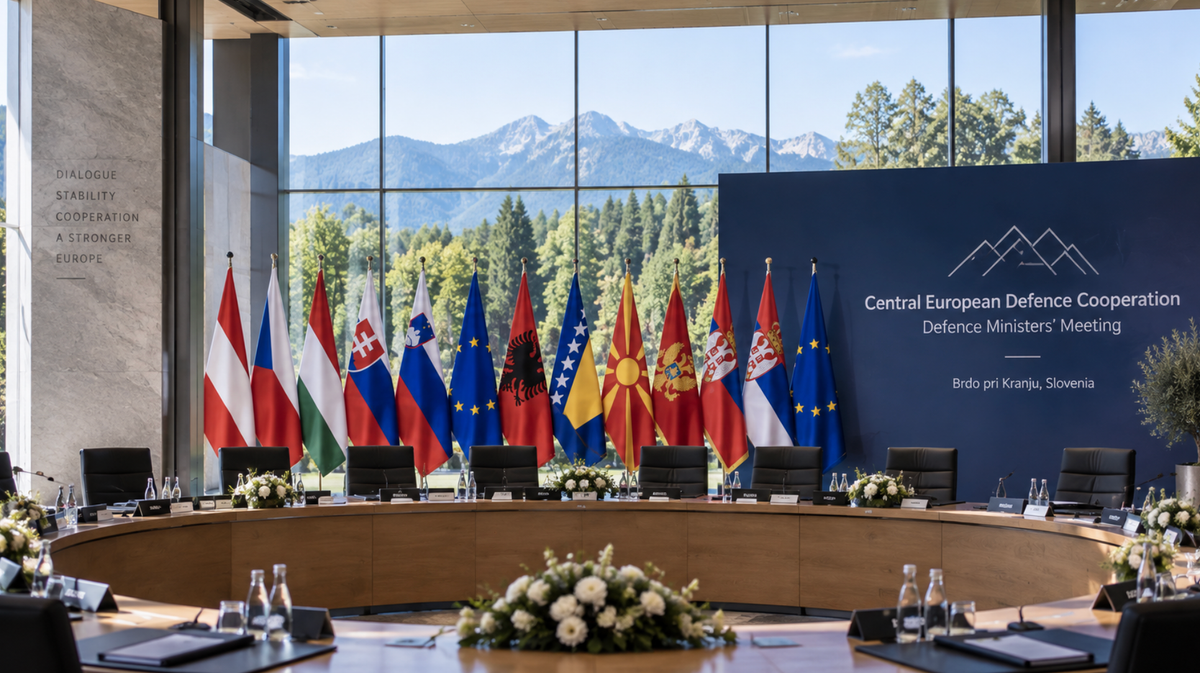
Defense ministers and senior officials from Central Europe and the Western Balkans are meeting in Slovenia on September 22 to discuss regional security, military mobility, European defense initiatives and closer military cooperation. The meeting brings six Central European Defence Cooperation members together with Albania, Bosnia and Herzegovina, Kosovo, Montenegro, North Macedonia and Serbia under Slovenia’s 2026 chairmanship.
Austria, Croatia, the Czech Republic, Hungary, Slovakia and Slovenia make up the Central European Defence Cooperation, or CEDC. Poland participates in the initiative as an observer.
The expanded CEDC format gives the Western Balkans a direct channel into a regional defense framework that increasingly focuses on practical military cooperation rather than political dialogue alone. Slovenia has made capability development and the transition from policy to implementation central priorities of its 2026 presidency.
Slovenia brings six Western Balkan states into CEDC talks
The two-day ministerial meeting began at the Brdo Congress Centre near Kranj on September 21, with the expanded CEDC and Western Balkans session taking place on September 22. Slovenian Defense Minister Valentin Hajdinjak is scheduled to deliver the closing media statement after the meeting.
Western Balkan participation includes representatives from Albania, Bosnia and Herzegovina, Kosovo, Montenegro, North Macedonia and Serbia. Montenegro confirmed ahead of the meeting that Defense Minister Dragan Krapović would participate, with European defense initiatives, regional security, military mobility and cooperation with Western Balkan countries among the subjects on the agenda.
The composition makes the meeting notable for Southeast European defense cooperation. It places NATO members, European Union members, EU candidates and militarily neutral Serbia around the same regional defense table.
CEDC itself dates to 2010 and was established as a framework for Central European countries to coordinate on shared defense and security interests. Its work includes EU Common Security and Defence Policy coordination, regional security challenges, potential projects between armed forces and capability development.
Military mobility moves higher on the regional agenda
Military mobility has emerged as one of the practical issues connecting Central Europe and the Western Balkans.
The subject was already discussed by CEDC chiefs of defense during a September 2-4 meeting in Slovenia. That meeting focused on military mobility alongside recruitment and personnel retention, indicating that mobility is moving beyond political discussions into military-level planning within the regional framework.
For Southeast Europe, military mobility has a geographic dimension. Routes running through Slovenia and Croatia connect Central Europe with the northern Adriatic and the Western Balkans, while infrastructure farther southeast provides access toward NATO members Albania, Montenegro and North Macedonia.
The issue is therefore relevant beyond the movement of national forces. Regional roads, railways, ports, border procedures and logistics networks affect how quickly allied forces and equipment can move between Central and Southeast Europe.
CEDC shifts its focus from policy toward joint capabilities
Slovenia assumed the rotating CEDC presidency on January 1, 2026. Its presidency uses the theme From Policy to Practice - Building a Stronger Central Europe, with Ljubljana emphasizing joint action and capability development.
The 2026 program includes meetings between defense ministers, defense policy directors and armaments directors, as well as military-level cooperation between chiefs of general staff. CEDC also organizes working-level activities covering training, resilience and other areas of military cooperation.
That structure creates potential pathways for cooperation beyond annual ministerial meetings. Joint projects between armed forces and coordinated capability development are explicitly part of the initiative’s mandate.
For smaller Central and Southeast European militaries, regional cooperation can also address problems that are difficult to solve exclusively at national level. These include military mobility, personnel shortages, training, logistics and interoperability.
The September meeting does not by itself establish new multinational capabilities. Its significance will depend on whether participating governments convert the political framework into specific projects, procurement cooperation, exercises or logistics arrangements.
Western Balkans defense ties move closer to European structures
CEDC has maintained an explicit focus on supporting closer integration of the Western Balkans with European structures. Slovenia says the initiative remains committed to supporting Western Balkan integration into the European Union.
Defense has also become increasingly connected with the EU enlargement process. A September 2026 European Parliamentary Research Service assessment noted that security and defense have gained greater importance in enlargement policy, while Western Balkan countries have increased defense investment alongside EU member states.
The European Union has separately expanded security cooperation with Western Balkan partners during 2026. The EU-Western Balkans summit in Montenegro in June emphasized security cooperation and alignment with the EU Common Foreign and Security Policy as part of the broader relationship between Brussels and the region.
The CEDC format operates at a smaller regional level. That can allow participating defense ministries and armed forces to concentrate on practical problems shared by neighboring countries rather than attempting to replicate NATO or EU structures.
For Slovenia and Croatia in particular, the Western Balkans are also their immediate strategic neighborhood. Their participation gives CEDC a geographic link between Central Europe, the Adriatic and Southeast Europe.
The next measure of the initiative will be whether the September 22 meeting produces concrete follow-up work in military mobility, capability development or joint military projects. Slovenia will retain the CEDC presidency through the end of 2026 before Croatia assumes the chairmanship in 2027.
Q&A: CEDC and Western Balkans defense cooperation
Which countries are members of the CEDC?
Austria, Croatia, the Czech Republic, Hungary, Slovakia and Slovenia are members of the Central European Defence Cooperation. Poland participates in CEDC meetings as an observer.
Which Western Balkan countries are attending the Slovenia meeting?
The expanded September 22 meeting includes Albania, Bosnia and Herzegovina, Kosovo, Montenegro, North Macedonia and Serbia alongside the CEDC countries.
What are the defense ministers discussing?
The announced agenda includes European defense initiatives, regional security, military mobility and cooperation with the Western Balkans. CEDC's broader work also covers capability development and potential joint projects between participating armed forces.
Who currently chairs the CEDC?
Slovenia holds the CEDC presidency from January 1 through December 31, 2026. Croatia is scheduled to take over the presidency in 2027.