Curtis Buzzard Calls for a U.S. Army Drone Branch. Can NATO Adapt?
Drawing on more than 30 visits to Ukraine, former U.S. commander Curtis Buzzard argues for specialized unmanned forces as NATO militaries reconsider how they organize for modern warfare.

The war in Ukraine is forcing military planners to reconsider not only how drones are employed, but how armies themselves should be organized. As unmanned systems become integral to reconnaissance, electronic warfare and precision strikes, traditional force structures are increasingly being tested.
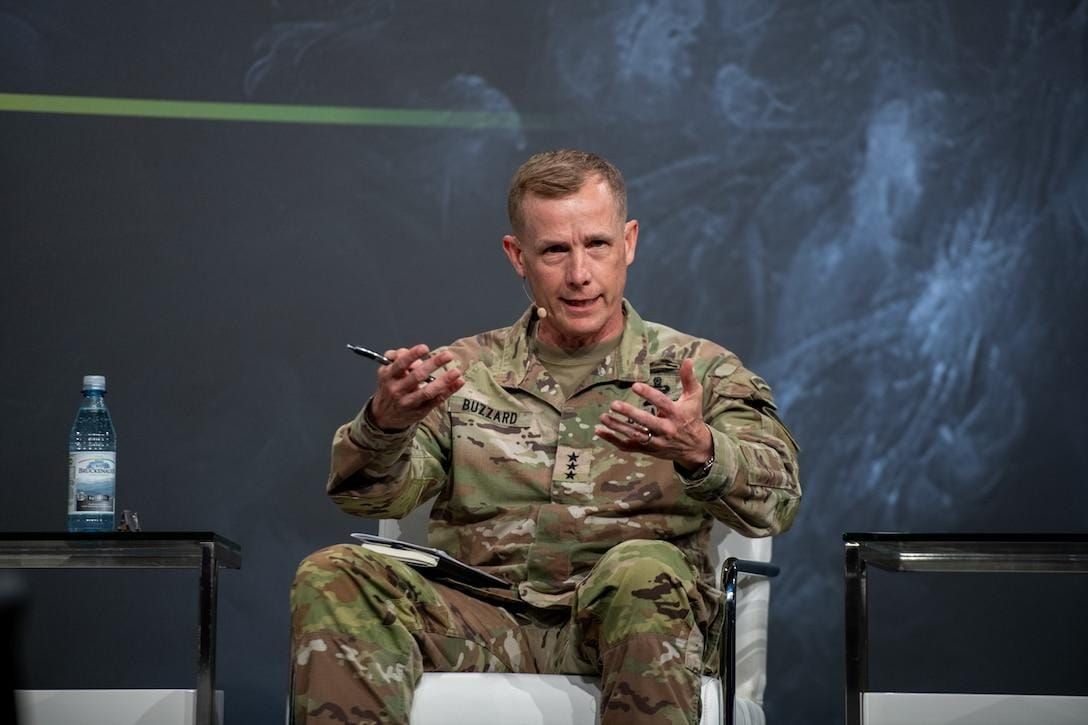
Former U.S. Army Lieutenant General Curtis A. Buzzard, who commanded Security Assistance Group-Ukraine (SAG-U) and NATO Security Assistance and Training for Ukraine (NSATU), has called for a dedicated unmanned systems branch within the U.S. Army, alongside specialized operational formations and drone capabilities embedded throughout conventional forces.
Drawing on more than 30 visits to Ukraine during two years of command, Buzzard wrote on LinkedIn:
"Drones are not simply equipment. They are reshaping the conduct of warfare, both offensively and defensively, and across the depth of the battlefield."
His argument raises a broader question for NATO: whether existing military organizations can fully exploit technologies that increasingly operate across traditional service and battlefield boundaries.
Ukraine's experience supports specialization, but raises questions
Ukraine formally established its Unmanned Systems Forces as a separate military branch in 2024, creating a dedicated structure for capabilities that had developed rapidly across individual combat formations.
Buzzard argues that specialized Ukrainian unmanned formations are significantly more effective than drone teams assigned to conventional maneuver units. He claims that Ukraine's dedicated unmanned force "destroys up to 10x what drone teams in maneuver units achieve."
That figure remains his assessment rather than an independently verified comparison. Differences in unit size, equipment, targeting responsibilities and operational conditions make direct measurements difficult.
The underlying organizational logic, however, is significant. Dedicated formations can concentrate experienced operators, intelligence specialists, electronic warfare capabilities and technical expertise. They can also coordinate strikes and reconnaissance across multiple sectors rather than operating exclusively in support of individual infantry or armored units.
Yet specialization introduces its own risks. Unmanned units separated from conventional formations could complicate command relationships, targeting priorities and coordination with artillery and maneuver forces.
The challenge is therefore not simply to create drone units, but to establish a structure that combines specialist expertise with effective combined-arms integration.
Washington and Berlin are adopting different approaches
The United States is already restructuring its autonomous warfare institutions.
On September 30, 2026, the Pentagon announced plans for a new Autonomous Warfare Command. The following day, the U.S. Army directed the establishment of its Futures and Autonomous Systems Command (FASCOM), with further organizational details announced on October 13.
These changes are designed to accelerate the development, acquisition and integration of autonomous capabilities. They do not, however, automatically establish the dedicated operational combat branch advocated by Buzzard.
Germany has taken a different, more formation-focused step. On October 2, Defense Minister Boris Pistorius announced that the Bundeswehr would begin establishing its first dedicated drone regiment in 2027.
Assigned to the 10th Panzer Division, the regiment is intended to combine unmanned reconnaissance, strike, counter-drone and electronic warfare capabilities. Germany also plans to expand unmanned systems integration across existing army units.
The distinction illustrates two related priorities: reorganizing military institutions to accelerate technological adaptation, and creating operational formations capable of employing unmanned systems at scale.
Neither approach alone guarantees effectiveness. Personnel training, command integration, electronic warfare resilience and the ability to replace equipment quickly will remain decisive.
Russia is competing on organizational scale
Russia is expanding its own unmanned warfare structures.
In April 2026, Ukrainian Commander-in-Chief General Oleksandr Syrskyi estimated that Russia's unmanned systems forces had reached approximately 101,000 personnel, with plans to expand to 165,500 by the end of the year.
These figures are based on Ukrainian intelligence assessments and reported Russian plans, not independently confirmed current force strength. They nevertheless demonstrate the scale of the organizational competition.
Buzzard also argues that Ukraine should become a direct partner in developing future military doctrine and capabilities, rather than simply providing battlefield lessons.
"Ukraine should be more than a source of lessons learned; it should be a partner in experimentation, adaptation, and preparing for future conflict."
That recommendation has practical relevance for NATO. Ukrainian units are adapting operational procedures, electronic warfare measures and unmanned technologies under continuous combat pressure, while Western military procurement and doctrine development traditionally operate on much longer timelines.
NATO's real test is institutional adaptation
The emergence of dedicated unmanned formations does not mean conventional military branches are becoming obsolete. Infantry, armor, artillery and air defense remain essential, and their ability to operate alongside unmanned systems will determine the effectiveness of future formations.
Nor does creating a new branch automatically deliver better battlefield results. Without clear command arrangements, sustainable procurement, specialized training and coordination across domains, organizational reform risks becoming another layer of military bureaucracy.
The central question is whether armies can translate technological innovation into lasting operational capability faster than their adversaries.
Ukraine has already institutionalized unmanned warfare as a military specialty. Germany is preparing a dedicated operational regiment, while Washington is restructuring its autonomous warfare institutions.
The emerging competition is not simply about who can field the largest drone fleet. It is about which military can organize, integrate and adapt those capabilities most effectively under combat conditions.
Sources: Buzzard's original LinkedIn statement; U.S. Army announcement, Bundeswehr announcement; Ukraine's presidential decree President of Ukraine; Syrskyi's assessment