Czech Army Opens FPV Drone Tender With Strict Security Rules
Czechia's CZK 13.15 million FPV equipment tender requires component origin disclosure, offline operation and strict telemetry controls, highlighting evolving military procurement standards.

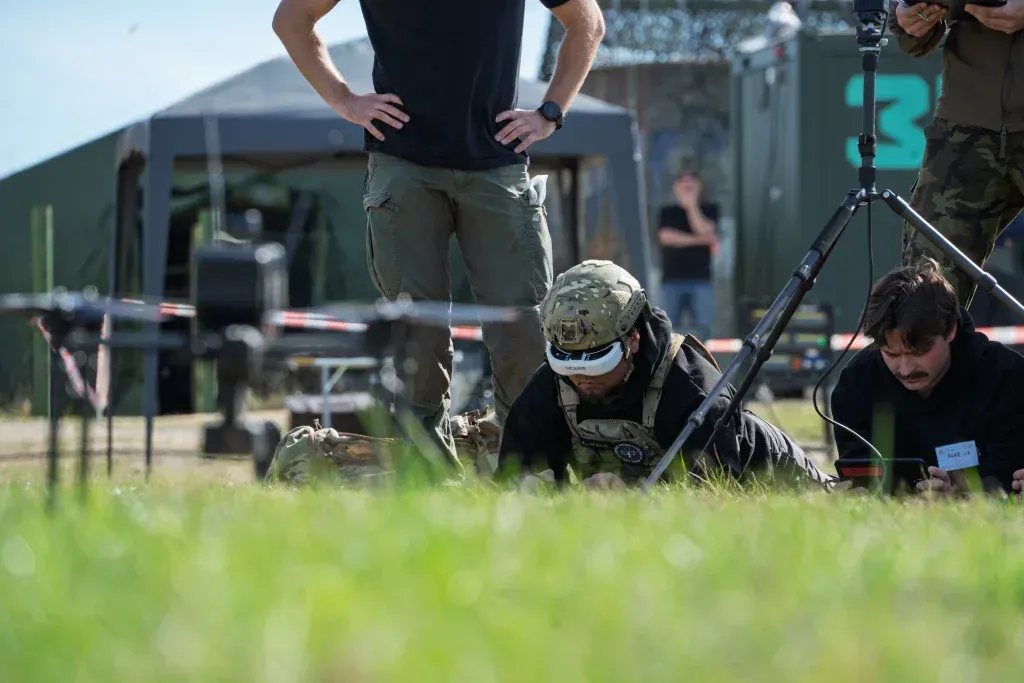
The Czech Ministry of Defense has launched a procurement procedure worth approximately CZK 13.15 million ($630,000) for first-person-view (FPV) drone equipment and spare parts, introducing detailed requirements for component origin, data security and independence from external digital infrastructure.
The tender, published on November 19, 2026, seeks equipment for testing, experimental exercises and military training. Its technical requirements offer an indication of how European defense customers are approaching supply chain transparency and operational control over unmanned systems.
The procurement covers 260 controller configurations, comprising 130 sets equipped with head-mounted displays and another 130 configurations with monitors, alongside additional spare parts and accessories.
Importantly, these figures do not represent an order for 260 complete FPV drones.
Component Origin and Software Transparency
One of the most notable aspects of the procurement concerns the documentation suppliers must provide for critical hardware and software.
According to tender requirements, suppliers must identify the country of manufacture for several categories of components, including flight controllers, video transmitters, FPV goggles, GPS modules, firmware and operator software.
The requirements also specify that relevant equipment must be capable of operating without an internet connection, cloud services or external manufacturer-controlled servers.
Control configurations must support restrictions on unauthorized application installation and allow operators to manage user permissions.
Suppliers must also describe network connectivity, telemetry functions and potential data transmission pathways. Unauthorized transmission of operational data or telemetry to external servers is prohibited.
The documentation additionally requires suppliers to declare that they are unaware of hidden communication channels or mechanisms that could transmit data outside the operator's controlled infrastructure.
The Ministry of Defense reserves the right to verify compliance through technical security inspections.
A Growing Focus on Procurement Security
The requirements reflect an important distinction in European military drone procurement: evaluating the physical performance of an aircraft is no longer sufficient without examining its digital dependencies and component sourcing.
A drone system that depends on external authentication services, remote infrastructure or undisclosed communication functions can introduce additional operational and cybersecurity risks.
Country-of-origin disclosure also provides military customers with information relevant to supply chain resilience, sanctions compliance and future maintenance.
However, the Czech tender does not establish a blanket prohibition on Chinese-made components. Its published requirements focus on origin disclosure, data control and technical independence, which should not be confused with a fully verified China-free supply chain.
As AdriaDefense recently reported, Czech manufacturer STV Group has introduced the FPV-NG tactical drone with a stated China-free design, reflecting growing industry interest in alternative component sourcing.
The procurement requirements provide a useful example of how government buyers can translate some of these concerns into contractual conditions rather than relying solely on manufacturers' public claims.
Supplier Selection and Next Steps
The Czech Ministry of Defense is conducting an open procurement procedure, with the lowest total bid price accounting for 100% of the evaluation score.
Suppliers must nevertheless demonstrate compliance with the technical specifications, including the submission of product samples for inspection. The selected contractor is expected to deliver the equipment within 12 weeks after the contract becomes effective.
Bids are due by December 28, 2026, and the equipment is intended for delivery to a military facility in Štěpánov, near Olomouc.
Although relatively modest in financial value, the tender illustrates how supply chain disclosure and software autonomy are becoming practical considerations in European military drone procurement.
For manufacturers seeking to serve NATO customers, the ability to document component origin and demonstrate operator control over communications infrastructure may become increasingly important alongside traditional performance and cost requirements.