European NATO Country Orders Patria Passive Radar System
Patria will deliver its MUSCL passive radar system to an undisclosed European NATO member, adding a low-signature air-surveillance and counter-UAS capability that operates without transmitting its own radar signal.

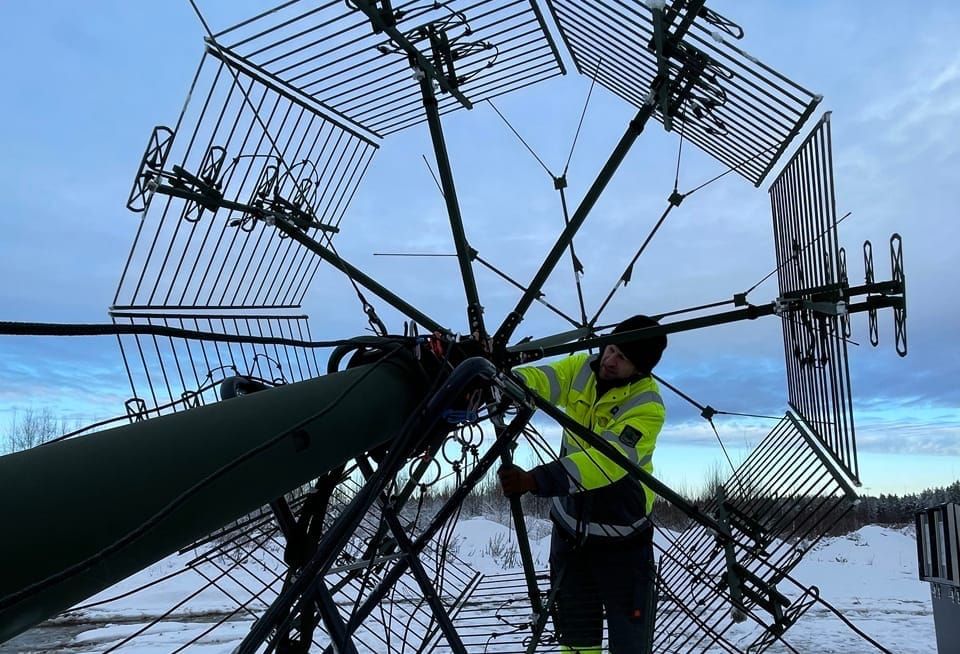
Patria will deliver its MUSCL passive radar system to an undisclosed European NATO member, expanding the use of low-signature sensing technologies for air surveillance and counter-UAS missions.
Finnish defense company Patria announced on September 15 that it has received an order for its MUSCL passive radar system from a European NATO country.
The customer has not been identified.
MUSCL is designed to detect and track aircraft and unmanned aerial systems without transmitting its own radar signal. Instead, the system exploits existing electromagnetic emissions in the surrounding environment, including signals from radio, television and telecommunications infrastructure.
That allows the system to monitor airspace while remaining significantly harder to detect and target than conventional active radars.
Patria positions MUSCL for air surveillance, early warning and counter-UAS applications.
The company did not disclose the value of the contract, the number of systems ordered or the expected delivery schedule.
Passive sensing gains importance in Europe
Passive radar technology has attracted growing interest as European armed forces adapt to environments where electronic warfare and long-range precision weapons make active sensors increasingly vulnerable.
Traditional radar systems transmit electromagnetic energy and analyze the returning signal to locate targets.
That emission can also expose the radar's position to electronic-support systems and anti-radiation weapons.
Passive radar avoids that problem by using signals that are already present in the environment.
MUSCL monitors how those external signals are reflected by aircraft and other objects, allowing operators to generate tracks without emitting a dedicated radar beam.
The approach can complement conventional air-defense radars rather than replace them, providing an additional sensor layer that is more difficult for an adversary to detect or suppress.
Counter-UAS and air-defense applications
Patria says the system can support detection and tracking of both conventional aircraft and drones.
That capability has become particularly relevant as NATO members invest heavily in counter-UAS networks and distributed air-surveillance architectures.
Small drones can present a difficult target for conventional sensors, particularly when operating at low altitude or in complex electromagnetic environments.
Passive systems can provide another source of tracking data that can be fused with active radar, electronic-support measures and other sensors.
Patria is also presenting MUSCL at EWLive 2026 in Estonia, where the company is demonstrating the system alongside its CATCHR electronic-support-measures platform.
The demonstrations are focused on monitoring airspace over Estonia and southern Finland using passive sensing technologies.
Patria expands electronic-warfare portfolio
The MUSCL order comes as Patria continues to expand its role beyond armored vehicles and aviation support into electronic warfare, surveillance and command-and-control technologies.
The company has increasingly positioned its sensor portfolio around distributed battlefield awareness and survivable intelligence collection.
For NATO countries, systems such as MUSCL offer an additional way to build resilient surveillance networks that remain operational even when active radars are jammed, targeted or forced to shut down.
The identity of the customer remains undisclosed, but the contract provides another indication that passive sensing is moving from specialized electronic-warfare applications into broader European air-defense and counter-UAS architectures.