German Startup INLEAP Completes Bundeswehr Laser Drone Defense Trials
German startup INLEAP Photonics has demonstrated its AI-assisted Laserdome laser system with the Bundeswehr, successfully intercepting small drones during military trials.

German defense technology startup INLEAP Photonics has completed a series of military trials of its laser-based counter-drone system in cooperation with the Bundeswehr's Cyber Innovation Hub, demonstrating the ability to disable small unmanned aircraft using AI-assisted targeting.
The results were presented on October 14 at Strausberg airfield in Brandenburg, following a testing program launched in April 2026. During the demonstration, the system tracked and engaged a flying drone using a focused laser beam.
The project, known as Laserdome, evaluates INLEAP's FASTLIGHT SHIELD technology for protecting military installations, airfields and critical infrastructure against small drones.
Laser System Neutralizes Drones in Seconds
According to the Bundeswehr's Cyber Innovation Hub, the trials demonstrated successful engagements against DJI Mini drones, with approximately two seconds of laser exposure required to neutralize a target.
FASTLIGHT SHIELD combines high-speed laser beam steering with AI-assisted target recognition. Its software identifies vulnerable components, such as rotor arms, motors or electronic assemblies, and directs laser energy toward those areas to disable the aircraft.
During the Strausberg demonstration, a drone was detected at a distance of approximately 500 meters and tracked using cameras and radar before the operator authorized the engagement.
The system is designed to rapidly switch between targets, making it a potential defense against multiple small drones and swarm attacks. However, the publicly reported results do not establish its effectiveness against large, coordinated drone swarms under combat conditions.
A central feature of the project is human control over the engagement decision. While AI assists with detection, tracking and target selection, the operator retains responsibility for authorizing laser use.
Bundeswehr Evaluates Operational Applications
INLEAP and the Bundeswehr began their joint Laserdome testing program in April 2026, conducting trials at military training areas under varying environmental conditions.
The evaluation focused on target acquisition, laser precision, operator interaction and system performance under changing weather and visibility conditions.
The technology is intended primarily for short-range protection of military facilities and other high-value locations. Its developers are also examining mobile configurations that could support deployed military units.
INLEAP's approach builds on laser beam steering technology originally developed for industrial manufacturing. The company was established as a spin-off from Laser Zentrum Hannover and has adapted its expertise in precision laser systems for counter-UAS applications.
€20 Million Investment Supports Commercial Development
The latest demonstration follows INLEAP Photonics' announcement in September that it had raised approximately €20 million in seed financing led by UVC Partners.
Other investors included HTGF, Balnord, Sentris and Scale Capital. The funding is intended to support product development, manufacturing expansion and the transition toward series production of the company's laser-based counter-drone systems.
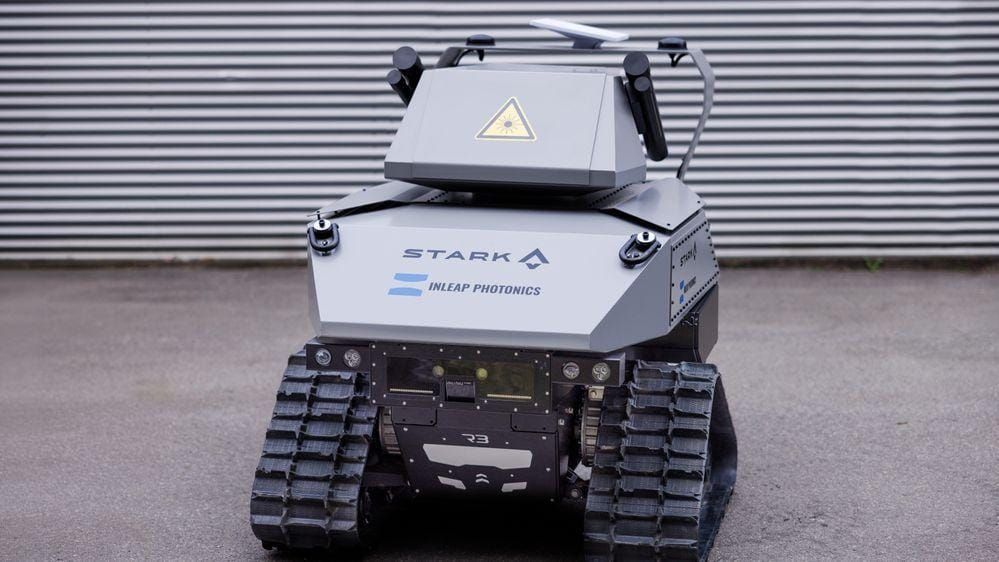
INLEAP has also partnered with German defense technology company STARK to explore the integration of laser effectors with unmanned ground and maritime platforms.
The Bundeswehr trials represent a technical validation milestone, but they do not constitute a procurement award. No production quantities, contract values or delivery schedules have been announced for Laserdome.
According to reporting from the Strausberg demonstration, operational readiness could potentially be achieved within two to three years, depending on further development and procurement decisions.