Kongsberg Adds €16M Navigation Package to Poland C-UAS
Advanced Navigation will supply hundreds of inertial navigation systems for Kongsberg PROTECTOR platforms supporting Poland's SAN counter-drone program.

Advanced Navigation has secured a €16 million supply agreement with Kongsberg Defence & Aerospace for hundreds of Boreas fiber-optic gyroscope inertial navigation systems intended for PROTECTOR Counter-Unmanned Aerial Systems platforms. The platforms will support Poland's SAN counter-drone program, a major new layer of the country's integrated air defense architecture.
The September 22 agreement adds a navigation component designed to keep counter-drone weapon stations accurately positioned and oriented when satellite navigation is jammed, spoofed or unavailable. It follows Poland's January 2026 award to Kongsberg Defence & Aerospace and Polska Grupa Zbrojeniowa for 18 SAN C-UAS batteries, with Kongsberg's portion of the program valued at approximately NOK 16 billion.
The procurement provides another indication of how Poland is building its counter-drone network around distributed sensors and multiple kinetic and non-kinetic effectors rather than relying on a single interceptor.
Boreas navigation will support PROTECTOR in GPS-denied conditions
Advanced Navigation will deliver hundreds of Boreas fiber-optic gyroscope inertial navigation systems for integration into Kongsberg's PROTECTOR C-UAS platforms.
The systems provide positioning, orientation and heading information independently of continuous Global Navigation Satellite System availability. For a counter-UAS weapon station, maintaining accurate orientation becomes particularly relevant when electronic warfare disrupts satellite navigation.
According to Advanced Navigation, the equipment will allow the PROTECTOR platforms to maintain the positioning data needed to detect, track and engage aerial threats in environments where GPS signals have been jammed, spoofed or lost.
The contract therefore addresses one of the technical requirements emerging from current drone warfare: counter-UAS systems themselves must continue operating under electronic attack.
Kongsberg's PROTECTOR family provides the weapon-station foundation for part of Poland's SAN architecture. The company says existing and future PROTECTOR systems can be configured for counter-UAS missions.
Poland's SAN system combines guns, missiles and interceptor drones
The €16 million navigation agreement forms a relatively small but specialized component of a much larger Polish acquisition.
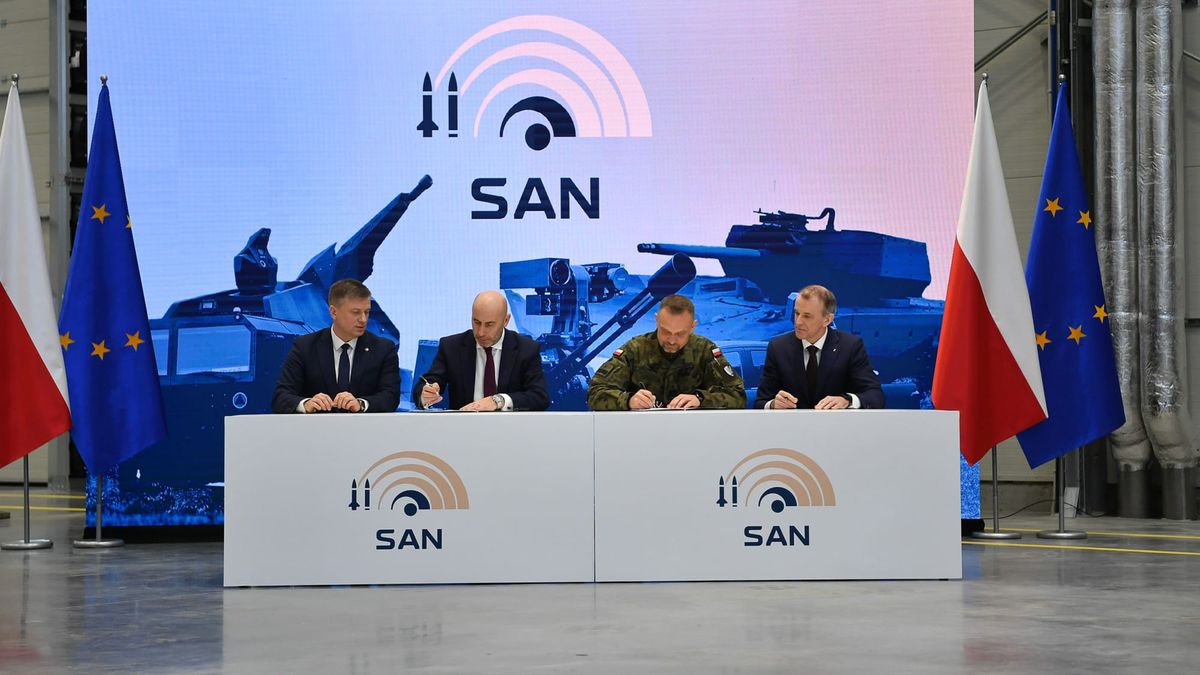
On January 30, the Polish Armaments Agency signed contracts with a consortium led by Polska Grupa Zbrojeniowa and Kongsberg Defence & Aerospace for the SAN system. Polish company Advanced Protection Systems serves as a key subcontractor.
The program covers 18 battery modules. Each battery will contain three fire platoons and one support platoon, while individual fire platoons are intended to independently detect, track, identify and engage aerial targets.
SAN will combine several types of effectors rather than depend on a single weapon.
Kongsberg has identified 35 mm, 30 mm and 12.7 mm guns, missiles and interceptor drones among the planned effectors. Its PROTECTOR Medium Caliber Turret MCT30 and Remote Weapon Station will form part of the architecture, with 70 mm guided missiles serving as the primary weapon on the relevant PROTECTOR remote weapon stations.
Advanced Protection Systems will provide a tailored command-and-control architecture connecting sensors and effectors and integrating SAN with Poland's wider national air defense system.
The resulting architecture gives commanders different options against targets with different characteristics and costs. Small drones can require a different engagement method from larger unmanned aircraft, while electronic warfare and interceptor drones can complement gun and missile systems.
SAN will reinforce Poland's eastern border
Poland intends SAN to supplement the country's developing layered integrated air and missile defense network.
The Polish Ministry of National Defense has specifically identified protection of the country's eastern border as the system's initial priority. Warsaw wants scalable kinetic and non-kinetic options for engaging unmanned aerial systems while reducing the cost of individual interceptions.
That requirement has gained urgency as Poland has confronted drone activity linked to the war in neighboring Ukraine.
Polish Defense Minister Władysław Kosiniak-Kamysz linked the development of SAN to the airspace violations during the night of September 9-10, 2025, which he described as a turning point for Polish counter-drone requirements. The ministry said development and integration work on the system had already been underway for months before the January 2026 contract.
SAN is therefore intended to fill a different layer from Poland's higher-end Patriot and Narew air defense capabilities. Its mix of guns, missiles, electronic measures and interceptor drones gives Poland additional options against relatively inexpensive unmanned threats.
Polish industry takes a central role in SAN
The program also has an industrial component.
Kongsberg said in January that it was preparing investments to increase manufacturing capacity and capabilities in Poland as part of the SAN deliveries.
Polska Grupa Zbrojeniowa leads the consortium, while Polish Advanced Protection Systems provides the command-and-control architecture. Poland also retains domestic capabilities relevant to some of the weapons planned for the system.
In an April parliamentary response, the Polish government said MESKO already possesses technology required for production of unguided 70 mm rockets. The same response stated that technology transfer for programmable 30 mm and 35 mm ammunition was not included in the contract between the Armaments Agency, Polska Grupa Zbrojeniowa and Kongsberg.
The distinction provides a clearer picture of the program's industrial structure. SAN combines Polish command-and-control technology and industrial participation with Kongsberg weapon stations and additional specialized components sourced internationally.
Advanced Navigation's new €16 million agreement adds assured navigation to that supply chain.
As deliveries move forward, SAN will become a test of whether Poland can integrate a large number of sensors, electronic warfare systems and different effectors into a distributed counter-drone network along NATO's eastern flank.
Poland SAN counter-drone system: key questions
What is Poland's SAN counter-drone system?
SAN is a layered Counter-Unmanned Aerial System being acquired by the Polish Armed Forces. Poland ordered 18 battery modules from a consortium involving Polska Grupa Zbrojeniowa and Kongsberg Defence & Aerospace, with Advanced Protection Systems serving as a key subcontractor.
What weapons will Poland's SAN system use?
Kongsberg says the batteries will include 35 mm, 30 mm and 12.7 mm guns, missiles, interceptor drones and other counter-UAS effectors. PROTECTOR remote weapon stations used in the program will employ 70 mm guided missiles as their primary weapon.
What is Advanced Navigation supplying to Kongsberg?
Advanced Navigation will supply hundreds of Boreas fiber-optic gyroscope inertial navigation systems under a €16 million agreement. The equipment is intended to maintain accurate positioning and orientation for PROTECTOR C-UAS platforms when satellite navigation is degraded or unavailable.
How many SAN batteries is Poland buying?
The program includes 18 C-UAS battery modules. Each battery consists of three fire platoons and a support platoon.