Lithuania Hardens Strategic Harmony Link Substation Against Shahed Drone Attacks
The planned Gižai power hub near Russia’s Kaliningrad exclave will feature blast-resistant transformer enclosures, anti-ram barriers and underground intrusion detection as Lithuania adapts critical infrastructure to wartime threats.

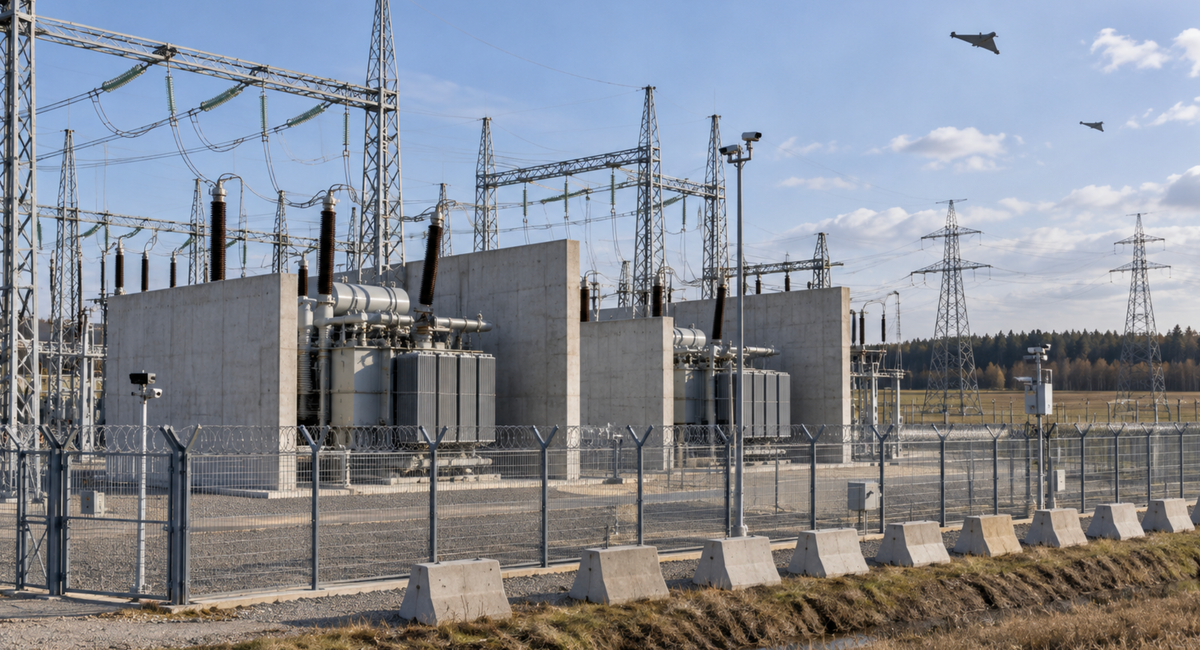
Lithuania is designing a major new electricity substation near Russia’s Kaliningrad exclave to withstand explosive drone attacks and other forms of sabotage, reflecting a broader shift in how NATO’s eastern members are protecting critical infrastructure.
The Gižai transformer substation, which will become the largest facility of its kind operated by Lithuanian transmission system operator Litgrid, is being designed with reinforced physical protection against threats ranging from vehicle-borne explosives and underground intrusion to direct attacks by military drones.
Litgrid CEO Andrius Šemeškevičius told Reuters that the company is planning the facility around scenarios involving multiple Shahed-type attack drones carrying approximately 100 kilograms of explosives. Lithuania’s military is advising Litgrid on the physical protection of critical energy infrastructure and measures against emerging threats.
The security concept includes anti-ram perimeter fencing, sensors capable of detecting possible tunneling beneath the site and reinforced-concrete structures protecting key transformers and other critical equipment.
Rather than concentrating essential systems in a small area, the approximately 35-hectare facility will spread infrastructure across the site, limiting the damage that could be caused by a single successful strike. Critical components will also be duplicated so that the substation can continue operating if individual units are damaged or destroyed.
The protective structures themselves require specialized engineering. According to Litgrid, conventional concrete would not provide sufficient protection, while enclosed transformers will also require artificial cooling systems.
The additional security measures are expected to add at least €48 million to the previously estimated cost of the Gižai project, with Lithuania seeking greater EU support for protecting infrastructure exposed to threats along the bloc’s eastern frontier.
Strategic node between Lithuania and Poland
Gižai will form the Lithuanian hub of Harmony Link, a new electricity interconnection between Lithuania and Poland that has become an increasingly important component of Baltic energy security.
Litgrid formally launched procurement for the substation in August. The planned 330/220/110/10 kV facility will introduce the 220 kV voltage level into Lithuania’s transmission system for the first time, converting electricity arriving from Poland to the 330 kV and 110 kV levels used by Lithuania’s domestic grid.
Harmony Link is being developed jointly by Lithuania’s Litgrid and Poland’s PSE as a 700 MW, 220 kV alternating-current connection. The project is scheduled to enter operation by the end of 2030.
Once completed, Harmony Link and the existing LitPol Link are expected to provide up to 1,200 MW of combined transmission capacity between Lithuania and Poland, strengthening the Baltic states’ integration with the continental European electricity system.
The route is particularly sensitive because it passes through the wider Suwałki Gap, the narrow area connecting Poland and Lithuania between Russia’s Kaliningrad exclave and Belarus. The corridor has long been regarded as strategically important for both NATO reinforcement and regional infrastructure connecting the Baltic states with the rest of the alliance.
The Baltic electricity systems disconnected from the Russian-controlled power system and synchronized with continental Europe in 2025, making physical resilience of the remaining cross-border connections increasingly important.
Critical infrastructure built for a different threat environment
The Gižai design illustrates how Russia’s war against Ukraine is reshaping infrastructure planning well beyond the battlefield.
Russian forces have repeatedly targeted Ukrainian electricity generation and transmission infrastructure with missiles and long-range attack drones, demonstrating how relatively inexpensive weapons can disrupt civilian energy systems at scale.
For Lithuania, this has changed the assumptions behind infrastructure protection.
Šemeškevičius said electricity networks were previously designed primarily around natural disasters. Planning now has to account for hybrid operations, sabotage and direct military attack.
That shift is increasingly visible across NATO’s eastern flank, where electricity networks, telecommunications infrastructure, transport corridors and other civilian systems are being treated not only as economic assets but as critical elements of national resilience in a potential conflict.