MBDA, Poland Advance Low-Cost Counter-Drone Interceptor
MBDA and Poland's WITU completed seeker trials for the Counter Mass Interceptor, a supersonic missile designed to defeat mass drone attacks.

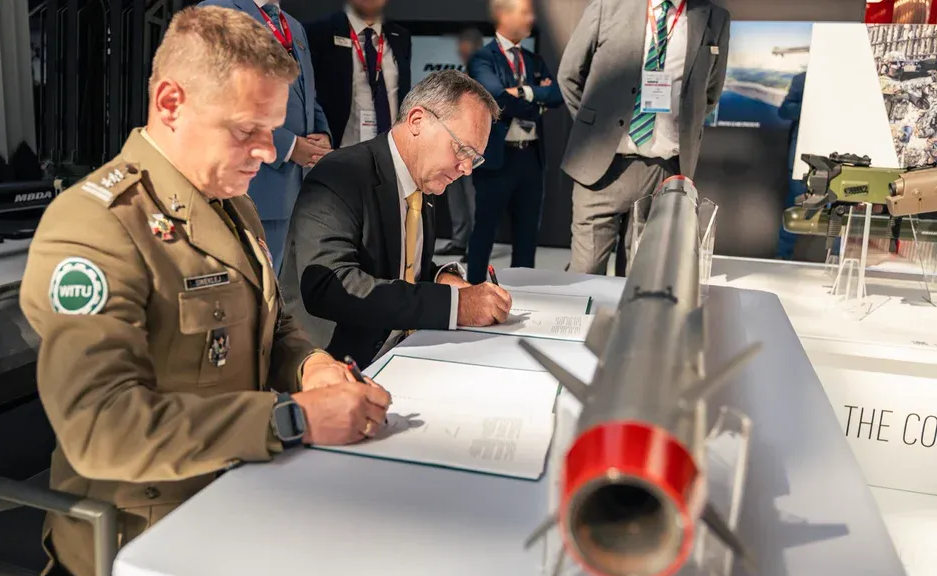
MBDA and Poland's Wojskowy Instytut Techniczny Uzbrojenia, or Military Institute of Armament Technology, are advancing a low-cost supersonic interceptor designed to counter mass attacks by drones and cruise missiles. The partners have completed seeker trials in Poland and plan an initial firing campaign for the Counter Mass Interceptor in 2027.
The Counter Mass Interceptor, known as CMI, is designed to engage one-way attack and intelligence, surveillance and reconnaissance drones, helicopters and cruise missiles at ranges and altitudes exceeding 6 kilometers. MBDA and WITU are positioning the weapon as a high-volume interceptor that could reduce reliance on more expensive surface-to-air missiles against relatively inexpensive unmanned threats.
The two organizations announced their cooperation during MSPO 2026 in Kielce, Poland, where they also signed a broader memorandum of understanding covering missile research. The agreement builds on growing British-Polish defense cooperation under the Northolt Treaty.
Seeker trials move CMI toward a prototype missile
MBDA and WITU completed a series of field trials at a Polish test range in September 2026. The trials evaluated the interceptor's seeker against several representative drone target types and across multiple operational scenarios.
The results clear the way for the partners to integrate the seeker into a prototype missile designed by WITU. According to MBDA, the development team intends to move toward the first firing campaign in 2027.
The division of work gives Poland a substantial role in the weapon rather than limiting WITU to local assembly. Polish reporting from MSPO indicates that WITU is responsible for the missile design, while MBDA contributes the seeker technology.
MBDA has not disclosed a unit price, production target or planned entry-into-service date. The company describes CMI as a low-cost, high-volume weapon, but no customer order has been announced.
Counter Mass Interceptor targets threats beyond 6 kilometers
CMI is a supersonic interceptor with engagement range and altitude exceeding 6 kilometers. Its target set includes one-way attack drones, ISR unmanned aircraft, helicopters and cruise missiles.
That combination places the missile above many very-short-range counter-drone effectors while keeping its mission focused on relatively numerous lower-tier aerial threats.
MBDA first presented CMI at the Farnborough International Airshow in July 2026. The September agreement with WITU establishes a Polish development path for the weapon and moves the project from the initial concept toward prototype integration and live firing.
The project addresses an increasingly important air-defense problem for European militaries: magazine depth. Large numbers of one-way attack drones can force defenders to expend surface-to-air missiles that were originally developed for more demanding aircraft and missile targets.
CMI follows a different approach by prioritizing an interceptor that can be manufactured and deployed in larger quantities. MBDA explicitly links the program to narrowing the cost gap between attacking drones and the missiles used to destroy them.
Poland is expanding its layered counter-drone defenses
The program fits Poland's broader investment in layered air and missile defense as Warsaw increases spending on counter-unmanned aircraft systems.
Army Recognition reported during MSPO that Poland had contracted approximately PLN 25 billion in unmanned and counter-UAS projects by June 2026, compared with PLN 250 million in 2023. Poland is developing a mix of missiles, guns, electronic warfare, radars and interceptor drones rather than relying on one effector against every class of unmanned threat.
CMI would occupy one part of that architecture. Cheaper systems can address small drones at shorter distances, while systems such as Piorun, CAMM and CAMM-ER provide other layers of Poland's expanding air-defense network.
MBDA already has a significant position in that network through Poland's NAREW and PILICA+ programs. The company said its cooperation with WITU builds on technology transfer associated with NAREW and increasing deliveries for PILICA+.
The WITU relationship extends beyond CMI. The Polish institute is also involved in Europe's Hypersonic Defence Interceptor System, or HYDIS, which is developing technologies for a future European interceptor against hypersonic and ballistic threats.
This gives Poland involvement at two very different ends of the air-defense spectrum: a relatively inexpensive interceptor intended for high-volume drone and cruise missile threats, and research supporting Europe's future defense against hypersonic weapons.
Counter Mass Interceptor: key questions
What is the MBDA Counter Mass Interceptor?
Counter Mass Interceptor is a supersonic air-defense missile being developed by MBDA and Poland's WITU. It is intended as a low-cost, high-volume weapon against drones, helicopters and cruise missiles.
What is the range of the Counter Mass Interceptor?
MBDA says CMI can engage threats at ranges and altitudes exceeding 6 kilometers. The company has not published a precise maximum range or altitude.
When will MBDA and WITU test-fire CMI?
The partners plan to begin the first firing campaign in 2027. Seeker field trials against representative drone targets were completed in Poland in September 2026.
Will Poland manufacture the Counter Mass Interceptor?
The cooperation is intended to produce what MBDA describes as a fully Polish sovereign solution for Poland, with potential application for other allied armed forces. WITU designed the prototype missile that will receive the seeker tested jointly with MBDA.
The next technical milestone will be integration of the seeker into WITU's prototype, followed by the planned 2027 firing campaign. A successful test program could give Poland another domestically anchored layer for countering the growing number of drones and cruise missiles that modern air-defense networks must be prepared to engage simultaneously.