NATO Air Defense Systems: Patriot, SAMP/T, IRIS-T, NASAMS
Patriot, SAMP/T NG, IRIS-T SLM and NASAMS protect different layers of NATO airspace. Here is how their missiles, roles and capabilities compare.

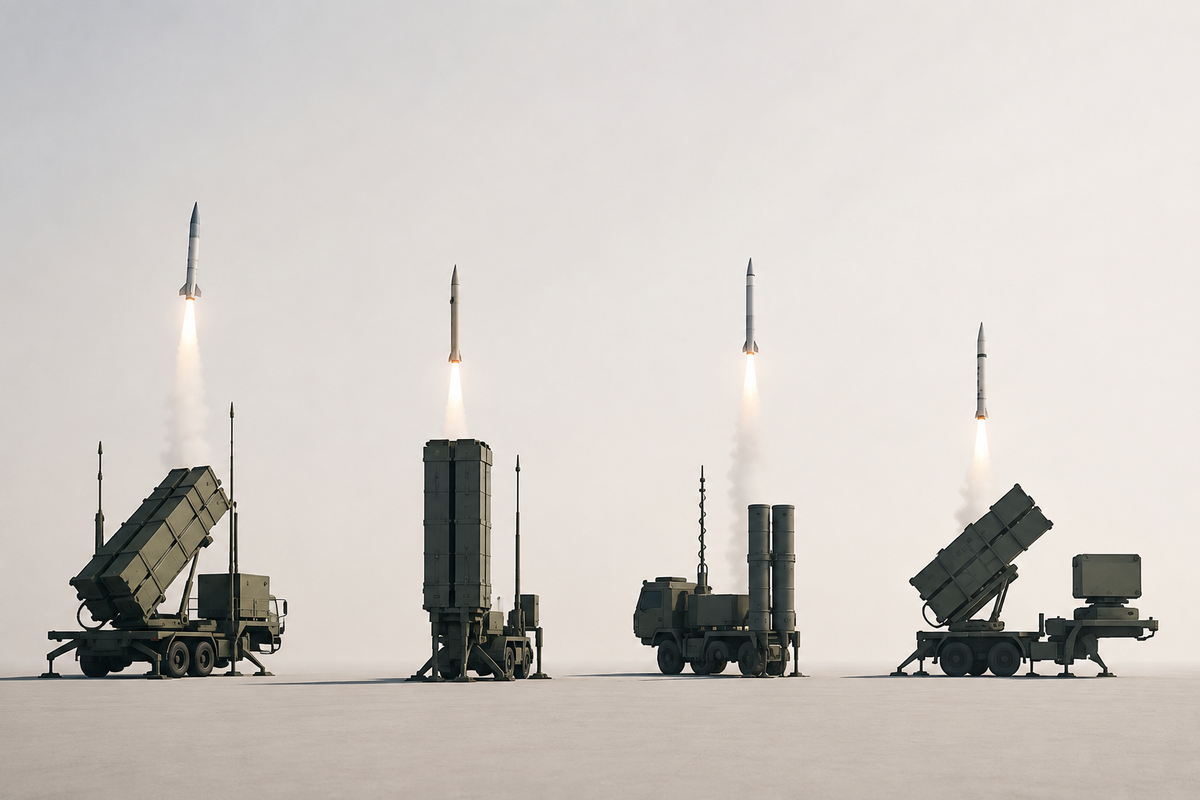
Patriot, SAMP/T NG, IRIS-T SLM and NASAMS are four of the most important ground-based air defense systems used or being acquired by NATO countries, but they do not perform identical missions. Patriot and SAMP/T NG provide the alliance with higher-end air and missile defense capabilities, including defense against tactical ballistic missiles, while IRIS-T SLM and NASAMS primarily cover the medium-range layer against aircraft, cruise missiles, drones and related airborne threats.
The distinction matters because NATO air defense is built around layers rather than a single missile system. Sensors, command-and-control networks and different interceptors work together so that expensive long-range missiles do not have to engage every target and shorter-range systems can protect higher-value batteries and infrastructure.
Patriot, SAMP/T NG, IRIS-T SLM and NASAMS compared
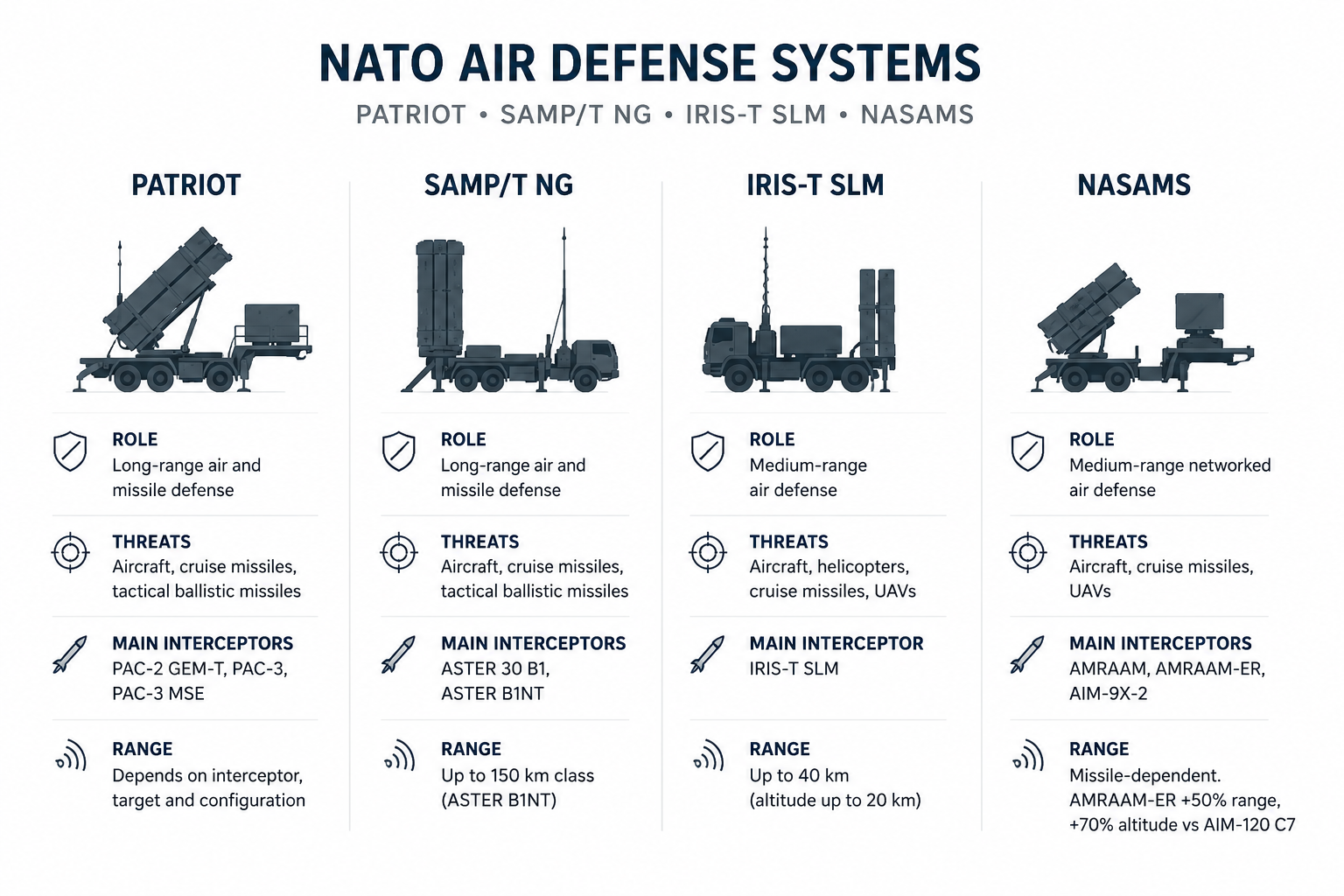
These published figures require context. A missile's maximum aerodynamic reach is not necessarily the distance at which a particular target can be successfully engaged, and radar detection range is not the same measurement as interceptor engagement range.
For that reason, simple online tables that assign one fixed maximum range to every air defense system can be misleading. Patriot and NASAMS in particular support different interceptor types, so their engagement envelopes change with missile, target geometry and system configuration.
Patriot combines aircraft defense with ballistic missile interception
The MIM-104 Patriot is a US-developed air and missile defense system built around radar, command-and-control equipment, launchers and several families of interceptors. Raytheon, an RTX business, produces the core Patriot system, while Lockheed Martin produces the PAC-3 family of interceptors.
Patriot can engage tactical ballistic missiles, cruise missiles, aircraft and other airborne threats. RTX states that the system forms part of the air defense architecture of 19 countries, including nine European nations as of 2026.
Its interceptor mix is central to understanding Patriot. PAC-2 Guidance Enhanced Missile-Tactical, or GEM-T, uses a fragmentation warhead and remains a primary Patriot effector for aircraft, cruise missiles and tactical ballistic missiles.
PAC-3 and PAC-3 Missile Segment Enhancement use a different approach. PAC-3 MSE is a high-velocity hit-to-kill interceptor that destroys its target through kinetic impact and incorporates a larger dual-pulse motor than the earlier PAC-3 design.
A Patriot launcher can carry different interceptor loads. Lockheed Martin states that a launcher can accommodate 12 PAC-3 MSE interceptors, or a mixed configuration involving PAC-3 MSE and earlier PAC-3 missiles.
Patriot is also undergoing a major sensor and command architecture transition. The US Army is replacing the legacy AN/MPQ-65A radar in its modernized architecture with the Lower Tier Air and Missile Defense Sensor, or LTAMDS, which provides 360-degree sensing and is designed to exploit the PAC-3 MSE interceptor over a larger battlespace.
This evolution is important when comparing Patriot specifications across different sources. A Patriot battery built around legacy radar and command architecture should not automatically be treated as technically identical to a future LTAMDS and Integrated Battle Command System-enabled configuration.
How far can Patriot shoot?
There is no single accurate Patriot range figure that applies to every threat and every interceptor.
The system can use different missiles with different flight profiles, seekers and intended targets. Manufacturers also do not publicly provide a single current engagement range covering the entire Patriot interceptor family.
This makes common claims that Patriot simply has one specific range misleading. For a meaningful comparison, the interceptor and target type must be identified first.
SAMP/T NG gives Europe a long-range alternative
Système Sol-Air Moyenne Portée/Terrestre New Generation, or SAMP/T NG, is the latest French-Italian evolution of the ASTER-based ground air defense system. Eurosam develops the system through its parent companies MBDA and Thales, with France and Italy as the principal customer nations.
SAMP/T NG combines vertical ASTER launchers with a new engagement module and modern active electronically scanned array radar. The French configuration uses the Thales Ground Fire radar, while the Italian configuration can employ the Leonardo Kronos Grand Mobile High Power radar.
The system can control up to six ASTER launchers with eight ready-to-fire missiles each, giving a maximum of 48 ASTER interceptors in that configuration. Its architecture is also being developed to integrate shorter-range launchers as part of a multilayer configuration.
The newest interceptor is the ASTER B1 New Technology, or ASTER B1NT. Eurosam validated the missile's long-range performance during a July 2025 firing, while MBDA describes it as a 150 km-class interceptor capable of reaching flight altitudes beyond 25 km during qualification.
ASTER B1NT also introduces a new Ka-band seeker and extends the system's ability to address more demanding ballistic and highly maneuverable threats. MBDA says first B1NT deliveries are planned from 2027.
SAMP/T NG itself reached another milestone in December 2025 when complete French and Italian configurations conducted successful firings. First systems were scheduled for delivery to French and Italian forces in 2026 for operational evaluation.
Denmark added an important export breakthrough in September 2025 by selecting SAMP/T NG for its future long-range ground-based air defense requirement. Copenhagen chose the European system over Patriot while separately acquiring medium-range systems, providing a practical example of layered architecture rather than dependence on a single interceptor family.
SAMP/T NG is expanding into a dual-layer system
France took the concept further in April 2026 by contracting Eurosam, MBDA and Thales to develop a dual-layer SAMP/T NG configuration.
The project will integrate VL MICA into the SAMP/T NG engagement chain alongside ASTER interceptors. The objective is to let commanders match lower-cost short-range or medium-range effectors to appropriate targets while preserving ASTER missiles for threats requiring their higher performance.
That development illustrates a broader direction in modern air defense. The key capability is increasingly not a single missile but the ability to connect multiple sensors and effectors under one command architecture.
IRIS-T SLM covers the medium-range layer
IRIS-T Surface Launched Medium Range, or IRIS-T SLM, is a German ground-based air defense system developed by Diehl Defence.
It is designed to engage aircraft, helicopters, cruise missiles and unmanned aerial vehicles at ranges of up to 40 km and altitudes of up to 20 km. A standard fire unit consists of launchers, a radar and a tactical operations center, supported by maintenance and reload vehicles.
The interceptor evolved from the IRIS-T air-to-air missile but received modifications to its propulsion and aerodynamics for surface launch. It uses an imaging infrared seeker for the terminal phase and thrust-vector control for high maneuverability.
IRIS-T SLM provides true 360-degree engagement coverage because its vertically launched missile can turn toward threats approaching from any direction. This differs from the physical field-of-view limitations associated with some older air defense radar and launcher architectures.
Ukraine became the system's first wartime operator and has used IRIS-T SLM against Russian missile and drone attacks. Diehl Defence has cited Ukrainian customer data reporting strong performance during raids involving more than 15 targets, although detailed engagement records remain operationally sensitive and independently verifiable public data are limited.
European procurement has expanded rapidly. Under the European Sky Shield Initiative framework, Germany, Estonia, Latvia, Slovenia, Bulgaria, Sweden, Switzerland and Denmark had selected Diehl air defense solutions by 2025, according to the company.
Estonia received its first IRIS-T SLM fire unit at Ämari Air Base in June 2026. Latvia was scheduled to begin receiving its systems in 2026, while Germany continued ordering additional IRIS-T ground-based interceptors.
IRIS-T SLM should therefore not be described as a German equivalent of Patriot. Its 40 km published engagement range and mission profile place it primarily in the medium-range layer, where it complements rather than replaces long-range ballistic missile defense systems.
NASAMS uses a networked and multi-missile architecture
National Advanced Surface-to-Air Missile System, or NASAMS, was developed by Norway's Kongsberg Defence & Aerospace and US company Raytheon.
A standard NASAMS fire unit combines Kongsberg's Fire Distribution Center with AN/MPQ-64-series Sentinel radar, electro-optical and infrared sensors and distributed missile launchers. Multiple fire units can be networked so that sensors, launchers and command posts do not need to occupy the same physical location.
This distributed architecture is one of NASAMS' defining characteristics. A launcher can receive engagement data through the wider network rather than depending only on a sensor positioned immediately beside it.
NASAMS also supports several interceptor types. Its standard weapon is the AIM-120 Advanced Medium-Range Air-to-Air Missile adapted for surface launch, while newer configurations can employ AMRAAM Extended Range and AIM-9X Block II.
Kongsberg states that AMRAAM-ER expands range by 50 percent and altitude by 70 percent compared with the AIM-120 C7 baseline used in its NASAMS data. The manufacturer does not publish one universal current kilometer figure for the entire NASAMS system, which is why a single fixed NASAMS range should be treated cautiously.
NASAMS is primarily intended for defense against aircraft, cruise missiles and unmanned threats rather than serving as the same class of dedicated ballistic missile defense asset as a Patriot configuration using PAC-3 MSE or SAMP/T NG with ASTER B1NT.
Ukraine has operated NASAMS since 2022. Kongsberg reported in 2025 that Ukrainian systems had intercepted more than 900 missiles and drones, citing a 94 percent success rate from customer data.
NASAMS has also continued expanding across NATO. Denmark signed a EUR 500 million contract in November 2025 and became the system's 14th user nation and eighth NATO user at that time.
Belgium is also rebuilding its ground-based air defense around NASAMS. In cooperation with the Netherlands, Belgium plans to acquire 10 NASAMS firing units, including one intended for Luxembourg, while studying a separate long-range layer.
Patriot vs SAMP/T NG: which system has ballistic missile defense?
Patriot and SAMP/T NG occupy the closest roles among the four systems examined here because both combine long-range air defense with meaningful tactical ballistic missile defense capability.
Patriot's PAC-3 MSE uses hit-to-kill technology and has an extensive operational and user base. SAMP/T NG uses the ASTER family, with ASTER B1NT bringing a European 150 km-class interceptor and enhanced capability against more demanding missile threats.
The technologies differ substantially. PAC-3 MSE destroys targets primarily through kinetic impact, while ASTER uses an active seeker, aerodynamic control and lateral thrust control and carries a blast-fragmentation warhead.
Neither system can therefore be reduced to a simple range comparison. Sensor architecture, interceptor inventory, defended footprint, target type, raid size, command network and available reloads all influence real operational performance.
IRIS-T SLM vs NASAMS: two approaches to medium-range defense
IRIS-T SLM and NASAMS overlap more directly in the medium-range air defense mission.
IRIS-T SLM offers a manufacturer-published 40 km engagement range and 20 km altitude coverage with a purpose-developed surface-launched IRIS-T derivative. NASAMS instead emphasizes open architecture and the ability to combine several Raytheon interceptor types.
Their seeker technologies also differ. IRIS-T SLM uses an imaging infrared terminal seeker, while AMRAAM and AMRAAM-ER employ active radar guidance.
This means one system is not universally superior to the other. Procurement decisions depend on existing missile inventories, radar requirements, national command networks, industrial considerations, delivery schedules and the threats a country expects to face.
Denmark is a useful example. Rather than choosing one medium-range solution for its entire network, Copenhagen has moved to field NASAMS, IRIS-T SLM and VL MICA alongside SAMP/T NG at the long-range layer.
NATO air defense depends on layers, not one best system
The central lesson from the war in Ukraine is that no individual surface-to-air missile system can economically or physically defeat every category of aerial threat.
A ballistic missile, a cruise missile, a Shahed-type one-way attack drone and a combat aircraft present different engagement problems. Firing a high-end antiballistic interceptor at every low-cost drone would rapidly exhaust inventories and create an unfavorable cost exchange.
NATO's Integrated Air and Missile Defence concept therefore relies on interconnected sensors, command-and-control systems and weapons. Patriot deployments, for example, can feed into NATO's broader integrated air defense network rather than operating as isolated national batteries.
The alliance is moving further toward modular architectures. NATO's Modular Ground Based Air Defence project is examining systems in which different sensors and effectors can form a common network, with Romania joining the multinational program in 2025 alongside countries including Germany, Italy, the Netherlands, Norway and Slovenia.
For Central and Eastern Europe, this shift has direct procurement implications. Countries are increasingly buying combinations of short, medium and long-range systems instead of seeking one platform capable of covering every threat.
Which NATO air defense system is best for each mission?
For high-end tactical ballistic missile defense, Patriot with PAC-3 MSE and SAMP/T NG with ASTER B1NT represent the most relevant systems among these four.
For medium-range defense against aircraft, cruise missiles and drones, IRIS-T SLM and NASAMS provide more appropriate layers and can preserve higher-end interceptors for the targets that require them.
For countries building national air defense from a limited existing base, interoperability and the number of available interceptors can matter as much as maximum missile performance. A system with sufficient missiles, distributed sensors, trained crews and reliable resupply can provide more operational value than a more capable system with inadequate coverage or ammunition stocks.
Europe's current procurement pattern reflects that reality. Patriot remains the foundation of air defense for nine European operators according to RTX, SAMP/T NG is entering service with France and Italy and has secured Denmark as an export customer, while IRIS-T SLM and NASAMS are expanding rapidly across the medium-range layer.
Questions about NATO air defense systems
What is the difference between Patriot and IRIS-T SLM?
Patriot is a higher-tier air and missile defense system capable of engaging tactical ballistic missiles as well as aircraft and cruise missiles. IRIS-T SLM is primarily a medium-range air defense system with a published engagement range of up to 40 km and altitude coverage of up to 20 km.
Is SAMP/T NG comparable to Patriot?
Yes, more closely than IRIS-T SLM or NASAMS. Both Patriot and SAMP/T NG provide long-range air defense and tactical ballistic missile defense, although they use different radars, command architectures and interceptor technologies.
What is the range of NASAMS?
NASAMS does not have one universal engagement range because it can use different missiles. Kongsberg states that AMRAAM-ER provides 50 percent greater range and 70 percent greater altitude than the AIM-120 C7 baseline in its NASAMS data, while the system can also use standard AMRAAM and AIM-9X-2 interceptors.
Which NATO air defense system can shoot down ballistic missiles?
Among the four systems compared here, Patriot equipped with appropriate interceptors and SAMP/T NG are specifically designed to provide meaningful tactical ballistic missile defense. IRIS-T SLM and NASAMS primarily address the medium-range air defense layer.
Why does NATO need several different air defense systems?
Different threats require different sensors and interceptors. Layering short, medium and long-range systems allows NATO forces to engage drones, aircraft, cruise missiles and ballistic missiles with weapons appropriate to each threat while conserving the most expensive and scarce interceptors.