NATO's Baltic Drone Wall: What Is Actually Being Built
A Latvian government collapsed over a single stray drone in May 2026. Here is what the Baltic Drone Wall actually is, why at least five overlapping programs share that name, and where the industrial opportunities sit.

On the night of May 7, 2026, two stray drones crossed from Russia into Latvia and struck an empty fuel depot in Rezekne, a town of 27,000 people near the Russian border. Four storage tanks were damaged. Nobody was hurt. Eight days later, Latvia's government had collapsed. Defense Minister Andris Sprūds resigned first, on May 10, after Prime Minister Evika Siliņa publicly said the incident showed defense leadership had failed to deliver on its promise of safe skies. When Sprūds's party withdrew from the coalition in protest, Siliņa lost her majority and resigned on May 15. It was, by most accounts, the first NATO government to fall over a drone.
That collapse is the clearest illustration yet of why the region's air defense gap has become an urgent political problem, not just a military one. It is also why the term Baltic Drone Wall now gets applied loosely to at least five distinct efforts that are not the same program, do not share the same budget, and in some cases do not even share the same membership.
Five initiatives, one name
Operation Eastern Sentry is NATO's military response, launched after a September 2025 incident in which Russian drones violated Polish airspace. It combines air, sea, and land assets to intercept drone incursions along the alliance's eastern edge, covering Estonia, Lithuania, Latvia, Poland, the Czech Republic, Slovakia, Hungary, Romania, and Bulgaria.
The European Drone Defence Initiative, often shortened to EDDI and colloquially called the European Drone Wall, is a separate European Union program under the bloc's Defence Readiness 2030 agenda. According to a European Parliament briefing, EDDI is targeting initial operational capability by the end of 2026 and full functionality by the end of 2027.
Eastern Flank Watch is a broader EU initiative announced at a December 2025 Helsinki summit, jointly led by Finland and Poland. It layers physical, air, and maritime defenses across the same nine countries covered by Eastern Sentry, plus Sweden and Norway, and is not expected to reach full functionality until the end of 2028, a full year behind EDDI.
Separately, Estonia, Latvia, and Lithuania are jointly building the Baltic Defence Line, a physical fortification of bunkers and obstacles along their borders with Russia and Belarus, intended to delay any incursion long enough for NATO reinforcements to arrive. Poland is building its own parallel project, called East Shield, covering roughly 700 kilometers of fortified surveillance infrastructure along its borders with Belarus and Russia.
Then there is the term Baltic Drone Wall itself, used most specifically by Estonia, Latvia, and Lithuania to describe their own joint counter-drone procurement effort, coordinated in large part through the Estonian Defense Industry Cluster.
For a company trying to figure out which of these programs to engage with for a contract, the honest answer is that the overlap is real, the coordination between them is still being worked out, and multiple structures announced within roughly a year of each other represent as much a governance challenge as a capability one.

What the Baltic states are actually buying
Estonia, Latvia, and Lithuania are preparing to spend approximately 12.2 billion euros in loans from the European Union's SAFE facility on new weapons, equipment, and ammunition, according to officials speaking at the DAIMEX Baltic conference in Vilnius in May 2026. Latvia alone has received 3.5 billion euros under SAFE, with unmanned systems and anti-drone systems named as a priority. Lithuania has earmarked 6.38 billion euros of its SAFE allocation for tanks, infantry fighting vehicles, and ammunition, a reminder that most of this SAFE money is funding broader rearmament, not the drone wall specifically.
Officials from all three Baltic states have been explicit that they want production located on their own territory rather than simply buying finished systems. Estonia has allocated 12 million euros in government funding over three years specifically for its domestic drone wall contribution, channeled through local firms including DefSecIntel Solutions, whose Erishield system integrates sensors, artificial intelligence, and mobile countermeasures into a single control hub, along with Rantelon, Marduk Technologies, and Hevi Optronics.
Preliminary procurement estimates for the drone wall segment covering Poland, Lithuania, Latvia, and Estonia specifically run at approximately 1 billion euros, considerably smaller than the multi-billion-euro rearmament packages each country is separately funding through SAFE.
The dependency problem
Even as Baltic officials talk about localizing production, the region's rearmament still runs through a small number of large Western contractors. Rheinmetall and KNDS dominate the armored vehicle and artillery side, while Lockheed Martin is expanding its footprint through deals like an 11 million dollar Estonian maintenance facility tied to that country's HIMARS purchase, announced in March 2026. The tension is real: three countries spending billions of euros on rearmament while remaining structurally dependent on a handful of external suppliers for the core hardware.
The drone and counter-drone segment looks somewhat different, and more favorable to smaller and regional players. Germany's Helsing, an AI-focused defense firm, has argued publicly for deploying tens of thousands of low-cost drones along the eastern flank as an asymmetric deterrent rather than relying solely on expensive, exquisite systems. That approach favors precisely the kind of smaller, software-heavy suppliers that Estonia's cluster model is built around, and it stands in contrast to the armor and artillery side of the rearmament effort, where scale still favors the largest incumbents.

A widening umbrella
The landscape kept expanding even as this piece was being researched. On July 3, 2026, the European Commission proposed five new European Defence Projects of Common Interest under the EDIP framework, one of them dedicated specifically to drones and counter-drone systems along the eastern flank, with 325 million euros in EDIP funding earmarked to help establish them. Four days later, at NATO's Ankara summit, Secretary General Mark Rutte announced a separate Drone Edge Initiative, a alliance-wide commitment of more than 40 billion dollars over five years covering drone procurement, counter-drone capability, and operator training, considerably larger in scope than the Baltic-specific effort but overlapping with it in practice.
For companies positioning for contracts in this space, the practical takeaway is that funding is flowing through several parallel channels at once, national SAFE allocations, EDIP-funded joint projects, and now a NATO-wide initiative, and the fastest-moving opportunities are likely to be the smaller, counter-drone-specific programs rather than the larger armor and fortification packages, where incumbents are already entrenched.
Copyright Notice
This article is original content from AdriaDefense.com. Republication is permitted only with attribution to AdriaDefense.com as the source and an active backlink to the original article. Republication without these conditions, or any alteration of the content for republication as original work, is not permitted.
Frequently asked questions
What is the Baltic Drone Wall? The term refers loosely to several overlapping counter-drone and air defense initiatives covering Estonia, Latvia, Lithuania, and Poland, including NATO's Operation Eastern Sentry, the European Union's EDDI and Eastern Flank Watch programs, and a Baltic-specific joint procurement effort coordinated largely through Estonia's defense industry cluster.
Why did Latvia's government collapse in May 2026? A stray drone, believed to be Ukrainian and likely intended for a target in Russia, crashed into an empty fuel depot in Rezekne on May 7, 2026, after evading detection. The political fallout led to the resignation of the defense minister on May 10 and the prime minister on May 15, after her coalition partner withdrew from government.
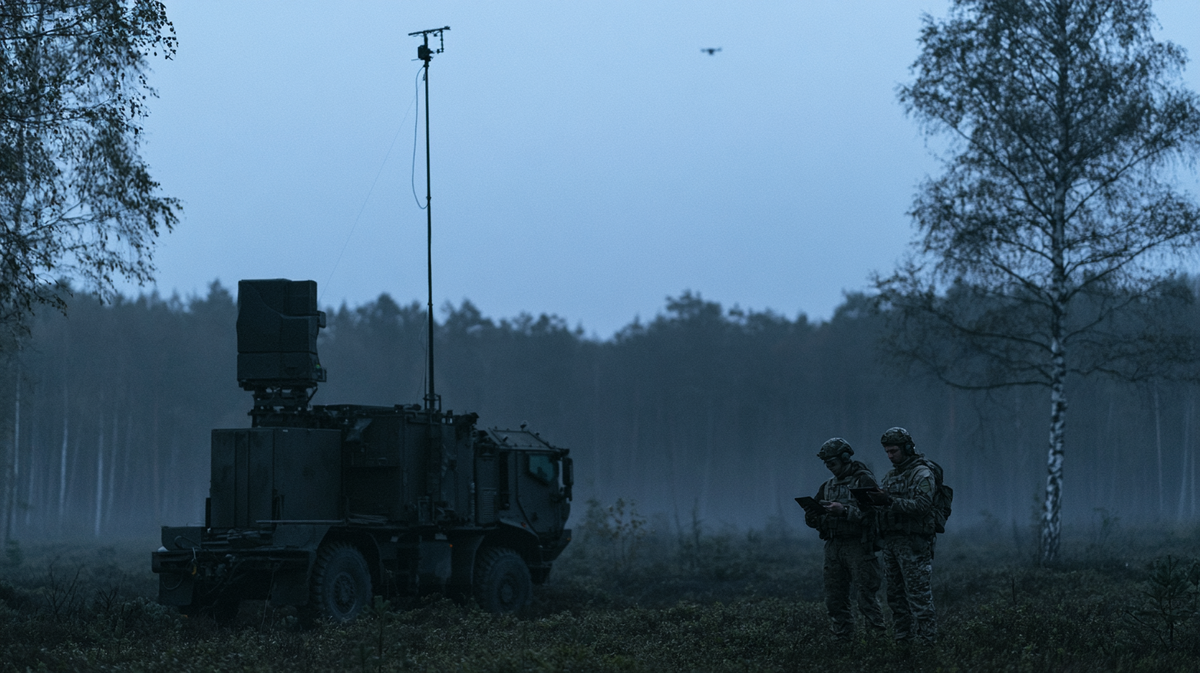
A mobile counter-drone radar unit monitors airspace near a NATO eastern border. Illustrative image / AdriaDefenseHow much is being spent on the Baltic Drone Wall specifically? Preliminary estimates put the drone wall segment covering Poland, Lithuania, Latvia, and Estonia at approximately 1 billion euros, separate from the far larger SAFE-funded rearmament packages each country is pursuing, which total roughly 12.2 billion euros across the three Baltic states alone.
When will these systems be operational? The EU's EDDI initiative targets initial operational capability by the end of 2026 and full functionality by the end of 2027. The broader Eastern Flank Watch program is not expected to reach full functionality until the end of 2028.