Nigeria Seeks Czech Ammunition Production and UAV Technology Transfer
Nigeria is seeking Czech support for a new DICON ammunition production line and UAV technology transfer as the two countries deepen defense-industrial cooperation.

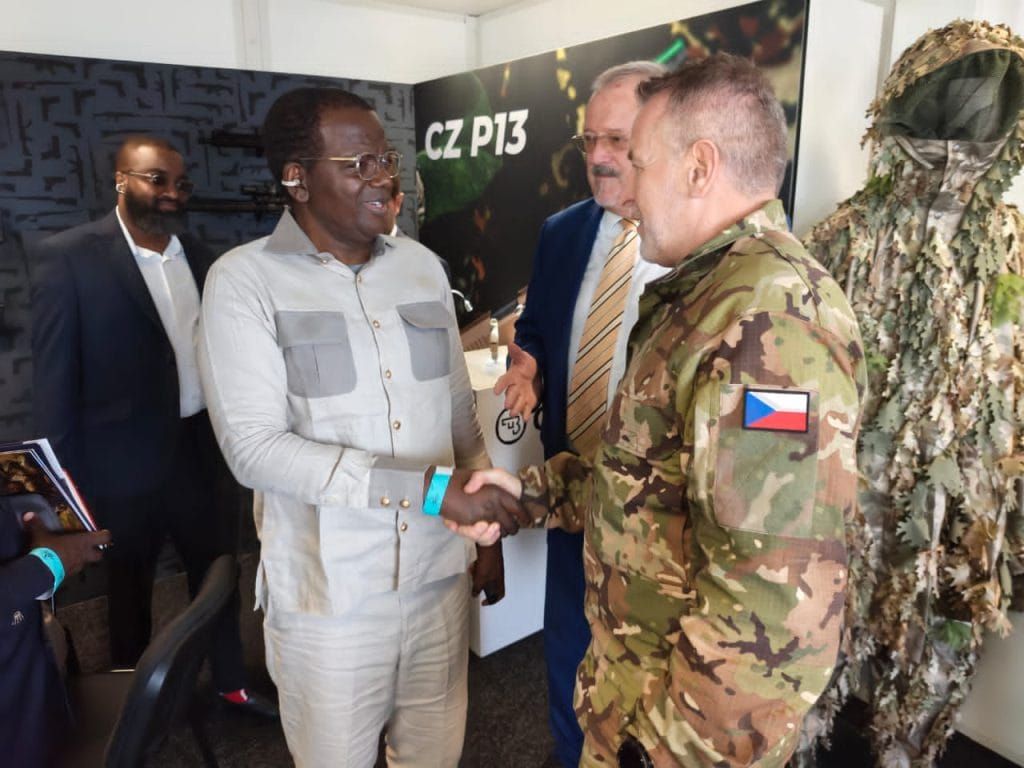
Nigeria is seeking Czech support to establish a new ammunition production line and transfer unmanned aerial vehicle technology as Abuja moves to expand domestic defense manufacturing and deepen an established security relationship with Prague.
Nigeria has opened discussions with the Czech Republic over an ammunition production line for the state-owned Defence Industries Corporation of Nigeria, or DICON, alongside potential technology transfer in unmanned aerial vehicles and other military systems.
The discussions took place during a three-day Czech visit led by Nigerian Minister of State for Defence Bello Muhammed Matawalle, whose delegation included officials from the Ministry of Defence, DICON and the National Agency for Science and Engineering Infrastructure, NASENI.
Matawalle met Jaromír Zůna, the Czech Republic's Deputy Prime Minister and Minister of Defence, during the visit. Zůna has served as defense minister since December 2025 following a career that included senior positions in the Czech Armed Forces and NATO.
According to Nigeria's Federal Ministry of Information and National Orientation, Matawalle specifically called for Czech cooperation with DICON to establish an ammunition production line in Nigeria. The two ministers also discussed technology transfer, with UAVs identified as a particular area of interest.
The Czech side expressed its readiness to cooperate with Nigeria in strengthening DICON's production capabilities, including technology transfer. However, neither government announced a contract, financial value, production capacity, ammunition caliber, specific UAV system or Czech industrial partner for the proposed projects.
That distinction is significant. The talks represent an effort to establish industrial cooperation, rather than a confirmed ammunition or UAV procurement program.
Nigerian Delegation Examines Skyfox and L-410NG
The discussions coincided with the NATO Days in Ostrava & Czech Air Force Days, held at Leoš Janáček Ostrava Airport on September 19 and 20. The event brought together Czech and international military units and defense companies for static and flying demonstrations.
During the visit, Matawalle's delegation inspected Czech aerospace and defense products including the Aero Vodochody L-39 Skyfox and the Aircraft Industries L-410NG, according to Voice of Nigeria.
The delegation also visited displays involving Colt CZ Group and MESIT, with discussions covering small arms, ammunition, tactical communications and other defense technologies. Matawalle subsequently met senior Czech military leaders, including Chief of the General Staff Lieutenant General Miroslav Hlaváč, Land Forces Commander Major General Josef Trojánek, and Air Force Commander Brigadier General Petr Tománek. Their current positions are independently confirmed by the Czech Ministry of Defence.
Those meetings covered training, maintenance and potential access to more advanced military systems, according to the Nigerian report. No procurement agreement emerged from the meetings.
Skyfox Interest Builds on a Long-Standing Aviation Relationship
The L-39 Skyfox appearance is particularly relevant because Nigeria already has a long-standing relationship with Aero Vodochody.
The Nigerian Air Force has operated Czech-built L-39 aircraft since the 1980s. In 2020, Aero Vodochody worked with Nigerian Air Force engineers and technicians on the in-country reactivation and life-extension of L-39ZA aircraft at the 403 Flying Training School in Kano.
In November 2024, the Nigerian Air Force disclosed that Aero had submitted proposals covering reactivation, upgrades and the potential acquisition of the L-39 Next Generation. That aircraft has since adopted the commercial name L-39 Skyfox.
Aero describes the current Skyfox as a subsonic jet trainer and tactical aircraft capable of advanced flight and tactical training, reconnaissance, air patrol and light-attack missions.
The dialogue continued in December 2025, when the Nigerian Air Force hosted a Czech delegation including Aero Vodochody. Discussions then covered the future of Nigeria's L-39 fleet, the L-410NG, surveillance technologies, UAV solutions for border security and specialized training.
The September 2026 inspection of the Skyfox and L-410NG therefore continues an existing series of discussions rather than marking the beginning of a new relationship.
Nigeria Pushes for More Domestic Defense Production
The ammunition and UAV discussions also fit into a broader Nigerian effort to shift more defense production inside the country.
Nigeria adopted a new DICON Act in 2023, expanding the corporation's authority to operate ordnance factories and establishing a broader framework for domestic defense manufacturing, research and private-sector participation. The legislation also created the Defence Industry Technology, Research and Development Institute.
DICON says its existing portfolio includes small arms and ammunition, while the organization has pursued a series of partnerships intended to expand local production of ammunition, weapons, drones, vehicles and other equipment.
The organization has historical experience in ammunition manufacturing. Its original Kaduna ordnance facilities were established in the 1960s with technical assistance from West German manufacturer Fritz Werner and were designed to produce rifles, submachine guns and millions of rounds of ammunition annually. Those historical capacities should not, however, be treated as an indication of DICON's current output.
Nigeria and the Czech Republic have also been intensifying defense-industry contacts. In August 2025, the first official Czech defense-industry mission to Nigeria in nine years brought representatives of 13 Czech companies to Abuja. Czech diplomatic reporting identified UAVs, aircraft, border-surveillance systems, military electronics, vehicles, training, maintenance and technology transfer among Nigeria's areas of interest.
The latest talks move that relationship further toward local industrial capacity. But for now, the proposed ammunition line and UAV technology transfer remain areas under discussion rather than concluded industrial agreements.