PBS GROUP Produces 2,000th TJ100 Turbojet Engine
Czech PBS GROUP has produced its 2,000th TJ100 turbojet as it expands output of small engines used across UAV, target drone and defense applications.

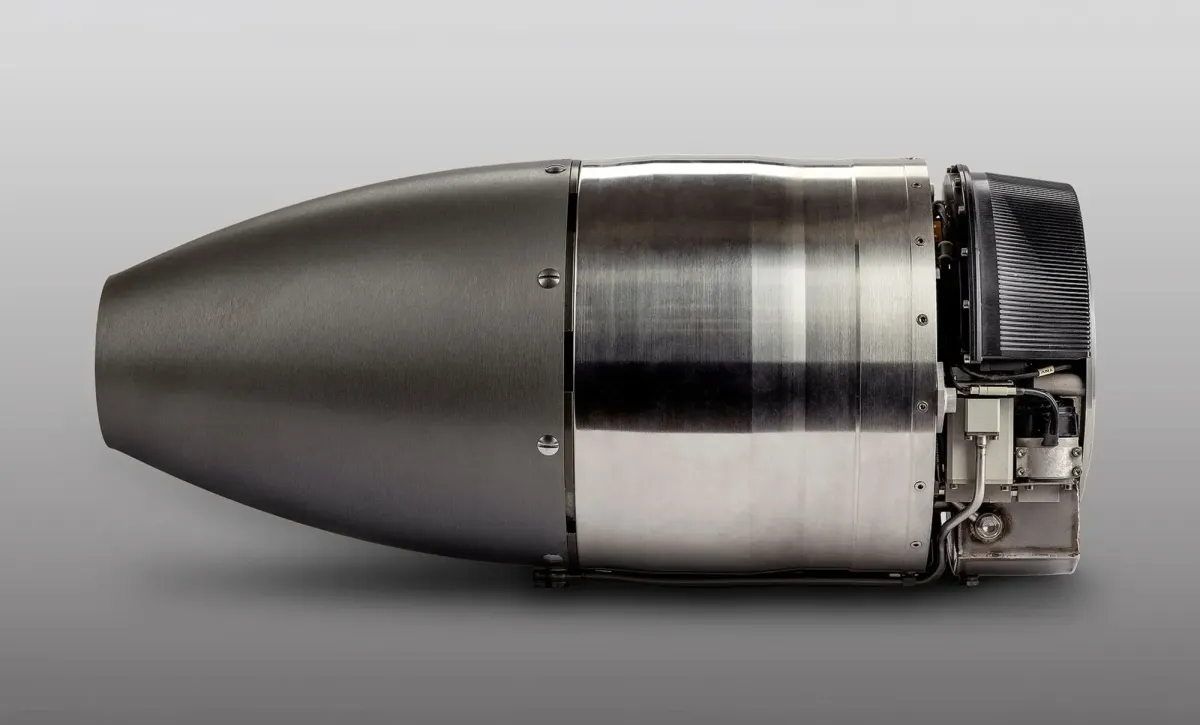
Czech aerospace manufacturer PBS GROUP has produced its 2,000th PBS TJ100 turbojet engine, reaching a production milestone for one of the company's longest-running small turbine engine families. PBS announced the milestone on April 8, 2026, as it continues expanding production capacity for propulsion systems used across unmanned aircraft, target drones and other aerospace applications.
The TJ100 entered serial production in 2008 after PBS began development of its own turbojet engines in 2003. Production of the family has accelerated as demand for compact propulsion systems has increased, with the company reaching its latest milestone less than two decades after serial manufacturing began.
TJ100A-125 delivers 1,250 N of thrust
The current PBS TJ100A-125 provides maximum thrust of 1,250 N while retaining the compact dimensions required for integration into small aircraft and unmanned systems.
The engine has an outer diameter of 272 mm, a length of 625 mm and a dry weight of 19.6 kg, according to PBS technical data. Maximum operating speed reaches Mach 0.9, while the specified maximum operating altitude is 9,000 meters.
The TJ100 incorporates a Full Authority Digital Engine Control system, or FADEC, and an integrated starter-generator. PBS also offers different configurations depending on customer and platform requirements.
The engine family can operate on several fuel types, including Jet A, Jet A-1 and JP-8. This flexibility supports integration across both civil and defense aerospace applications.
TJ100 family expands toward expendable systems
PBS has continued developing the TJ100 architecture rather than treating the engine as a fixed design.
One of the newer derivatives is the PBS TJ100P, which uses fuel-lubricated bearings and therefore eliminates the need for a conventional separate oil lubrication system. The configuration reduces system complexity and is designed for applications where compact installation and simplified operation are priorities.
PBS identifies the TJ100P as suitable for single-use systems in addition to other applications. That places the derivative in a propulsion segment relevant to expendable unmanned aircraft and other defense systems where engine service life requirements differ substantially from reusable aircraft.
The manufacturer has not publicly identified all platforms or customers using TJ100-family engines, and specific military integrations are often not disclosed.
PBS lists broader applications for its small turbojet portfolio that include unmanned aerial vehicles, target drones and other specialized aircraft.
PBS scales production as demand for small jet engines grows
The 2,000th TJ100 milestone comes during a broader increase in PBS GROUP's engine manufacturing output.
The company produced approximately 1,700 jet engines in 2025, more than twice its production volume in the previous year. PBS has been investing in additional manufacturing capacity at its main aerospace operation in Velká Bíteš while simultaneously expanding production outside the Czech Republic. (pbs.cz)
That expansion reflects a wider change in demand for compact turbine propulsion. Small turbojet engines have become increasingly relevant to high-speed unmanned aircraft, target drones, interceptors and missile-class systems.
PBS is responding by expanding both its production capacity and its engine portfolio.
At the higher end of that portfolio, the company introduced the PBS TJ200 in 2025. The engine delivers 2,280 N of continuous thrust and up to 2,700 N for 30 seconds, moving PBS beyond the thrust class covered by the TJ100 and TJ150 families.
The company has also expanded manufacturing in the United States, adding another production base alongside its Czech operations.
TJ100 shows how PBS built its small turbojet business
The TJ100 milestone also illustrates the development of PBS from a broader aerospace engineering company into a significant producer of compact turbine engines.
PBS began its own turbojet development program in 2003. The TJ100 subsequently became an important part of the company's propulsion portfolio and entered serial production in 2008.
Reaching 2,000 units gives the TJ100 family a substantial production history compared with newer PBS engines.
The milestone is also relevant to the company's current expansion. PBS can use manufacturing experience accumulated through the TJ100 program as it scales production of newer engines and pursues customers in Europe, the United States and other markets.
The next phase will depend on how quickly demand develops for the newer TJ100 derivatives and higher-thrust engines. PBS has not disclosed an annual production target specifically for the TJ100 family.
PBS TJ100: key questions
How many PBS TJ100 engines have been produced?
PBS GROUP announced on April 8, 2026, that it had produced its 2,000th TJ100 turbojet engine. The engine family has been in serial production since 2008.
How much thrust does the PBS TJ100 produce?
The current PBS TJ100A-125 produces maximum thrust of 1,250 N. The engine weighs 19.6 kg and has an outer diameter of 272 mm.
What is the PBS TJ100 used for?
The TJ100 family can power unmanned aerial vehicles and other specialized aircraft, while PBS also markets variants for defense-related applications. The TJ100P configuration is designed to support applications including single-use systems.
Where are PBS TJ100 engines produced?
PBS GROUP's primary aerospace manufacturing operation is located in Velká Bíteš, Czech Republic, where the company develops and manufactures its small turbine engines.