Romania, US Signal Stronger Black Sea Military Presence
Romania and US lawmakers discussed Black Sea security and military cooperation as Bucharest said there is no signal of a US troop withdrawal.


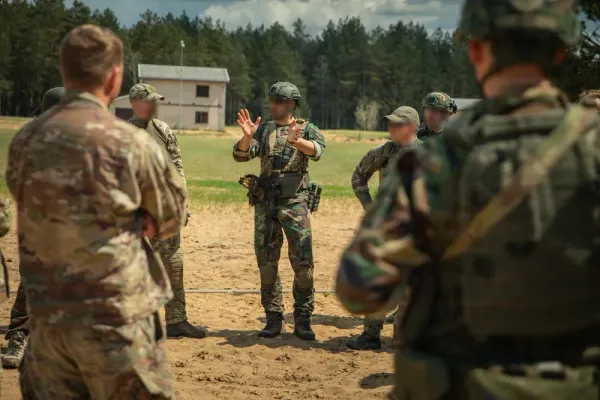
Romania and the United States have put the future of the American military presence on the Black Sea back in focus after senior US lawmakers visited two Romanian air bases on August 30. President Nicușor Dan said expanding the US military presence in Romania remains a priority, while Defense Minister Radu Miruță said Bucharest has received no indication that American troops will leave the country.
The meetings come as the United States reassesses its wider military posture in Europe and European NATO members assume a larger share of the continent's defense burden. Romania, meanwhile, is expanding Mihail Kogălniceanu Air Base into a regional NATO hub capable of supporting significantly larger Romanian and allied deployments.
US lawmakers visit Romania's main Black Sea air base
Dan met US Representatives Mike Rogers and Eric Sorensen at the Romanian Air Force's 57th Air Base Mihail Kogălniceanu on August 30. Rogers chairs the United States House Armed Services Committee, while Sorensen serves on the committee.
According to the Romanian presidency, the talks focused on the strategic importance of the Black Sea for transatlantic security and the need to strengthen collective deterrence and resilience. Dan also indicated that Romania was prepared to assume greater responsibility for its own defense by increasing and meeting its commitments.
The two sides also reviewed cooperation in the defense industry, energy, infrastructure, critical minerals and emerging technologies.
Dan identified strengthening and expanding the US economic and military presence in Romania as a priority for the bilateral relationship, Black Sea security and NATO cohesion.
Romania sees no signal of US troop withdrawal
The timing gives the congressional visit additional significance because Washington has been reassessing the distribution of US forces across Europe.
Miruță said on August 30 that Romania's Ministry of National Defense had received no indication that US forces would withdraw from the country. He also disclosed that up to 400 additional US military personnel had arrived several months earlier alongside additional capabilities.
Those deployments followed approval by Romania's Supreme Council of National Defense for additional US personnel, aerial refueling aircraft and surveillance equipment. Romanian reporting in March indicated that the deployment involved approximately 400 to 500 personnel and would use more than one Romanian air base.
The additional forces are notable against the longer-term evolution of the US footprint in Romania. Romanian defense officials said in April 2025 that more than 1,700 US troops were deployed in the country, principally at Mihail Kogălniceanu, Deveselu and Câmpia Turzii.
The US presence in Romania is largely rotational rather than based on the permanent stationing model used at major American installations in Germany and Italy.
Mihail Kogălniceanu is becoming a larger NATO hub
Romania is simultaneously making a long-term infrastructure investment that could increase the military importance of its Black Sea coast regardless of fluctuations in individual US rotations.
The Romanian government is investing more than €2.5 billion in the modernization and expansion of Mihail Kogălniceanu. The Romanian Ministry of National Defense has said the project is structured across four stages over 20 years and will eventually allow the base to accommodate up to 10,000 Romanian and allied military personnel.
The expanded installation is intended to support a wider range of air and ground operations and provide the infrastructure required for larger allied deployments on NATO's southeastern flank.
Its location near Constanța gives allied forces access to the western Black Sea region while placing the installation close to Ukraine and NATO members Bulgaria and Turkey.
The August 30 congressional delegation also visited the Romanian Air Force's 86th Air Base at Borcea. Romanian officials presented the base and its role in F-16 operations and training, including the European F-16 Training Center established to train Romanian and Ukrainian pilots.
Black Sea security keeps Romania central to NATO's southeastern flank
Romania's strategic value has increased since Russia's full-scale invasion of Ukraine in February 2022. The country borders Ukraine, hosts the US-operated Aegis Ashore ballistic missile defense installation at Deveselu and provides territory for NATO air policing and rotational allied deployments.
The Black Sea security environment also continues to affect Romanian air-defense operations directly. Russian attacks against Ukrainian infrastructure near the Danube have repeatedly prompted Romanian and allied aircraft to monitor targets approaching NATO airspace.
Against that background, the August 30 meetings point to continuity rather than an announced change in US force posture. Neither the Romanian presidency nor the defense ministry announced a new permanent US deployment or a new basing agreement.
The more significant development is the combination of Romania's infrastructure spending, the additional US personnel deployed in 2026 and Bucharest's effort to preserve an American military presence while assuming a larger national defense burden.
For NATO, Mihail Kogălniceanu increasingly provides infrastructure that can support that model: a Romanian-funded base designed to host larger allied forces when the security environment requires them.
Q&A: US military presence in Romania
Is the United States withdrawing troops from Romania?
Romania's defense ministry had received no indication as of August 30, 2026 that US troops would withdraw from the country, according to Defense Minister Radu Miruță. He said additional US personnel had instead arrived in Romania several months earlier.
How many additional US troops were sent to Romania in 2026?
Miruță said up to 400 additional US military personnel arrived in Romania. Earlier Romanian reporting connected the deployment with US aerial refueling and surveillance capabilities approved by the Supreme Council of National Defense.
How large will Mihail Kogălniceanu Air Base become?
Romania's defense ministry has said the expanded base will be able to accommodate up to 10,000 Romanian and allied military personnel. The Romanian government is investing more than €2.5 billion in the project over a four-stage, 20-year program.
Why is Mihail Kogălniceanu important to NATO?
The base sits near Romania's Black Sea coast and supports allied deployments on NATO's southeastern flank. Its location provides access to the Black Sea region and places NATO infrastructure close to Ukraine, Bulgaria and Turkey.