RSI Europe Plans €50M Drone and Defense Systems Plant in Lithuania
RSI Europe plans to invest up to €50 million in Panevėžys, expanding Lithuanian production of drone-related defense systems and components.

Lithuanian defense technology company RSI Europe plans to invest up to €50 million in a new production facility in Panevėžys district, expanding its ability to develop and manufacture defense systems and produce more components domestically. Lithuania's Ministry of the Economy and Innovation signed a large-scale investment project agreement with the company on September 17, with the project expected to create up to 40 new jobs.
The expansion will complement RSI Europe's existing production facility in Vilnius, which has annual capacity of approximately 120,000 drone systems. Company CEO Tomas Milašauskas told BNS that the Panevėžys investment is not expected to increase that overall production volume, but will allow RSI Europe to introduce additional system elements and bring more component production into Lithuania.
Panevėžys plant will expand domestic component production
The new facility is planned for Panevėžys district in northern Lithuania. Panevėžys District Municipality said the plant is expected to be completed by the end of 2027 and that a state-owned land plot has been reserved for the project.
RSI Europe currently imports components required for its defense systems from more than 40 countries, including suppliers in Europe and the United States. The municipality said development of the new facility is also linked to increasing the share of those components manufactured in Lithuania.
Milašauskas said during the investment agreement signing that construction is planned to begin in early 2027, with most of the work scheduled for completion by the end of that year. He described the investment as part of RSI Europe's transition from technology development toward industrial-scale production of defense systems.
The Ministry of the Economy and Innovation expects the project to create up to 40 jobs, with around 35% allocated to highly skilled engineering and technical specialists. The ministry also expects the capital-intensive manufacturing project to generate opportunities for Lithuanian suppliers and engineering companies in Panevėžys and the surrounding region.
BNS separately reported that Milašauskas had discussed a workforce of up to 50 employees at the planned plant, with most expected to be highly skilled. For the formal investment project, however, the ministry's agreement specifies an expected total of up to 40 new jobs.
RSI Europe says overall output will remain near 120,000 systems
RSI Europe already operates a 1,500-square-meter production facility in Vilnius with annual capacity of approximately 120,000 drone systems. According to Milašauskas, the Panevėžys expansion is not intended to raise that overall production figure but to add system elements that the company does not currently manufacture internally.
That distinction makes the investment broader than an expansion of final drone assembly. Panevėžys District Municipality said the facility will support production of drones and other advanced defense systems while increasing the share of required components produced inside Lithuania.
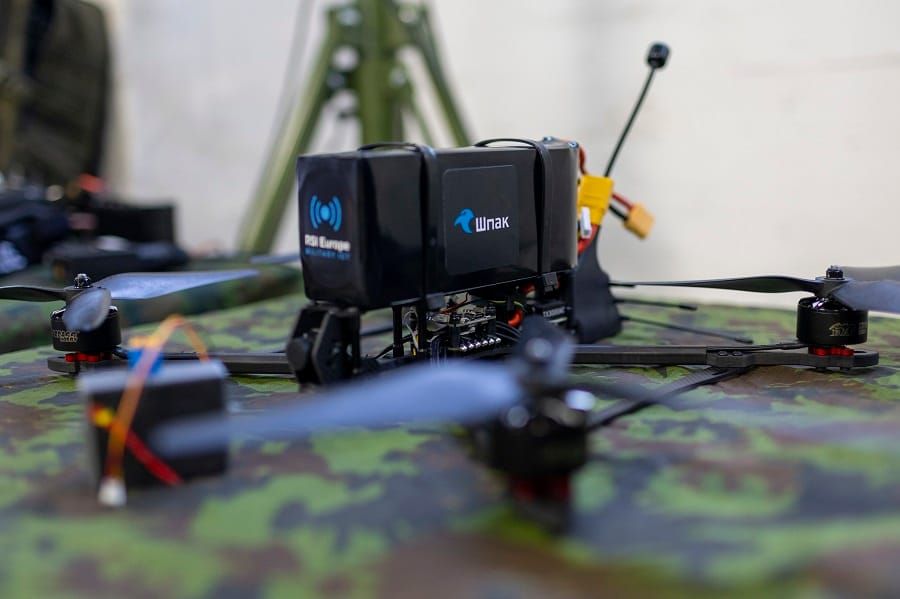
RSI Europe was founded in 2022 and develops defense systems including the Shpak first-person-view drone family and RISE-1 remote initiation system. The company's official product portfolio also includes electronic components, training systems and related equipment.
Milašauskas said in March that armed forces in 12 NATO countries had either acquired RSI Europe Shpak drone systems or its remote initiation systems. He also said approximately 80% of the company's drone production was being delivered to Ukraine. Those figures are company statements reported by BNS rather than procurement totals independently disclosed by the respective armed forces.
RSI Europe recorded €15.5 million in revenue in 2025, double the previous year's figure, while net profit reached €3.5 million, according to Lithuanian Register of Legal Entities data cited by BNS. The company expected revenue to increase by at least three to four times in 2026.
Lithuania investment follows RSI Europe's U.S. market push
The Panevėžys investment follows RSI Europe's move to pursue opportunities in the U.S. defense market.
In May 2026, Maryland-based WGS Systems and RSI Europe announced a strategic teaming arrangement covering RSI Europe's unmanned aircraft systems. Under the agreement, WGS Systems will integrate National Defense Authorization Act-compliant variants of RSI systems and offer them through U.S. defense tenders.
Initial efforts are focused on Group 1 first-person-view drone capabilities for the U.S. Army, Navy and Marine Corps, among other potential customers. WGS Systems is serving as the U.S. integration and delivery partner for NDAA-compliant configurations of RSI Europe's Shpak family of FPV strike drones.
The agreement represents a route to compete for U.S. defense requirements rather than confirmation of a U.S. military procurement contract.
Lithuania is expanding regional defense manufacturing
RSI Europe's project is the tenth large-scale investment project agreement signed by Lithuania's Ministry of the Economy and Innovation in 2026. Before the RSI Europe agreement, the ministry had concluded 31 large-scale investment agreements representing planned investment of €2.456 billion and 6,465 new jobs.
The Panevėžys project also supports Lithuania's policy of directing more investment outside the country's largest urban centers. The government has set a target of attracting at least 30% of new investment to Lithuania's regions by 2030.
For RSI Europe, the investment adds another stage to a production structure that has expanded rapidly since the company was established in 2022. The main industrial change in Panevėžys is not a declared increase beyond the existing annual output of approximately 120,000 drone systems, but a move toward producing a broader range of defense system elements and components inside Lithuania.
Construction progress and further disclosure of the components and systems assigned to the Panevėžys facility will determine how much of RSI Europe's current international supply chain can ultimately be transferred to domestic production.
Questions about RSI Europe's Lithuania investment
How much will RSI Europe invest in Panevėžys?
RSI Europe plans to invest up to €50 million in the project. The company signed a large-scale investment project agreement with Lithuania's Ministry of the Economy and Innovation on September 17, 2026.
What will RSI Europe produce at the new facility?
The Panevėžys facility will develop and manufacture defense systems and support greater domestic production of components currently sourced internationally. RSI Europe imports components from more than 40 countries, including suppliers in Europe and the United States. The company has not publicly provided a complete list of the systems and components that will be assigned to the new plant.
Will the new factory increase RSI Europe's drone output?
Not according to the company's current plan. RSI Europe's Vilnius facility has annual capacity of approximately 120,000 drone systems, and CEO Tomas Milašauskas told BNS that the Panevėžys capacity would not increase the overall production volume but would enable additional system elements to be introduced.
When will the Panevėžys factory open?
RSI Europe plans to begin construction in early 2027 and complete most of the work by the end of 2027, according to Milašauskas. Panevėžys District Municipality separately states that the factory is planned for completion by the end of 2027.