Austria's €2.5B Air Defense Race: Who Can Challenge IRIS-T?
Austria plans a €2.5 billion medium-range air defense purchase. IRIS-T has an early advantage, but at least six suppliers may fit the requirement.

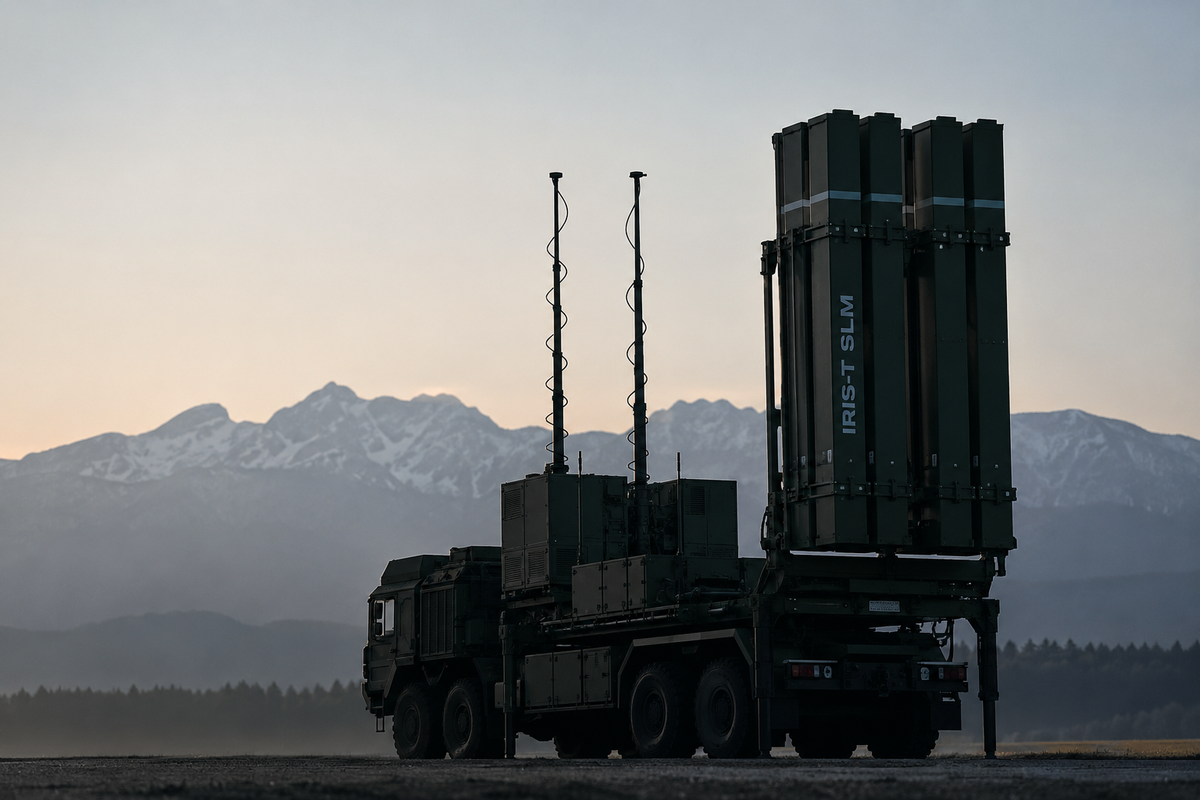
Austria plans to select a new medium-range ground-based air defense system by the end of 2026, with approximately €2.5 billion allocated for two batteries, training and logistics. Diehl Defence's IRIS-T SLM enters the decision with substantial institutional momentum, but Austrian officials maintain that no type has been selected and have indicated that around six suppliers remain possible.
The distinction matters. Public reporting has identified IRIS-T SLM, CAMM-ER, VL MICA, NASAMS, SPYDER and SAMP/T among systems that could meet all or part of Austria's requirement, while Barak MX has also appeared in Austrian reporting as a possible alternative. These names should not be interpreted as a formal Ministry of Defense shortlist or as confirmation that every manufacturer has submitted a bid.
For Austria, the procurement will fill a capability gap between its shorter-range defenses and a potential future layer beyond 50 kilometers. Defense Minister Klaudia Tanner told parliament in July that the ministry hoped to sign the medium-range air defense contract before the end of 2026, with one battery planned at each of two locations. Capabilities beyond 50 kilometers would require separate legislative funding authorization.
IRIS-T entered Austria's plans years before the 2026 decision
IRIS-T SLM starts from a position none of the publicly discussed alternatives can currently match.
Austria announced plans in September 2023 to acquire Diehl Defence's IRIS-T family through cooperation with Germany. The plan discussed at the time covered four IRIS-T SLS short-range fire units and four IRIS-T SLM medium-range fire units, with three launchers per unit. Those statements remain part of the public record even though Austria subsequently stressed that a final type decision had not been made.
Austria also joined the German-led European Sky Shield Initiative, or ESSI. In April 2026, Tanner described integration into European structures through ESSI as the most appropriate option from both military and economic perspectives and said the necessary procurement steps would begin during 2026.
There is another significant link. Austria's Ministry of Defense is listed alongside Germany, Slovenia, Bulgaria, Estonia and Latvia in the European Union-backed Joint Air Missile Defence Initiative in Europe, or JAMIE. The European Commission describes JAMIE as a project supporting the joint procurement of interoperable IRIS-T SLM systems.
None of those facts constitutes a final Austrian contract award. Together, however, they explain why IRIS-T SLM can reasonably be treated as the system with the strongest documented position going into the decision.
Diehl currently lists an effective range of up to 60 kilometers and altitude coverage of 20 kilometers for the latest IRIS-T SLM configuration. Austria has defined its immediate medium-range requirement around engagements out to approximately 50 kilometers.
Previous AdriaDefense comparison of IRIS-T, NASAMS, Patriot and SAMP/T: AdriaDefense NATO air defense systems guide
Austria says the type decision remains open
IRIS-T's earlier political visibility has also attracted scrutiny inside Austria.
The independent Beschaffungs-Prüfkommission, which reviews Austrian Armed Forces procurement, raised concerns in its 2024 annual report about procurement processes in which political decisions or international agreements preceded parts of the formal procurement assessment. For medium-range air defense, the commission concluded that earlier public statements and a memorandum of understanding could have had the practical effect of limiting competition to a specific product.
The commission explicitly stopped short of concluding that an unlawful procurement procedure had occurred. Its criticism centered on sequencing, competition and the need to involve procurement-law specialists earlier in major acquisition decisions.
The Austrian Ministry of Defense disputes the suggestion that IRIS-T was predetermined. In its response, the ministry said the ESSI memorandum did not instruct Austria to buy IRIS-T, preserved freedom of type selection and did not represent a final decision by the ministry. A ministry expert subsequently told parliament in November 2025 that around six suppliers could still be considered.
For AD, that makes the legally and factually supportable conclusion narrower than saying Austria has already chosen IRIS-T. The available record shows that IRIS-T has substantial institutional and procurement momentum, while the Austrian government continues to describe the selection as open.
CAMM-ER and VL MICA give MBDA two possible routes
MBDA potentially enters the Austrian requirement with more than one system.
CAMM-ER forms the medium-range element of the Enhanced Modular Air Defence Solutions architecture. MBDA states that the interceptor has an engagement range exceeding 40 kilometers and can operate independently or as part of a wider air defense network.
That places CAMM-ER within the broad performance category Austria is seeking. Austrian newspaper Kurier identified it among the systems relevant to the defense ministry's evaluation, but neither Austria nor MBDA has publicly confirmed an Austrian CAMM-ER bid in the sources reviewed by AD.
VL MICA NG provides MBDA with another option. The company says its latest ground-based MICA variant can intercept targets beyond 40 kilometers, roughly double the reach of the preceding generation, and that MICA NG entered series production availability in 2026.
Kurier also identified MICA among the systems potentially relevant to Austria. Again, that establishes it as a publicly discussed option rather than a confirmed bidder.
NASAMS offers an established alternative architecture
Kongsberg Defence & Aerospace's National Advanced Surface-to-Air Missile System, developed with RTX's Raytheon, represents another technically relevant option.
NASAMS uses a distributed architecture combining command posts, radars, electro-optical sensors and launchers. Its missile mix can include AIM-9X for shorter-range engagements, AIM-120 Advanced Medium-Range Air-to-Air Missile and AMRAAM Extended Range for a larger engagement envelope.
Kongsberg says AMRAAM Extended Range increases range by 50 percent and altitude by 70 percent compared with the AIM-120 AMRAAM C7. Kurier included NASAMS among the systems that could be considered for Austria's medium-range requirement.
NASAMS therefore fits the broad mission category, but there is no public evidence reviewed by AD showing that Austria has selected Kongsberg and Raytheon for negotiations or that the system occupies the same institutional position as IRIS-T.
Israeli systems could broaden the competition
Rafael Advanced Defense Systems' SPYDER also falls within the required performance envelope in some configurations.
Rafael lists a maximum range of 40 kilometers for the I-Derby ER missile in its SPYDER All-in-One configuration, alongside shorter-range I-Derby and Python 5 effectors. Kurier identified SPYDER among systems relevant to the Austrian evaluation.
Israel Aerospace Industries' Barak MX offers a wider family of interceptors. The manufacturer lists Barak SR at 15 kilometers, Barak MR at 35 kilometers, Barak LR at 70 kilometers and Barak ER at 150 kilometers. That modular structure could technically cover multiple layers, although AD has found no Austrian government confirmation that Barak MX is a formal contender in the current procurement.
The distinction between technical suitability and formal participation is important. Neither publicly available product specifications nor media references establish that an offer has been submitted.
SAMP/T NG appears oversized for Austria's immediate requirement
The Franco-Italian SAMP/T NG also appears in Austrian reporting, but its capabilities extend considerably beyond the immediate medium-range layer Austria has described.
Eurosam lists an engagement range exceeding 150 kilometers for the Aster-based SAMP/T NG architecture. Austria, by contrast, currently places the relevant procurement boundary around 50 kilometers and has said that a capability beyond that distance would require separate funding legislation.
That does not make SAMP/T NG impossible for Austria in the longer term. It does make direct comparison with IRIS-T SLM, CAMM-ER or similar medium-range systems less straightforward for this specific requirement.
Austria has separately acknowledged that the layer beyond 50 kilometers remains outside the existing Aufbauplan ÖBH 2032+ funding structure.
Industrial cooperation could influence Austria's final evaluation
The procurement will not be judged on missile range alone.
Austria's armaments director Harald Vodosek told Kurier that the government wants the best equipment combined with the strongest prospects for deeper cooperation with a partner country. Austrian officials have also emphasized potential industrial participation as the country increases defense spending.
That factor could favor European suppliers capable of tying an Austrian purchase to existing multinational procurement, training, maintenance and supply networks. It could also give competing manufacturers an opportunity to differentiate their proposals through Austrian industrial participation.
The first fire units are expected from 2029 if the program proceeds on schedule, according to Kurier. Austria plans to build the new medium-range capability around existing formations in Salzburg and Zeltweg, while full development of the wider ground-based air defense structure runs toward 2032.
For now, the safest assessment is that Austria still has a procurement decision to make. IRIS-T SLM has the clearest documented institutional path into the program, while CAMM-ER, VL MICA, NASAMS, SPYDER and other systems remain alternatives whose formal status is not publicly established.
Austria air defense procurement: key questions
Has Austria selected IRIS-T SLM?
No final Austrian type selection has been publicly announced. The Ministry of Defense has maintained that the choice remains open, although Austria previously announced plans involving IRIS-T and participates in European initiatives connected to joint IRIS-T SLM procurement.
How much is Austria planning to spend?
Approximately €2.5 billion is planned for two medium-range air defense batteries, including training and logistics, according to Defense Minister Klaudia Tanner's July 2026 parliamentary briefing.
Which systems could compete with IRIS-T SLM?
Austrian reporting has identified CAMM-ER, VL MICA, NASAMS, SPYDER and SAMP/T alongside IRIS-T among systems potentially relevant to the evaluation. These should be treated as publicly identified possible options, not as an official shortlist of confirmed bidders.
When could Austria sign the air defense contract?
The Austrian Ministry of Defense hopes to sign the medium-range air defense contract by the end of 2026. First deliveries have been reported as planned from 2029 if the program remains on schedule.