Austria’s Schiebel and Poland’s OSIRIS Test Drone Mothership Concept
Austria's Schiebel and Poland's OSIRIS have demonstrated the CAMCOPTER S-100 launching and supporting a smaller drone in flight, opening a potential path toward airborne counter-drone systems.

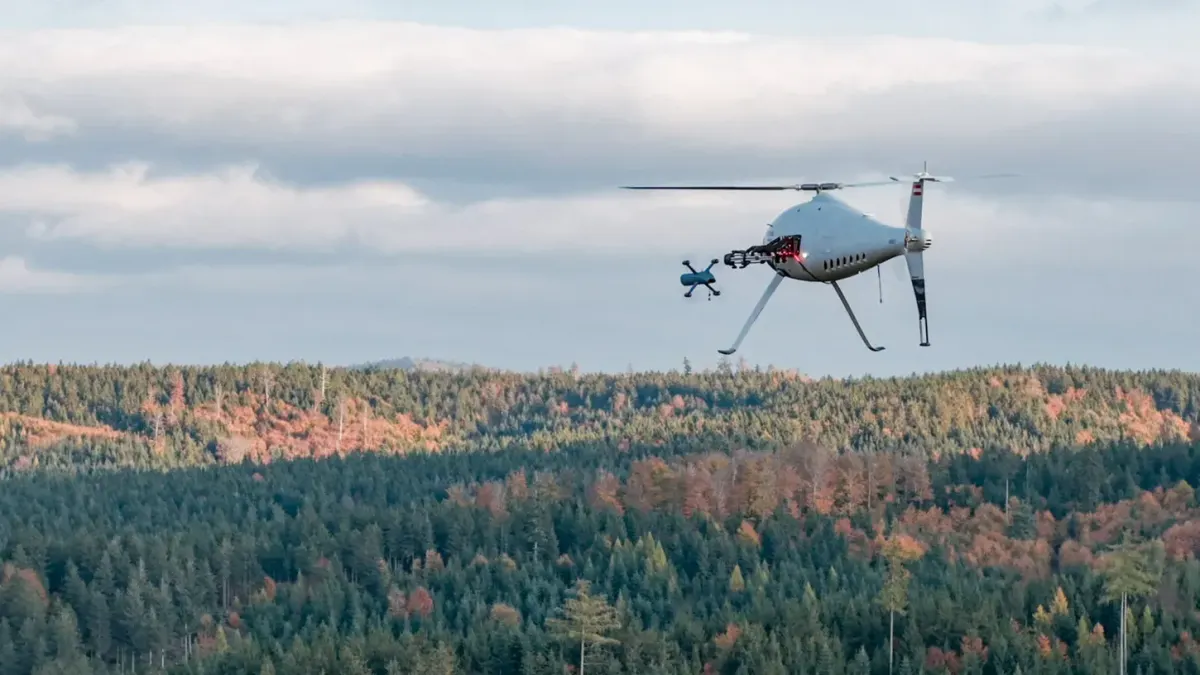
Austrian unmanned aircraft manufacturer Schiebel has successfully demonstrated a new capability for its CAMCOPTER S-100, allowing the unmanned helicopter to carry, deploy and support smaller drones during flight. The proof-of-concept demonstration, conducted in Austria with Polish company OSIRIS Poland, represents a step toward airborne drone launch platforms that could eventually support counter-drone operations and loitering munitions.
During the demonstration, the CAMCOPTER S-100 carried an OSIRIS HSCD-1 High-Speed Camera Drone and released it while flying forward. Following separation, the smaller aircraft continued operating through a communications connection relayed by the S-100, demonstrating that the larger helicopter could function both as a launch platform and as an airborne control and video relay.
The concept combines the endurance and operational range of Schiebel's unmanned helicopters with the speed and flexibility of smaller, specialized aircraft. Instead of launching a drone from a fixed ground position, operators could transport it closer to its intended mission area before deployment, potentially extending its effective operational reach while maintaining communications from the air.
Potential Applications in Counter-Drone Warfare
One potential application involves deploying high-speed interceptor drones against hostile unmanned aircraft. Airborne launch platforms could allow interceptors to reach operational areas without depending entirely on ground-based launch sites, an increasingly important consideration as European armed forces develop defenses against large-scale drone attacks.
The demonstration did not involve an armed interception. Schiebel used an inert test drone to validate the deployment and communications architecture, meaning further testing would be required before the concept could be considered an operational counter-UAS capability.
Hans Georg Schiebel, Chairman of the Schiebel Group, described the successful integration as evidence of the potential created by combining the CAMCOPTER platform with smaller, mission-specific unmanned systems.
According to the company, the architecture could also be adapted to other aircraft in its portfolio, including the CAMCOPTER S-300, S-101 and S-301, potentially creating a broader family of airborne carriers for smaller drones and loitering munitions.
For Schiebel and OSIRIS Poland, the demonstration highlights a direction in European unmanned systems development: integrating different classes of aircraft into coordinated operational networks rather than treating individual drones as standalone platforms. The next challenge will be proving how reliably such systems can operate under realistic military conditions, including contested communications environments.