Five European Loitering Munition Makers Enter Operational Trials in Portugal
Helsing, Destinus, Slovenia’s C-Astral, UAVision and Spirit Aeronautical Systems are moving into operational field testing as Europe seeks faster ways to evaluate emerging strike-drone capabilities.

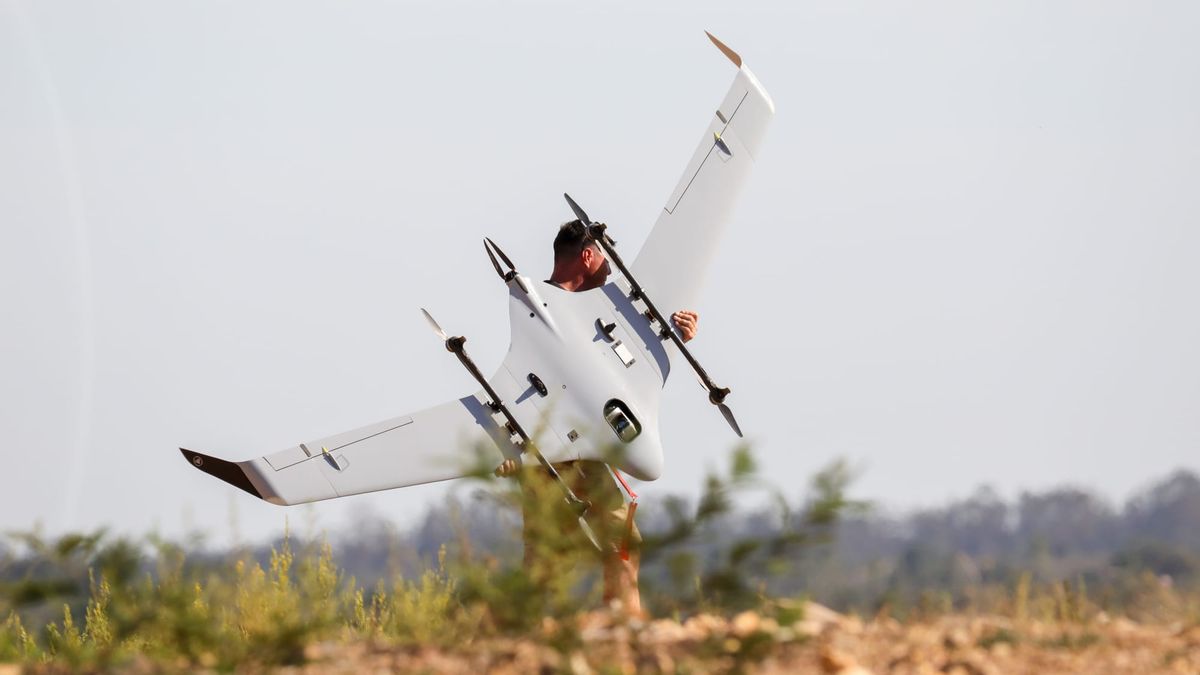
Five European defense companies are entering the operational testing phase of the European Defence Agency’s Sentinel Strike Challenge as a major defense experimentation campaign begins in Portugal.
Helsing of Germany, Destinus of the Netherlands, C-Astral of Slovenia, UAVision of Portugal and Greece’s Spirit Aeronautical Systems were selected from more than 140 expressions of interest to advance to the second stage of the competition.
Their loitering munition systems will now be evaluated at the Santa Margarida Military Training Area as part of EU OPEX 2026, the European Defence Agency’s flagship operational experimentation campaign.
EU OPEX begins on September 28 and brings together more than 40 companies, start-ups and innovation organizations, alongside more than 200 military personnel, technology developers, experts and end users from across Europe.
The campaign is organized jointly by the European Defence Agency and the Portuguese Army.
Testing loitering munitions under operational conditions
Unlike a conventional technology demonstration, Sentinel Strike is designed to compare complete loitering munition systems under common and operationally relevant conditions.
The five finalists will be assessed across the precision-strike mission cycle, including mission planning, deployment, launch, target detection and identification, tracking, engagement and post-strike assessment.
Eligible systems fall within the Class I aerial loitering munition category, with a maximum take-off mass of up to 25 kilograms and an operational range of up to 40 kilometers.
The European Defence Agency says testing will examine factors including performance, resilience, reliability, safety and operational suitability.
During EU OPEX, the technologies will face increasingly complex scenarios. The agency says loitering munition systems will, among other tasks, be required to engage multiple targets at night.
The wider exercise will also test unmanned aerial and ground systems, reconnaissance technologies, logistics applications and electronic communications in contested and degraded operating environments.
Cross-domain field experiments are scheduled for October 7 and 8, followed by a high-visibility event on October 14.
€1.8 million available in Stage 2
Each of the five Sentinel Strike finalists already received a €30,000 prize after completing the first stage.
They will now compete for a combined €1.8 million available during Stage 2.
Five additional companies reached the Stage 1 top ten: Denmark’s Renegade UxS and Robotto, Germany’s Cerberon Defence Systems, France’s Thales LAS and Greece’s ALTUS LSA. Each received €10,000 but did not advance to operational testing.
The overall Sentinel Strike prize budget is €2 million.
Importantly, the program is not a procurement competition and selection does not mean that any of the systems have been approved for acquisition.
Instead, the European Defence Agency is seeking comparable operational data that EU defense ministries can use in capability planning, requirement development and potential future cooperative programs.
Final Sentinel Strike winners are expected to be announced in early 2027.
Slovenian C-Astral among the finalists
The inclusion of Slovenia-based C-Astral gives Central and Southeastern Europe representation among a group that also includes some of Europe’s most closely watched defense technology companies.
C-Astral has developed unmanned aircraft systems for intelligence, surveillance and reconnaissance applications and has increasingly expanded its work around tactical unmanned and strike capabilities.
Its selection alongside Helsing and Destinus places the Slovenian company in a direct European field-evaluation environment where systems will be assessed under the same broad operational framework.
The approach reflects a wider shift in European defense innovation toward testing technologies with military users earlier in the development process rather than relying primarily on technical proposals and controlled demonstrations.
Recent conflicts have accelerated development cycles for loitering munitions and other unmanned strike systems, while electronic warfare and rapid battlefield adaptation can quickly expose limitations that are difficult to identify through laboratory testing alone.
For European defense ministries, EU OPEX and Sentinel Strike are intended to provide operational evidence before decisions are made on future capability development or procurement.