Greece to Sign €3 Billion Achilles Shield Deal With Israel
Greece and Israel are set to sign agreements for the €3 billion Achilles Shield air and missile defense network in Tel Aviv on August 31.

Greece and Israel are set to sign agreements on August 31 for the Achilles Shield, a nationwide multilayered air and missile defense network valued at more than €3 billion. The signing in Tel Aviv will move one of Greece's largest current defense programs from government approval toward implementation.
The agreements are expected between the General Directorate for Defense Investments and Armaments of the Greek Ministry of National Defense and SIBAT, the International Defense Cooperation Directorate of the Israeli Ministry of Defense. Israeli defense organizations and companies participating in the program are also expected to be involved.
Athens approved Achilles Shield through the Government Council for Foreign Affairs and Defense on July 23, 2026. Greek Defense Minister Nikos Dendias subsequently put the value of the air defense systems at slightly above €3 billion and said the complete system would become operational within 35 months, with deliveries taking place in stages.
Achilles Shield combines three Israeli air defense systems
The reported Achilles Shield configuration centers on three Israeli system families covering different layers of the air defense network. These are Rafael Advanced Defense Systems' SPYDER All-in-One and David's Sling, together with the BARAK MX system developed by Israel Aerospace Industries.
The final contractual configuration, including the precise number of batteries, launchers and interceptors, has not been publicly disclosed. Those details will remain important when assessing the actual scale and geographic coverage of the network.
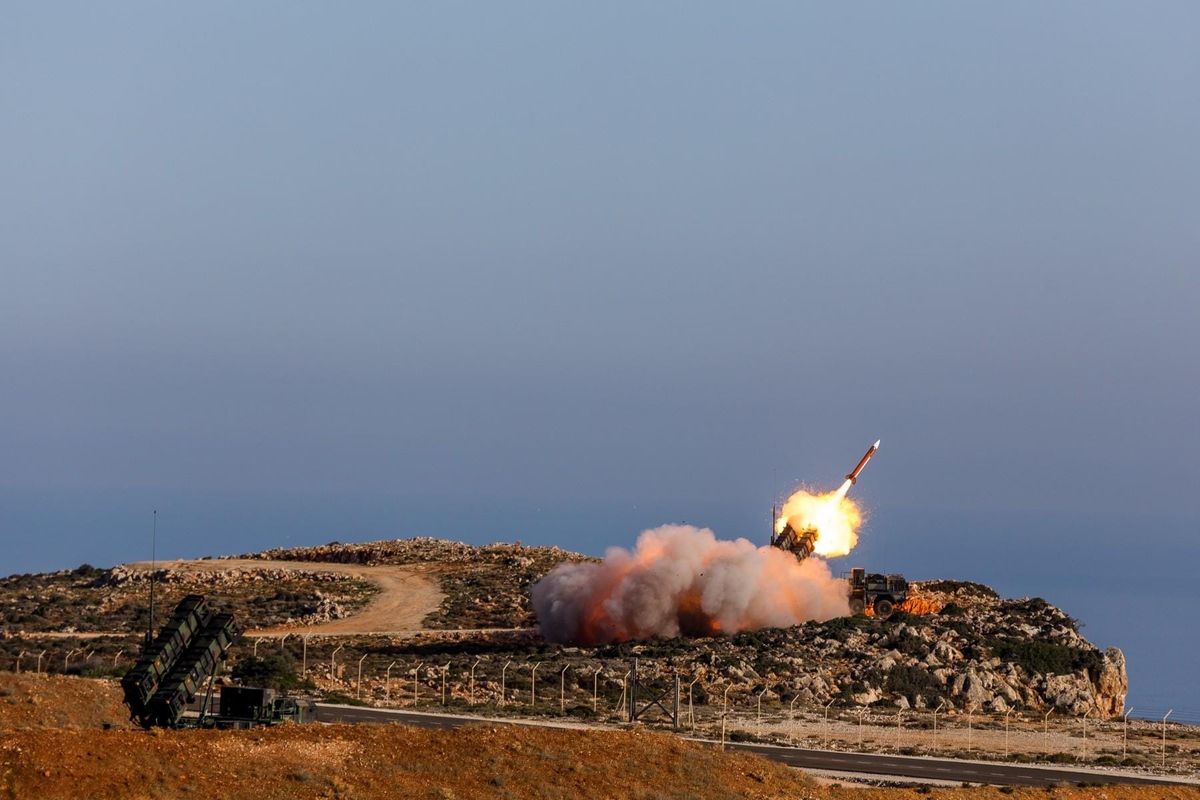
Rather than operating as independent missile batteries, the new systems are intended to form an integrated architecture connecting sensors, command-and-control infrastructure and different interceptors. Existing Greek assets, including Patriot systems and national sensors, are expected to remain part of the broader air defense structure.
The network is intended to address aircraft, unmanned aerial vehicles and ballistic missile threats. It will also allow Greece to progressively reduce reliance on older Russian-origin air defense equipment, including systems that have become increasingly difficult to sustain following Russia's invasion of Ukraine.
Greek industry secures 25% share of Achilles Shield
Industrial participation represents a significant component of the program. Greek defense sources reported that negotiations secured a 25% domestic industrial share, with Greek companies expected to receive work valued at more than €700 million.
The agreement also reportedly includes provisions for the transfer of source code. That element could give Greece greater control over integration and future development than a conventional off-the-shelf missile procurement, although the precise scope of the source-code access has not been publicly detailed.
Twelve Greek companies were previously reported as participating in the program. The domestic share matches Athens' broader policy of seeking at least 25% Greek industrial participation in major defense procurement programs.
Greece is replacing a fragmented Cold War air defense inventory
Achilles Shield forms part of Greece's wider Agenda 2030 military modernization program, under which Athens plans approximately €28 billion in defense investment through 2036. The country is simultaneously introducing F-35 fighters, new frigates, unmanned systems and transport aircraft.
Air defense presents a particular modernization challenge because the Hellenic Armed Forces operate equipment originating from multiple suppliers and technological generations. Greece currently fields U.S.-supplied Patriot systems alongside Russian-origin S-300, Tor-M1 and OSA-AK systems and other shorter-range assets.
The Israeli procurement therefore addresses both capability and sustainment requirements. SPYDER is expected to cover part of the short- and medium-range requirement, while BARAK MX and David's Sling would provide additional layers against more demanding aerial and missile threats.
The program also deepens an already substantial Greece-Israel defense relationship. The two countries conduct military exercises and cooperate in areas including flight training, unmanned systems, counter-drone technology and cybersecurity. Greece has also expanded its procurement of Israeli systems through separate programs, including a €650 million PULS rocket artillery acquisition.
For southeastern Europe, Achilles Shield will be one of the region's largest investments in integrated ground-based air and missile defense. Its implementation will also provide an indication of how Greece intends to combine new Israeli technology with existing NATO-standard systems rather than replacing its entire air defense inventory with a single supplier.
The August 31 signing should provide the next opportunity for Athens and Jerusalem to clarify the contractual structure, industrial workshare and potentially the final system configuration.
Achilles Shield: key questions
How much will Greece's Achilles Shield cost?
Greek authorities have placed the value of the air defense systems at slightly above €3 billion. Greek reporting has commonly put the overall figure at approximately €3.1 billion.
Which air defense systems will Greece acquire from Israel?
The reported configuration includes Rafael Advanced Defense Systems' SPYDER All-in-One and David's Sling and Israel Aerospace Industries' BARAK MX. Final quantities of batteries, launchers and interceptors have not been publicly confirmed.
When will Achilles Shield become operational?
Greek Defense Minister Nikos Dendias has said the overall program is expected to become operational within 35 months, with equipment delivered progressively rather than in a single batch.
Will Greek companies participate in Achilles Shield?
Yes. Greek defense sources report a 25% domestic industrial share, with more than €700 million in work expected for 12 Greek companies. The arrangements also reportedly include source-code transfer provisions.