Israel and Germany Sign 10-Year Space Agreement as Defense Firms Expand European Presence
Israel and Germany signed a ten-year space cooperation agreement as IAI, Elbit Systems, Rafael and other Israeli technology companies expanded their presence at Space Tech Expo Europe 2026.

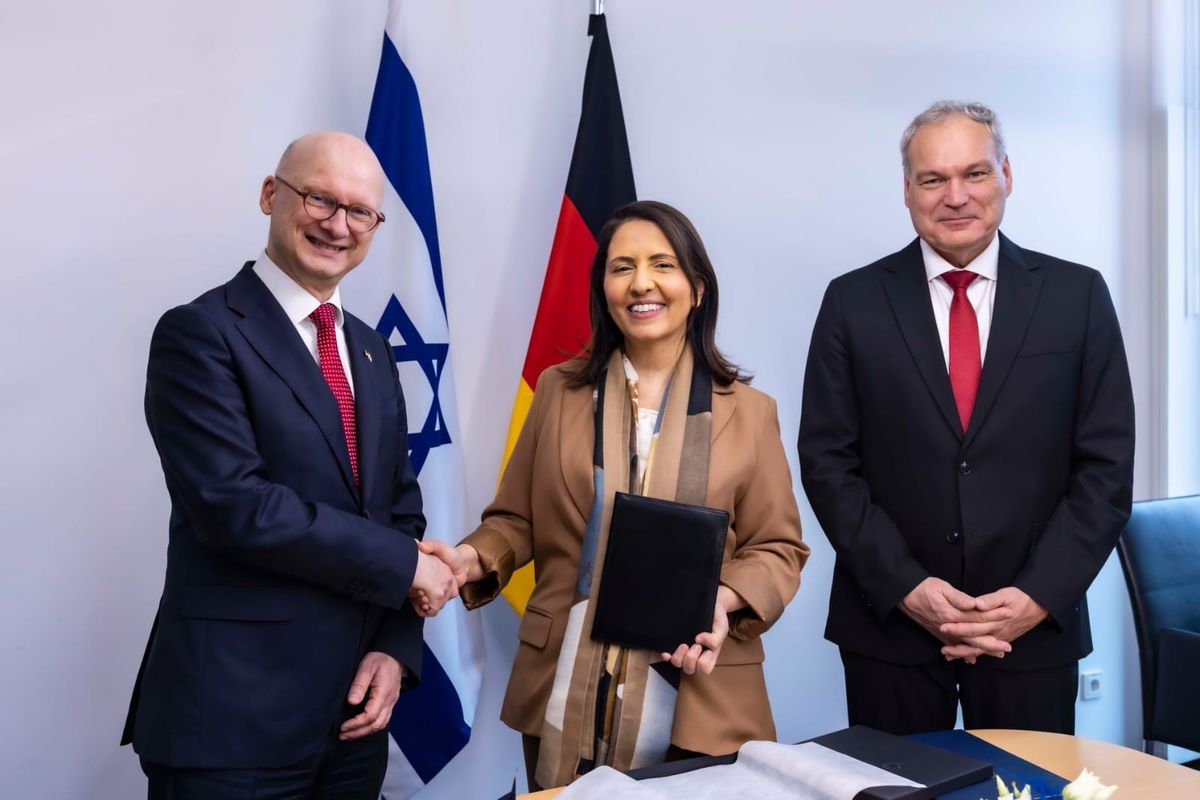
Israel and Germany have signed a ten-year strategic space cooperation agreement, establishing a long-term framework for scientific research and technological collaboration as Israeli aerospace and defense manufacturers increase their presence in Europe's space industry.
The agreement was signed in Berlin on November 19 by Israel's Minister of Innovation, Science and Technology, Gila Gamliel. It connects the Israel Space Agency with the German Space Agency at the German Aerospace Center (DLR), with the stated objective of advancing cooperation in the peaceful use of space.
The signing ceremony was attended by German State Secretary Dr. Marcus Pleyer, German Space Agency Director General Dr. Walther Pelzer and representatives of the Israeli Embassy.
The agreement is intended to support joint research and create opportunities for cooperation between academic institutions, technology developers and industrial companies in both countries. No specific defense procurement contracts or funding commitments were announced as part of the signing.
Israeli Defense Manufacturers Gather in Bremen
The agreement coincides with Israel's first national pavilion at Space Tech Expo Europe 2026, held in Bremen from November 17 to 19.
Approximately 110 representatives from 24 Israeli companies participated in the delegation, including three of the country's largest defense manufacturers: Israel Aerospace Industries (IAI), Elbit Systems and Rafael Advanced Defense Systems.
The Israeli pavilion was organized by the Israel Space Forum by Rakia in cooperation with the Israel Space Agency. Its purpose was to connect Israeli manufacturers and technology developers with European companies, research institutions and potential industrial partners.
The delegation included companies working on satellite communications, artificial intelligence, mission simulation and advanced space components.
Among the participating technology providers were NOVELSAT-AYECKA, which develops satellite communications solutions for civil and defense applications; HiSky, which specializes in satellite connectivity; and Sim Dot Space, a developer of AI-supported simulation and digital twin technologies. Kratos Microwave Electronics Division was also among the companies represented at the pavilion.
Space Technology and European Industrial Cooperation
Although the new bilateral agreement focuses on peaceful space activities, several technologies represented by the participating companies have both civil and defense applications.
Satellite communications, Earth observation, advanced sensors and space-based data services are increasingly important to military operations, infrastructure resilience and national security. For manufacturers already active in defense markets, participation in European space programs can also provide opportunities to establish industrial relationships beyond traditional military procurement.
Germany is particularly significant because of its position as Europe's largest contributor to the European Space Agency and its extensive aerospace research and industrial base.
The agreement also builds on existing Israeli-German scientific cooperation, including the Artemis I radiation experiments and work on the ULTRASAT space telescope, whose scientific camera involves Germany's DESY research center.
Israel has pursued similar international arrangements elsewhere in Europe. On October 13, 2026, the country signed a declaration of intent with the Czech Republic covering satellite operations, Earth observation, robotics and optical systems.
A Wider European Space Industry Opportunity
The Berlin agreement comes as European defense organizations are expanding their use of commercially developed space capabilities.
As AdriaDefense reported this week, NATO has launched a commercial space data marketplace involving 222 companies from 17 Allied countries, reflecting growing demand for private-sector technologies supporting space situational awareness and military operations.
That NATO initiative is separate from the Israeli-German agreement, which does not establish Israeli participation in NATO procurement.
For Israeli manufacturers, the immediate significance of the new agreement lies in the opportunity to build longer-term research, development and industrial partnerships with German and European organizations.
The combination of government-level cooperation in Berlin and direct industry engagement in Bremen provides a foundation for future projects, although specific commercial agreements resulting from the initiative have yet to be announced.