Latvia's Rannon Develops 40mm Anti-Drone Missiles for UAV Interceptors
Latvia's Rannon is developing 40mm air-to-air missiles for interceptor drones, with AI-assisted aiming and future testing planned in Ukraine.

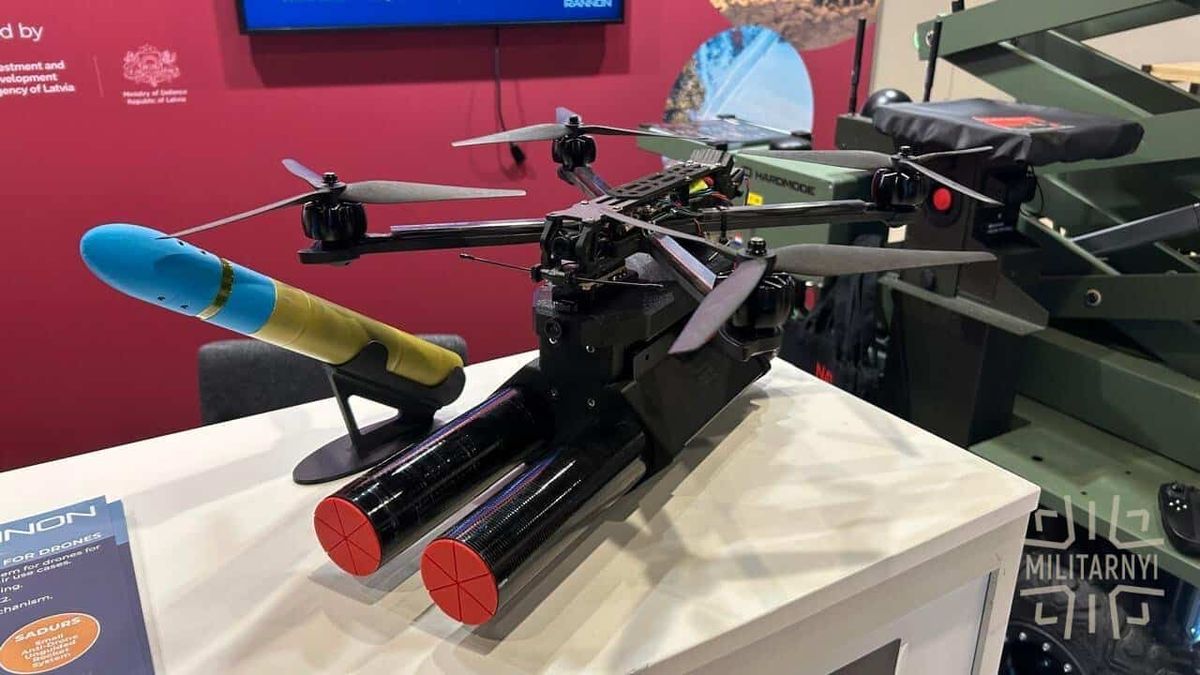
Latvian defense technology company Rannon is developing compact 40mm anti-drone missiles designed to be launched from unmanned aerial vehicles, potentially allowing relatively small interceptor drones to engage multiple airborne targets during a single mission.
The company presented details of the system at the Defence Innovation Forum 2026 in The Hague, where a representative told Ukrainian defense publication Militarnyi that the missiles are being prepared for future testing in Ukraine.
The unguided missiles are designed for integration with fixed-wing UAVs and multicopters. According to the company, a typical configuration could carry between four and twelve missiles, depending on the payload capacity of the aircraft. Rannon has already tested a configuration involving two launchers operating simultaneously.
Each missile measures 400mm in length, weighs approximately 1.2 kilograms and carries a 0.5-kilogram high-explosive fragmentation warhead. The developer claims a flight speed of 250 meters per second and an effective engagement range of approximately 300 meters.
Rather than incorporating a conventional onboard guidance system, the concept relies on a ballistic computer and AI-assisted target recognition to support aiming and launch decisions. The missile itself is equipped with a proximity fuse and a self-destruct mechanism.
Designed for the Growing Drone Interception Market
The development reflects increasing interest in affordable aerial interception systems that could complement conventional air defense against relatively inexpensive attack drones.
Rannon says its missiles could potentially be deployed from jet-powered interceptor UAVs against targets such as Russian Shahed-type drones. However, the system remains at the prototype stage, and its effectiveness against such targets has not yet been demonstrated in operational conditions.
The company is also developing solid-fuel rocket-assisted takeoff boosters for unmanned aircraft, intended to reduce dependence on launch catapults and other ground infrastructure.
Rannon expects to finalize development of its anti-drone missiles around mid-2027. The company has emphasized that the system has not yet been deployed in Ukraine and that further testing is required before combat evaluation.
Rannon is also among the first-phase winners of BraveTech EU, the joint European Union and Ukrainian defense innovation initiative. Its participation provides a potential route for testing and further cooperation with Ukraine's rapidly developing unmanned systems sector.