Poland’s WB Group Details Gladius 2 With 300 km Range
WB Group has disclosed new Gladius 2 details ahead of MSPO 2026, including a roughly 300 km range, jet propulsion and reduced signatures.

Polish defense company WB Group has disclosed new technical details about its Gladius 2 unmanned strike system ahead of its public debut at MSPO 2026 in Kielce. The jet-powered aircraft has an approximate range of 300 km, reduced radar and infrared signatures and a high subsonic speed, expanding the Gladius family beyond the shorter-range systems already fielded by the Polish Armed Forces.
WB Group also outlined an expanded Stormrider unmanned surface vessel family and said its current unmanned aircraft production rate has reached 25 units per day. The developments show the company broadening its portfolio across air, land and maritime unmanned operations while Poland expands procurement of domestically produced drone systems.
Gladius 2 adds a 300 km jet-powered strike capability
Gladius 2 uses a flying-wing configuration with a flat lifting body and swept wings, according to details presented by WB Group ahead of MSPO 2026 and reported by Polish defense publication MILMAG on August 30.
The unmanned aircraft uses a jet engine and is designed to reach high subsonic speeds. Its air intake sits on the upper forward section of the airframe, while the aircraft has been designed to reduce both radar and thermal signatures.
WB Group puts its approximate range at 300 km.
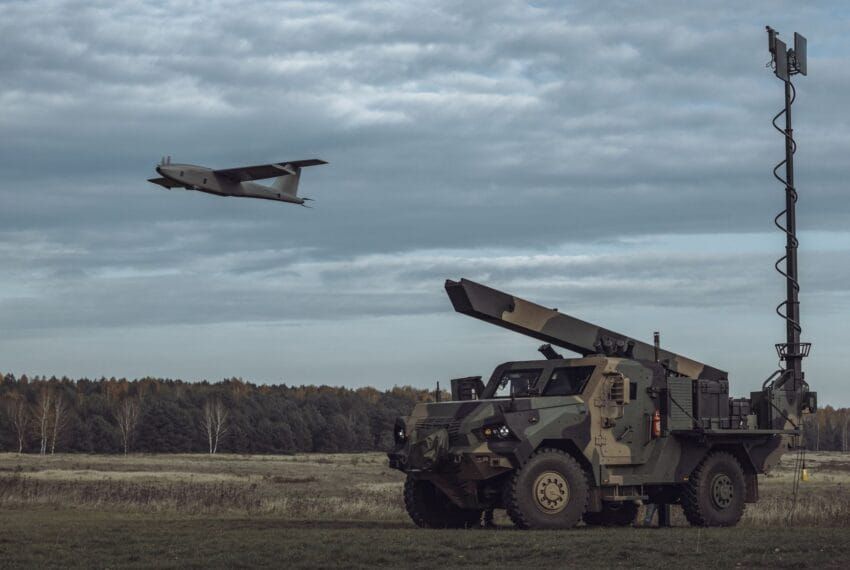
The dimensions of Gladius 2 allow it to use launchers associated with the existing Gladius system. The aircraft can launch with a booster from the existing launcher or operate without the launch booster depending on the configuration.
That compatibility is significant because Poland is already investing heavily in the wider Gladius architecture rather than acquiring Gladius 2 as an isolated platform.
Poland is expanding the wider Gladius network
The Polish Armed Forces integrate Gladius unmanned aircraft with the TOPAZ battlefield management system developed by WB Group.
A Gladius battery combines unmanned reconnaissance and strike aircraft with launchers, command vehicles, ammunition vehicles and technical support vehicles. The architecture links reconnaissance, targeting, communications and strike functions rather than treating the unmanned aircraft as standalone effectors.
Poland's Armament Agency signed three contracts with WB Group on May 28, 2026 covering additional Gladius, FlyEye and Warmate systems. The Gladius portion covers 12 battery-level modules, while the wider procurement includes more than 400 Warmate systems and nearly 200 FlyEye unmanned aircraft.
The contracts are being financed through the European Union's Security Action for Europe, or SAFE, instrument.
WB Group President Piotr Wojciechowski indicated during the company's pre-MSPO media event that Gladius has also attracted interest from NATO countries. Export configurations could differ from the Polish system because individual customers have different operational requirements, while some capabilities will remain specific to the Polish Armed Forces.
The company is also considering establishing production facilities outside Poland as part of potential cooperation with foreign customers.
WB Group said it is developing additional Gladius variants but has not disclosed further technical details.
WB Group says drone output has reached 25 aircraft per day
WB Group also provided a new indication of the scale of its unmanned aircraft manufacturing capacity.
Wojciechowski said the company currently produces 25 unmanned aircraft per day, with Warmate 5 accounting for most of that output.
The company says production covers all key components without relying on Chinese components.
That industrial capacity has become increasingly relevant as European militaries move from acquiring unmanned systems in relatively small quantities toward establishing larger inventories that can sustain training, operational deployments and wartime attrition.
For Poland, domestic production also reduces dependence on external suppliers for a capability that has become central to the country's force modernization plans.
Stormrider 550 expands WB Group into smaller maritime drones
WB Group is also expanding its Stormrider unmanned surface vessel family.
The larger platform unveiled in 2025 now carries the Stormrider 850 designation. The 8.5-meter modular reconnaissance and strike vessel has a stated range of 500 km and can carry Warmate TL-R or TL-C loitering munitions or a ZMU-05 weapon module.
Its sensor options include navigation radar, sonar and an electro-optical payload.
The newly detailed Stormrider 550 is a smaller 5.5-meter unmanned surface vessel intended for patrol, reconnaissance, training and strike missions in territorial waters, internal waterways and ports.
WB Group has developed low and high configurations of the Stormrider 550.
The low configuration prioritizes speed, maneuverability and a reduced profile. One version is designed to intercept other unmanned surface vessels through collision or an explosion near the target.
A separate training configuration can serve as a target for naval weapons crews and force-protection exercises.
The high configuration uses a mast and carries a larger sensor package for patrol and reconnaissance missions. Potential tasks include seabed mapping, searches for underwater and mine-like objects, inspection of underwater critical infrastructure, search-and-rescue support and monitoring of ports and coastlines.
WB Group says patrol variants could operate in groups of four to six vessels.
MSPO 2026 will show Poland's expanding unmanned portfolio
Gladius 2 is scheduled for its public debut at the International Defence Industry Exhibition, or MSPO 2026, in Kielce.
The program also illustrates a broader shift in Poland's unmanned systems strategy. Warsaw is procuring reconnaissance aircraft, loitering munitions and longer-range strike systems while integrating them through a common command-and-control architecture.
Gladius 2 extends that architecture toward targets at approximately 300 km while retaining compatibility with existing Gladius launch infrastructure.
At sea, the Stormrider family gives WB Group a parallel route into unmanned maritime operations, including reconnaissance, infrastructure protection and interception of hostile unmanned vessels.
The combination makes MSPO 2026 important not simply because WB Group is unveiling another drone. The exhibition will provide the first public view of how Poland's largest domestic unmanned systems supplier is extending a common portfolio across increasingly long-range air and maritime missions.
Q&A: WB Group Gladius 2
What is the range of Gladius 2?
WB Group has disclosed an approximate range of 300 km for Gladius 2. The unmanned aircraft uses jet propulsion and is designed to operate at high subsonic speed.
Is Gladius 2 a stealth drone?
WB Group describes Gladius 2 as having reduced radar and thermal signatures. The available information does not establish that the aircraft meets any specific definition of stealth.
Can Gladius 2 use existing Polish launchers?
Yes. According to information presented ahead of MSPO 2026, the aircraft's dimensions allow it to launch from the launcher used by the existing Gladius system with the assistance of a launch booster.
What is Stormrider 550?
Stormrider 550 is a 5.5-meter unmanned surface vessel developed by WB Group for patrol, reconnaissance, training and strike missions. Variants are being developed for tasks including maritime surveillance, critical infrastructure inspection and interception of other unmanned surface vessels.