EU proposes its own ‘Article 4’ for drone incursions, sabotage and cyberattacks
The EU is proposing an Emergency Security Protocol that would allow any member state to convene the bloc in response to drone incursions, sabotage, cyberattacks and other hybrid threats below the threshold of armed conflict.

The European Union is preparing a new security mechanism designed to coordinate its response to drone incursions, sabotage, cyberattacks and other hostile activity that falls short of conventional military aggression.
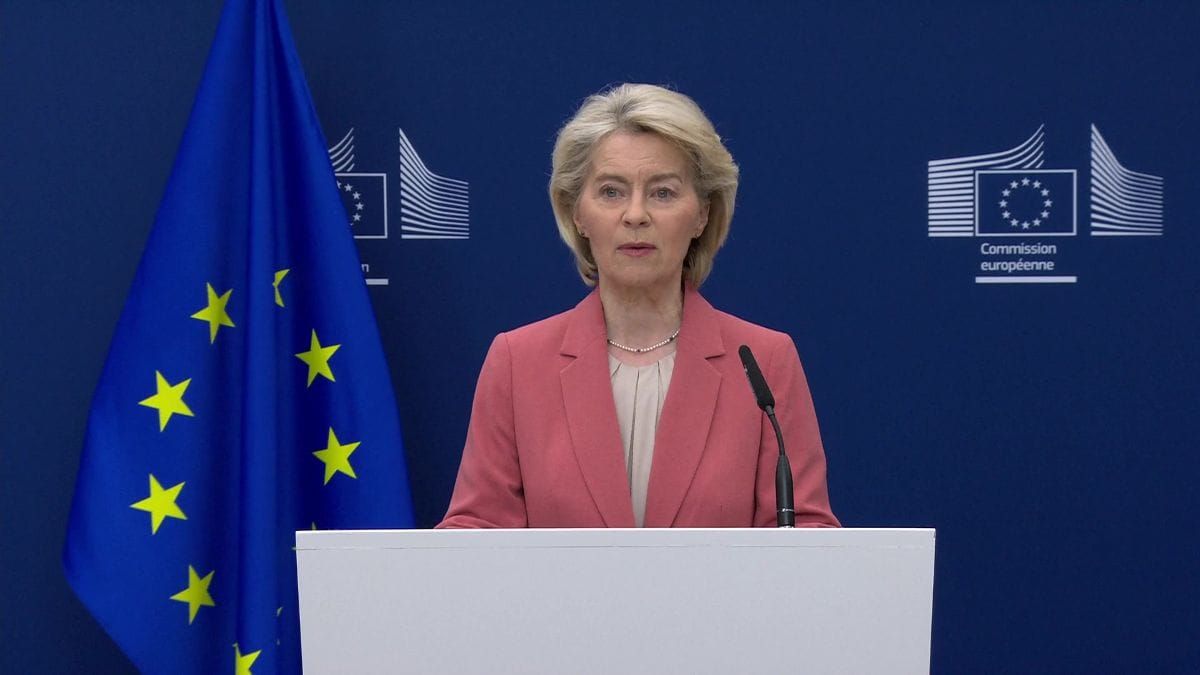
European Commission President Ursula von der Leyen proposed what she called “Europe’s own Article 4” during her State of the Union address in Strasbourg on Wednesday.
Under the proposed Emergency Security Protocol, a single EU member state facing a serious security incident could trigger consultations among all 27 members, allowing governments to coordinate a European response and consider measures aimed at preventing further escalation.
The proposal takes inspiration from NATO’s Article 4, which allows any NATO member to request consultations when it believes its territorial integrity, political independence or security is threatened.
Unlike NATO’s Article 5, Article 4 does not automatically involve collective military action.
For the EU, the new mechanism would primarily address the increasingly difficult space between routine security incidents and an armed attack.
Von der Leyen pointed specifically to cyberattacks, sabotage, arson and drone incursions as examples of threats that increasingly require a coordinated response.
“Europe needs its own counter-hybrid playbook,” she told lawmakers, arguing that European institutions and decision-making structures have not kept pace with the changing security environment.
A response to attacks below the threshold of war
European governments have struggled with how to respond collectively to suspected hostile operations that can cause significant disruption without crossing the threshold that would normally trigger a military response.
Recent incidents have included drone activity around critical infrastructure and airports, suspected sabotage, cyber operations and attacks on infrastructure across several European countries.
The European Commission said the proposed protocol would be intended to coordinate responses, deter further escalation and reduce the impact of such incidents.
Von der Leyen referred in her speech to recent security incidents in Denmark, Lithuania, Poland and Germany and said Europe needed clearer procedures for handling operations that threaten national security without amounting to conventional armed aggression.
The mechanism would complement rather than replace NATO’s existing consultation framework.
The details still have to be developed, including what types of incidents could trigger the protocol, what responses would be available to EU governments and whether any decisions would require unanimity.
European Security Council also proposed
Von der Leyen also called for the creation of a European Security Council, another proposal intended to provide political leaders with a dedicated forum for major security questions.
Unlike existing EU formats, the council could involve important European and transatlantic partners outside the bloc.
Von der Leyen specifically mentioned the United Kingdom, Norway, Ukraine and Canada as potential participants.
The Commission has not yet set out the council’s membership structure, legal basis or decision-making powers.
The proposal is expected to form part of a broader European security strategy that the Commission plans to develop together with the EU’s High Representative for Foreign Affairs.
The strategy will also address military capabilities and strategic infrastructure.
Von der Leyen announced a separate European Instrument for Strategic Enablers intended to support capabilities including air and missile defense, strategic transport, aerial refueling, space and cyber systems.
For European governments, the central question will be how quickly they can turn the proposed mechanisms into procedures that can be used during an actual security incident.
The growing number of drone, cyber and sabotage cases has increasingly exposed the gap between national law-enforcement responses and NATO mechanisms designed for more serious military threats.
The proposed Emergency Security Protocol is intended to operate in precisely that gap.