Poland Unveils ORP Wicher, First New Miecznik Frigate
Poland has unveiled ORP Wicher, the first of three Miecznik frigates that will rebuild its surface fleet and add naval air defense capacity in the Baltic.

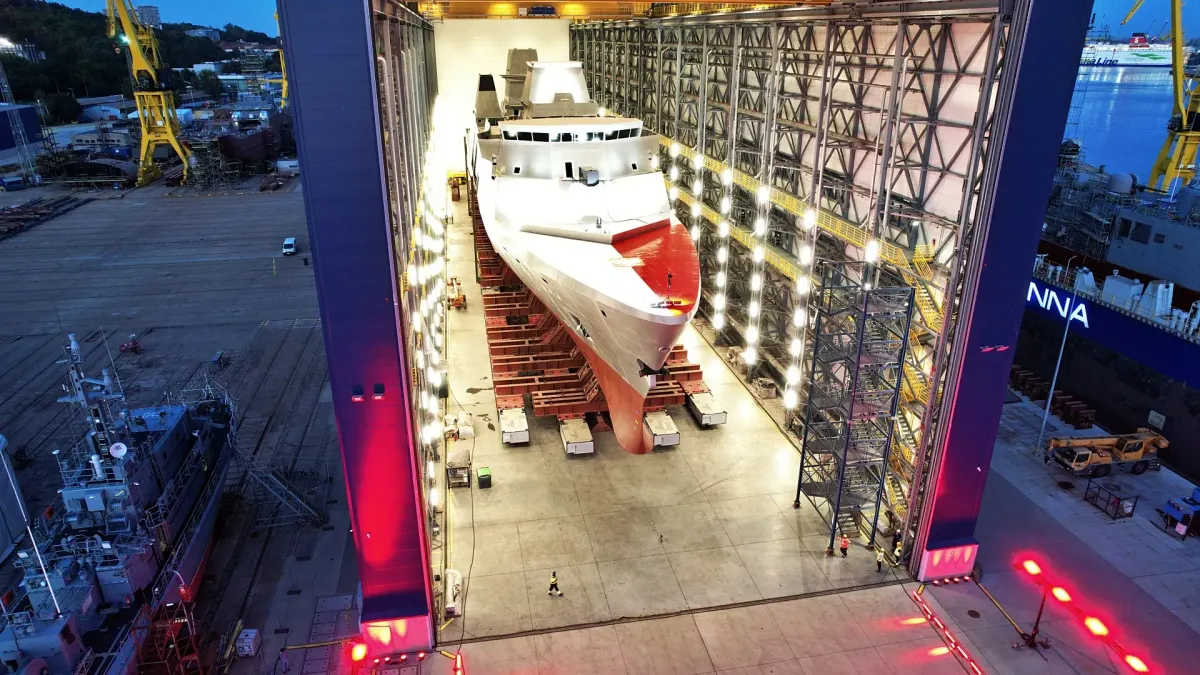
Poland unveiled ORP Wicher, the first of three Miecznik-class frigates for the Polish Navy, during a naming ceremony at PGZ Stocznia Wojenna in Gdynia on August 12, 2026. The Arrowhead 140-based warship is scheduled to enter the water as Poland advances a naval modernization program valued at around PLN 15 billion, or approximately €3.5 billion.
ORP Wicher will become the first of the three frigates expected to form the future core of Poland’s major surface combatant fleet. The program combines ship construction in Poland with British platform, missile and combat-system technology and is intended to strengthen Poland’s ability to conduct air defense, anti-surface warfare and anti-submarine operations in the Baltic Sea.
ORP Wicher begins the Miecznik fleet renewal
The Miecznik program covers three Project 106 multi-role frigates named Wicher, Burza and Huragan. The Polish Armament Agency signed the original contract in 2021 with the PGZ-MIECZNIK consortium, led by state-owned Polska Grupa Zbrojeniowa, with PGZ Stocznia Wojenna responsible for construction in Gdynia.
The program initially carried a value of approximately PLN 8 billion, but amendments had increased the figure to around PLN 15 billion by the end of 2023. Construction of the second ship, Burza, began in 2025, while steel was cut for the third frigate, Huragan, on April 28, 2026.
Wicher is scheduled to join the Polish Navy in 2029, according to PGZ. The overall Miecznik program is expected to run into the early 2030s.
The new ships will replace Poland’s two former United States Navy Oliver Hazard Perry-class frigates, which were built during the Cold War and transferred to Poland in 2000 and 2002.
Arrowhead 140 gives Poland a 7,000-ton frigate platform
Poland selected the Arrowhead 140 design from Babcock International as the basis for Miecznik. The platform is derived from the Royal Danish Navy’s Iver Huitfeldt class and also forms the basis of the British Royal Navy’s Type 31 frigate.
PGZ lists the Polish configuration at approximately 138 meters long and 20 meters wide, with a maximum displacement of approximately 7,000 tonnes. The ships are designed for a maximum speed of 28 knots and a range of approximately 8,000 nautical miles.
Each frigate will have a core crew of approximately 120 and capacity for around 60 additional personnel. Four diesel engines in a combined diesel and diesel configuration will drive two controllable-pitch propellers.
The size of the Arrowhead 140 platform gives Poland more than a direct replacement for its aging Perry-class ships. Miecznik is intended to provide a multi-role surface combatant capable of contributing to national maritime defense while operating within NATO naval formations.
CAMM links Miecznik to Poland’s wider air defense network
Air defense represents one of the most consequential elements of the Miecznik configuration. MBDA received a contract to equip all three frigates with the Sea Ceptor naval air defense system using the Common Anti-Air Modular Missile, or CAMM.
The missiles will use a quad-pack configuration in Mk 41 Vertical Launching System cells. Poland will also be able to draw on CAMM stocks acquired for its land-based air defense programs, creating ammunition commonality between naval and ground-based air defense.
That commonality connects Miecznik with Warsaw’s broader effort to build a layered national air defense architecture. Poland has already adopted CAMM for its land-based systems, while technology transfer under the Narew program is intended to establish domestic production capabilities for the missile family.
The approach gives the Polish Navy a maritime air defense component tied to the same missile family being fielded ashore. It also provides a pathway for Polish industry to support missile availability across multiple military domains.
Thales sensors expand Wicher’s Baltic surveillance role
Thales is supplying the integrated combat system, with its TACTICOS combat management system serving as the central command and decision-making component. The sensor package includes the SM400 Block 2 multifunction S-band radar and NS50 radar.
The SM400 Block 2 provides air and surface surveillance, helicopter control and weapon-control functions at ranges of up to 400 kilometers, according to Thales. The frigates will also receive the BlueHunter hull-mounted sonar and CAPTAS-2 towed-array sonar for anti-submarine warfare.
An ARTEMIS 360-degree infrared search-and-track system and STIR 1.2 EO Mk2 fire-control radar complete additional elements of the sensor package. Thales is transferring integration knowledge to Polish industry, allowing selected sensors and effectors to be integrated with TACTICOS by PGZ.
This combination positions the ships for missions beyond conventional surface patrol. Poland expects the frigates to protect maritime areas and naval bases, engage surface, submarine and coastal targets, and contribute to air defense during national and NATO operations.
Miecznik strengthens Poland’s Baltic Sea posture
The arrival of a modern frigate class comes as Poland places greater emphasis on Baltic Sea security. Warsaw has expanded defense cooperation with Nordic and Baltic allies while NATO has increased attention to maritime infrastructure and security in the region.
For Poland, Miecznik provides a surface component to a broader naval recapitalization effort. Warsaw has also selected Sweden’s Saab for three A26 submarines, adding an undersea modernization track alongside the new frigates.
The frigates are particularly relevant to the protection of shipping routes, ports and critical maritime infrastructure. Their air defense and anti-submarine capabilities also allow Poland to contribute higher-end assets to NATO naval formations rather than relying primarily on aging legacy surface combatants.
Wicher’s launch therefore represents more than the replacement of one old frigate. The three-ship Miecznik program is creating a new surface-warfare capability while rebuilding Polish naval shipbuilding capacity and linking the fleet more closely with Poland’s wider air defense modernization.
Poland Miecznik frigates: Key questions
What is ORP Wicher?
ORP Wicher is the first of three Project 106 Miecznik-class multi-role frigates being built for the Polish Navy. It is based on Babcock International’s Arrowhead 140 design and is scheduled to enter Polish Navy service in 2029.
How many Miecznik frigates is Poland building?
Poland is building three ships: Wicher, Burza and Huragan. Construction is taking place at PGZ Stocznia Wojenna in Gdynia under the PGZ-MIECZNIK consortium.
What weapons will Poland’s Miecznik frigates carry?
The ships will use MBDA’s Sea Ceptor air defense system with CAMM missiles installed in Mk 41 vertical launch cells using a quad-pack configuration. Their missions will also include engagement of surface, submarine and coastal targets.
Why is the Miecznik program important for NATO?
The frigates will give Poland modern surface combatants capable of maritime air defense, anti-submarine warfare and protection of shipping and infrastructure in the Baltic. They are also designed for operations within NATO naval formations and will replace Poland’s aging former US Navy Oliver Hazard Perry-class frigates.