Serbia Drills With Pantsir-S1 as Air Defense Network Expands
Serbia's 250th Air Defense Missile Brigade is conducting intensive Pantsir-S1 training as Belgrade builds a layered network around Russian and Chinese systems.

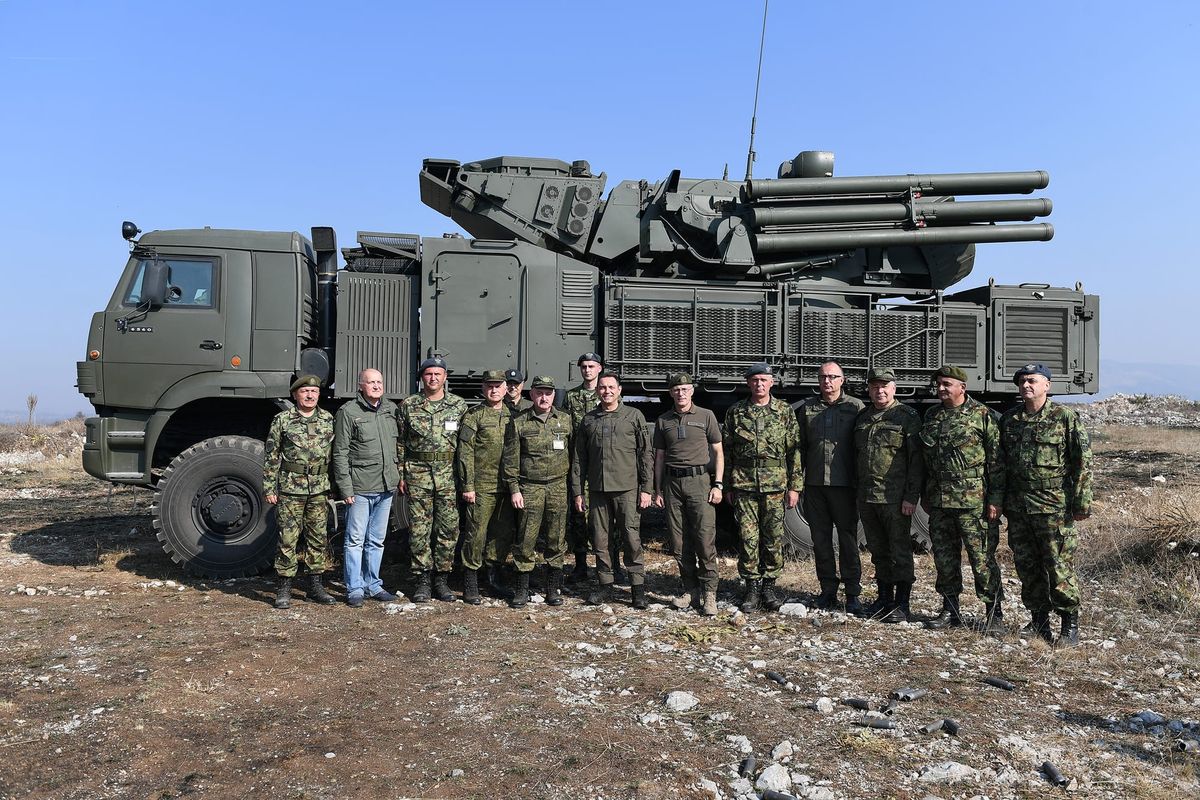
The Serbian Armed Forces are conducting intensive training with Russian-supplied Pantsir-S1 air defense systems operated by the 250th Air Defense Missile Brigade. The August training focuses on rapid deployment, combat preparation, engagement procedures and ammunition replenishment as Serbia continues to build a layered air defense network combining Russian, Chinese and modernized legacy systems.
The Pantsir-S1 entered Serbian service in 2020 and provides the short-range component of a broader architecture that now includes China's FK-3 and HQ-17AE surface-to-air missile systems. Serbia's recent training cycle across all three types points to an increasing emphasis on integrating newly acquired systems into the country's standing air defense structure rather than treating them as isolated acquisitions.
Pantsir-S1 crews practice rapid deployment and reloading
The latest training involves a battalion of the 250th Air Defense Missile Brigade equipped with the Pantsir-S1 hybrid gun-and-missile system. Serbia's Ministry of Defense said the exercises are intended to improve the skills required for timely tactical action and effective engagement of targets in the air and on the ground.
Crews are practicing the rapid occupation of firing positions while moving, transitioning the system into combat operation and carrying out elements of the engagement process. Training also covers replenishing combat vehicles with surface-to-air missiles and artillery ammunition.
Those procedures reflect the Pantsir-S1's role as a mobile point-defense system. The Serbian Armed Forces identify command posts, airfields, medium- and long-range air defense units, depots, maintenance facilities, troop concentrations and military convoys among the assets the system can protect.
Serbia received its Pantsir-S1 systems from Russia and introduced the type into the 250th Air Defense Missile Brigade at the beginning of 2020. The acquisition followed the Slavic Shield 2019 exercise, during which Russian forces deployed both Pantsir-S1 and S-400 systems to Serbia for joint training.
Serbia now combines Russian and Chinese air defense systems
The latest exercise is more significant when viewed alongside the broader modernization of the 250th Air Defense Missile Brigade.
The brigade currently operates Pantsir-S1, FK-3 and HQ-17AE systems alongside modernized Neva M1T and Kub M2(SM) systems. The unit consists of a command element, three air defense missile battalions and three self-propelled air defense missile battalions, according to Serbia's Ministry of Defense.
The Chinese FK-3 entered Serbian service in 2022 and provides a longer-range layer. Serbia's Ministry of Defense states that the system can engage aircraft, helicopters, cruise missiles, unmanned aerial vehicles and air-to-surface missiles at ranges of up to 100 kilometers and altitudes of up to 27 kilometers.
The HQ-17AE entered service in 2024 and provides another mobile short-range layer. Serbian forces describe its mission as protecting military facilities, administrative and political sites, critical infrastructure, military units and designated areas from aerial reconnaissance and attack.
This creates an unusual mix within a European air force. Serbia operates Russian Pantsir-S1 systems alongside two Chinese surface-to-air missile families while retaining upgraded Soviet-designed Kub and Neva systems.
The procurement pattern also reflects Serbia's attempt to maintain military relationships outside NATO while progressively modernizing equipment inherited from the Yugoslav and Soviet era.
250th Brigade has trained across all three modern systems in 2026
Serbia's training activity during 2026 suggests that the 250th Brigade is focusing on maintaining readiness across the different layers of its modernized network.
In February, Serbian FK-3 crews conducted intensive training focused on air defense operations, launcher replenishment and simultaneous engagements. The Serbian Armed Forces said the FK-3 had substantially improved the brigade's ability to respond to modern aerial threats since entering service in 2022.
In April, personnel equipped with the HQ-17AE trained on deployment, movement and air defense procedures. The exercises placed particular emphasis on replenishing missiles during operations, with Serbian officers citing the requirement to respond to massed aerial attacks.
FK-3 crews returned to intensive training in June, practicing operations against aircraft, helicopters, cruise missiles, unmanned aerial vehicles and air-to-surface missiles.
The August Pantsir-S1 training therefore completes a visible sequence of exercises involving all three of Serbia's newer air defense families within the same brigade.
The available Serbian statements do not establish that all three systems operated together during the latest Pantsir exercise. They do show that Belgrade is training their respective crews within a common organizational structure responsible for national airspace protection.
Layered air defense remains central to Serbian modernization
The 250th Air Defense Missile Brigade has responsibility for protecting Serbian airspace, major economic facilities, administrative and political centers and Serbian Armed Forces units. Its history dates to 1962, when the 250th Air Defense Missile Regiment was established to defend Belgrade with the S-75 Dvina system.
The brigade also played a major role during NATO's 1999 air campaign against the Federal Republic of Yugoslavia. That experience remains institutionally significant for Serbia and continues to influence the priority Belgrade places on ground-based air defense.
The addition of Pantsir-S1, FK-3 and HQ-17AE has substantially changed the brigade's equipment mix since 2020. Instead of relying predominantly on upgraded Cold War-era systems, Serbia now fields several mobile missile families intended to cover different engagement envelopes.
For the Pantsir-S1 crews training in August, the immediate objective remains narrower: faster deployment, coordinated combat procedures and efficient replenishment under operational conditions. At the force level, however, the exercise forms part of Serbia's continuing effort to maintain multiple layers of ground-based air defense around military units, infrastructure and strategic areas.
Serbia's Pantsir-S1: key questions
When did Serbia receive the Pantsir-S1?
Serbia introduced the Pantsir-S1 into the 250th Air Defense Missile Brigade at the beginning of 2020. Russian Pantsir systems had previously deployed to Serbia during the joint Russian-Serbian Slavic Shield 2019 exercise.
What is Serbia practicing with the Pantsir-S1?
The August 2026 training includes rapid occupation of firing positions, transition into combat operation, target engagement procedures and replenishment with missiles and artillery ammunition.
What other modern air defense systems does Serbia operate?
The 250th Air Defense Missile Brigade operates Chinese FK-3 and HQ-17AE systems alongside the Russian Pantsir-S1. It also retains modernized Neva M1T and Kub M2(SM) systems.
How far can Serbia's FK-3 engage targets?
Serbia's Ministry of Defense lists a maximum engagement range of up to 100 kilometers and altitude of up to 27 kilometers for the FK-3. The system is intended to engage targets including aircraft, helicopters, cruise missiles and unmanned aerial vehicles.
Serbia's next challenge is less about acquiring individual air defense systems and more about operating its Russian, Chinese and modernized legacy equipment as a coherent network. The frequency of training across Pantsir-S1, FK-3 and HQ-17AE units in 2026 indicates that crew readiness and sustained operation of the new equipment have become a central part of that process.