Serbia Tests New Combat Drones and Robots in Major Exercise
Serbia publicly demonstrated armed robot dogs, PULS and Vampire rocket launchers and eight drone types during the Victor 2026 live-fire exercise.

Serbia has publicly demonstrated armed robotic dogs alongside new long-range rocket artillery and multiple unmanned systems during the Victor 2026 live-fire exercise at the Pešter training area. The September 13 demonstration included robot dogs carrying machine guns and other weapons, the Israeli-made PULS rocket launcher, Czech RM-70 Vampire, Mali Miloš unmanned ground vehicles and eight types of drones.
The Serbian Armed Forces used the systems as part of a combined offensive operation rather than displaying them statically. Serbian officials said one sequence demonstrated an attack on a settlement conducted by robotic, unmanned ground and aerial systems without soldiers directly participating in the initial assault.
Armed robot dogs enter Serbia’s live-fire exercise
The robot dogs provided one of the clearest new elements at Victor 2026. Serbia publicly demonstrated the quadruped robotic systems in an operational exercise configuration for the first time, according to Radio Television of Serbia.
The systems were equipped with 7.62 mm machine guns, revolver-type grenade launchers and Zolja anti-armor weapons in different configurations. Serbian President Aleksandar Vučić indicated that stabilizing the weapon systems sufficiently for accurate fire had presented a technical challenge.
During the exercise, the robotic dogs were assigned to secure terrain ahead of special forces and protect areas against a subsequent opposing-force entry. They are also intended to enter confined, difficult-to-observe or potentially mined structures before soldiers, reducing the exposure of personnel during the initial phase of an assault.
The Serbian Armed Forces did not identify the manufacturer or disclose how many quadruped systems have been acquired. Their appearance nevertheless indicates that Serbia is testing armed quadruped robots beyond the technology-demonstrator stage and integrating them with special operations scenarios.
Serbia demonstrates PULS and Vampire rocket artillery
Victor 2026 also provided a significant artillery milestone.
Serbia demonstrated the PULS Precise and Universal Launching System and RM-70 Vampire multiple-launch rocket system during the exercise. Serbian media described their appearance at Pešter as the first public exercise demonstration of the two systems.
The PULS acquisition substantially extends the reach of Serbian ground-based fires. Chief of the Serbian Armed Forces General Staff General Milan Mojsilović previously said Serbia selected a family of munitions allowing precision engagements at ranges between 30 and 300 kilometers. The systems are intended for the Mixed Artillery Brigade.
PULS is produced by Israel's Elbit Systems and uses a modular launcher architecture capable of employing different rocket and missile types.
The maximum 300-kilometer range represents a substantial increase over Serbia's traditional rocket artillery capability. Serbian military officials said before Victor 2026 that the armed forces can now engage targets beyond 100 kilometers with modern artillery systems, compared with ranges of roughly 20 kilometers available to some earlier capabilities.
Serbia is introducing the Czech-built 122 mm RM-70 Vampire alongside PULS. The Ministry of Defense publicly confirmed the Vampire as a newly introduced Serbian Armed Forces system during live-fire activities in July.
The two acquisitions therefore provide complementary capabilities rather than identical roles. Vampire supplies high-volume 122 mm rocket fire, while PULS introduces longer-range precision strike options.
Eight drone types support Serbia’s unmanned assault
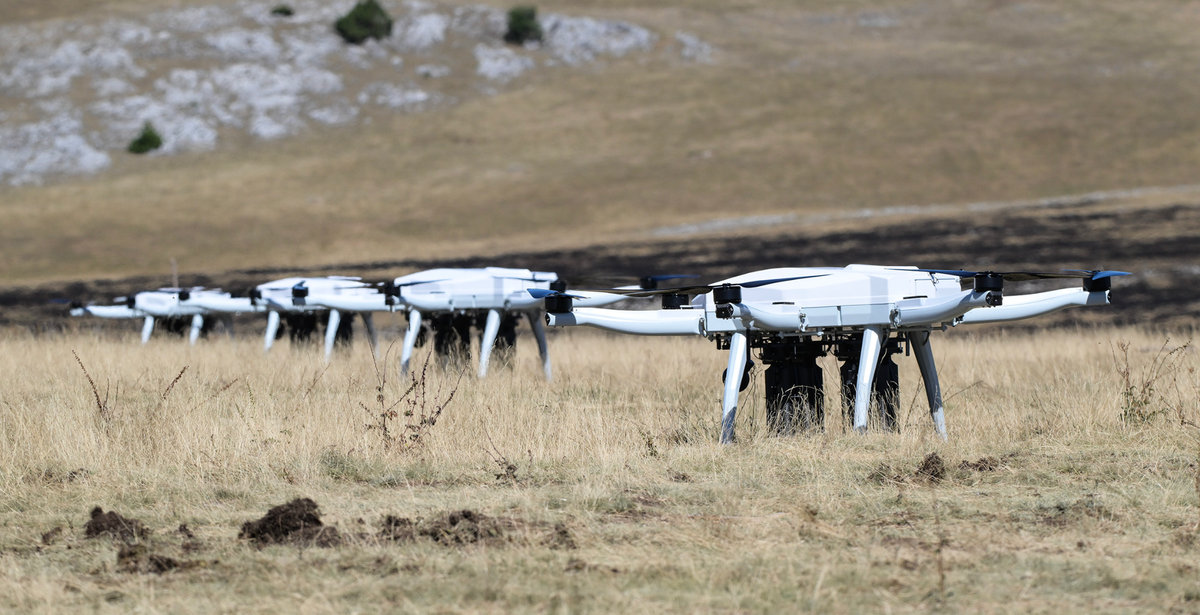
The September 13 exercise involved eight different drone types, according to Serbian officials. Some drones were deliberately intercepted during the exercise to train Serbian forces against unmanned aerial threats.
Among the systems identified during the demonstration was the Komarac K2A, which conducted a live engagement using a dual-effect warhead.
Serbia also incorporated drone interceptors into Victor 2026. Colonel Stevan Žigić of the Serbian Armed Forces General Staff said ahead of the event that some interceptor drones had previously only been used as targets and had not been employed in this type of simulated combat scenario.
The exercise therefore tested both sides of Serbia's expanding unmanned capability: drones designed to conduct reconnaissance and attacks, and systems intended to counter hostile unmanned aircraft.
The Ministry of Defense said the broader objective was to verify how newly introduced unmanned technologies integrate with Serbia's existing command, reconnaissance and fire-support systems. The exercise included remotely piloted aircraft for reconnaissance and strike missions as well as ground robotic platforms intended to engage opposing forces.
Mali Miloš joins robotic assault formation
Serbia also deployed the domestically developed Mali Miloš unmanned ground vehicle during the exercise.
Unlike the newly displayed robot dogs, Mali Miloš is an established Serbian robotic combat platform. Its inclusion is significant because Victor 2026 combined different categories of unmanned ground systems within a larger tactical scenario rather than demonstrating a single robotic vehicle independently.
Serbian forces practiced using unmanned and robotic platforms to conduct missions that would otherwise expose personnel, including surveillance, reconnaissance, data transmission, combat support and direct engagement.
Serbia had already demonstrated a robotic-company attack during live-fire activities at Pasuljanske Livade in July, alongside the artificial intelligence-enabled Lanius-X short-range combat drone and the Vihor interceptor drone.
Victor 2026 moves that experimentation into a larger combined-arms framework involving ground forces, aviation, air defense, special forces and military police.
Victor 2026 combines new systems with Serbia’s existing force
More than 2,000 Serbian Armed Forces personnel and over 500 major pieces of military equipment participated in the Pešter phase of Victor 2026.
The exercise included modernized M-84 tanks, armored vehicles, MiG-29 aircraft, Mi-35 attack helicopters, artillery, anti-tank weapons and air-defense systems alongside the unmanned platforms. Serbia also demonstrated the Chinese HQ-17 air-defense system and domestically developed PASARS.
The combination reflects Serbia's current modernization model. Belgrade is simultaneously acquiring Israeli, Chinese and European systems while modernizing domestic platforms and expanding its own drone and robotic vehicle programs.
PULS provides a particularly important addition because it gives the Serbian Army a precision-strike capability reaching substantially deeper than its older rocket artillery.
The robotic element points toward a different objective. Serbia is increasingly experimenting with transferring reconnaissance, breaching, close combat and other high-risk battlefield tasks from soldiers to unmanned systems.
Victor 2026 provided the clearest public demonstration so far of how those systems could operate together.