AI on the Battlefield: 7 Systems Already Changing How Wars Are Fought
From autonomous drone wingmen to AI-generated kill lists, artificial intelligence has moved from defense lab to active combat. These are the 7 systems reshaping modern warfare right now.

For most of the past decade, artificial intelligence in warfare meant prediction software, logistics optimization, and maintenance alerts. Useful, but invisible. The kind of technology that improved efficiency without changing what war actually looked like.
That period is over.
In 2025 and 2026, AI moved from the back office to the battlefield. It is now generating target lists, flying autonomous combat aircraft, coordinating drone swarms, and processing intelligence at speeds no human analyst can match. Some of these systems have already been used in active combat operations. Others are weeks away from operational deployment. None of them are theoretical.
This is a guide to the seven systems that matter most right now, what they do, where they have been used, and why they are changing the rules of modern warfare.
1. Maven Smart System: The AI That Picks Targets
The Maven Smart System, developed by Palantir Technologies for the U.S. Department of Defense, is the most operationally significant AI system currently deployed in active warfare. Originally built to process drone footage and satellite imagery for target identification, Maven has evolved into the central nervous system of American military intelligence operations.
In practical terms, Maven ingests raw data from satellites, drones, signals intelligence, and human sources, processes it, and produces prioritized target recommendations for human commanders to approve. The speed advantage is not incremental. It is categorical. Where a team of analysts might take hours to process a complex intelligence picture, Maven completes the same task in minutes.
Where it has been used: NATO acquired a version of Maven Smart System from Palantir in 2025, and the U.S. military deployed it actively in Iran operations beginning in early 2026. During the first 24 hours of U.S. strikes against Iran in February 2026, the Pentagon struck approximately 1,000 targets, a pace that analysts across multiple outlets, including Chatham House and the Atlantic Council, described as operationally impossible without AI-assisted target generation. In Ukraine, Palantir's platforms have been embedded in battlefield intelligence infrastructure since 2022.
Why it matters: Maven represents the clearest evidence that AI is already inside the kill chain of the world's most powerful military. The human commander still approves each strike. But the target list, the priority ranking, and the precision coordinates are increasingly AI-generated.
2. Lavender and The Gospel: Israel's AI Targeting Architecture
While the United States built Maven around a commercial software contractor, Israel's military intelligence directorate built its AI targeting systems in-house. The result is a set of tools that represent the most documented case of artificial intelligence being used to generate individual human targets at scale.
Lavender is an AI system that assigns numerical scores to individuals based on their suspected affiliation with armed groups. Each person tracked by the system receives a probability rating. Those above a threshold are flagged as potential targets. According to investigative reporting by +972 Magazine, based on testimony from Israeli intelligence officers, Lavender was processing tens of thousands of individuals at a time during the Gaza campaign.
The Gospel, known in Hebrew as Habsora, operates at a different level. Rather than rating individuals, it generates lists of buildings, facilities, and infrastructure targets. Investigative reporting indicated the system was capable of producing up to 100 new targets per day, addressing what military planners described as a historical constraint: the human capacity to generate sufficient targets during a high-tempo campaign.
Where's Daddy functions as a location tracking tool, designed to identify when a targeted individual is at home with family members, providing a strike window.
Why they matter: These systems represent the first publicly documented case of AI being used to generate individual human kill lists at operational scale. They have attracted significant attention from international law scholars, UN investigators, and arms control researchers, and have become the primary reference point in ongoing debates about autonomous weapons regulation.
3. Anduril Lattice: The AI Operating System for Autonomous Weapons
If Maven is the targeting brain, Lattice is the coordination layer. Developed by Anduril Industries, Lattice is an AI-powered software platform designed to connect autonomous systems across domains and enable them to operate as a coordinated network rather than individual units.
In practical terms, Lattice allows a mix of drones, ground vehicles, maritime systems, and sensors to share data in real time and coordinate responses without requiring a human to direct each action individually. An operator sets the objective. Lattice handles the coordination.
Anduril has integrated Lattice into multiple operational systems, most notably its counter-drone platforms and its Fury autonomous combat aircraft. In December 2024, Anduril partnered with OpenAI to combine OpenAI's large language models with Lattice for threat prediction and autonomous drone defense applications.
Where it has been used: Anduril systems using Lattice are actively deployed with U.S. Special Operations Command under a 10-year, $1 billion contract. Lattice is also the software backbone of the Pentagon's Replicator program, the initiative to field thousands of autonomous systems across multiple domains.
Why it matters: Lattice is the clearest example of the shift from individual autonomous platforms to networked autonomous systems. The military significance of this shift is substantial. A single sophisticated drone is a useful tool. A thousand coordinated autonomous systems sharing a common intelligence picture and coordinating responses in real time is a different category of military capability entirely.
4. Anduril YFQ-44A Fury: The Autonomous Combat Wingman
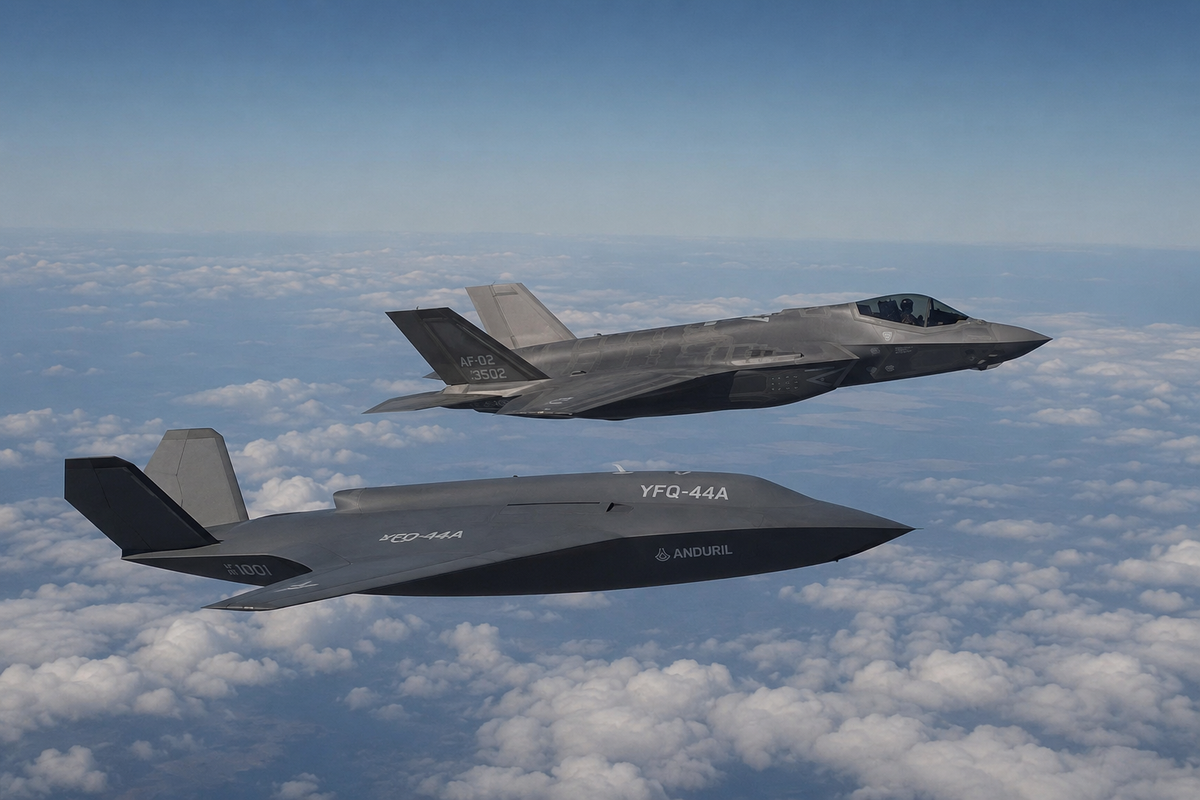
The YFQ-44A Fury is Anduril's autonomous combat aircraft, designed to fly alongside crewed fifth-generation fighters as part of the U.S. Air Force's Collaborative Combat Aircraft (CCA) program. It represents the most operationally advanced example of human-machine teaming in aerial combat.
The aircraft completed its first flight on October 31, 2025, and moved through captive-carry weapons testing with AIM-120 AMRAAM missiles in February 2026. It operates at Mach 0.95, can sustain 9G maneuvers, and is designed to function as a forward-deployed weapons magazine and strike platform flying alongside an F-35 or F-22.
The concept is straightforward: rather than risking a $100 million crewed aircraft as the first system into a contested airspace, the Fury flies ahead to absorb threats, conduct reconnaissance, and engage targets, while the human pilot directs the mission from a survivable position behind it.
Why it matters for CEE and NATO: The CCA program is not a distant future capability. It is in prototype testing now, with production decisions expected in 2026 and 2027. For NATO allies in Central and Eastern Europe operating F-35s, the Fury represents a near-term force multiplication tool that could significantly change the calculus of air combat over the region's contested eastern approaches.
5. Ukraine's FPV AI Drones: The Low-Cost Targeting Revolution
While American systems represent the high end of AI-enabled warfare, Ukraine has demonstrated something arguably more strategically significant: that artificial intelligence applied to inexpensive commercial hardware can produce battlefield-decisive results at scale.
Ukrainian engineers have been integrating AI guidance systems into first-person view (FPV) drones that cost as little as $400 to manufacture. The AI component handles the most operationally challenging problem in drone warfare: electronic warfare jamming. Russian forces have become sophisticated at jamming GPS signals and radio control links. An FPV drone dependent on either of these will simply stop functioning when the signal is cut.
AI-guided Ukrainian drones use onboard computer vision to identify and track targets autonomously, maintaining terminal guidance even when all external signals are completely jammed. The pilot releases the drone, guides it toward the target area, and the AI takes over for the final approach.
Ukraine scaled domestic drone production from 2.2 million units in 2024 to 4.5 million in 2025. That production rate, combined with AI guidance, has created a situation where the cost of the attacking system is orders of magnitude lower than the cost of the target it destroys.
Why it matters for the Balkans and CEE: This is the model most accessible to smaller armed forces and non-state actors alike. The components are commercial. The software is increasingly open-source. Any military in the region that is not actively developing countermeasures against AI-guided FPV drones is already operationally behind.
6. AI-Enabled Air Defense: Shooting Down the Drone Flood
The same AI revolution that is making offensive drones more capable is driving parallel development in air defense. Ukraine's experience defending against mass Russian drone and missile attacks has produced some of the most sophisticated AI-assisted air defense operations in history.
Ukrainian air defense commanders reported destroying more than 3,500 Russian unmanned aerial systems in May 2026 alone, across three layered tiers of interdiction. Coordinating that volume of intercepts, across multiple platforms, at the speeds required by incoming threats, is a task that pushes human operators to their limits. AI-assisted command and control systems handle prioritization, assignment, and tracking across the entire intercept layer.
On the offensive drone side, Russia has been equipping its Shahed-series drones with mesh networking capabilities that allow individual drones to share navigation data and coordinate flight paths even when individual units are jammed. This is AI-enabled swarm behavior applied to cheap mass-produced attack drones.
At NATO's testing range in Selia, Latvia, European startups demonstrated counter-drone AI systems in May 2026, with interceptors from companies including Nordic Air Defense, JetDrones, and DK Unity. Results were mixed, which is itself instructive: the AI targeting problem for counter-drone systems operating against fast-moving, maneuvering targets in real electromagnetic environments remains genuinely unsolved.
Why it matters: The race between AI-guided attack drones and AI-assisted air defense is the defining tactical competition of this period. Every military in CEE and the Western Balkans that operates near contested airspace is already inside this competition, whether or not its procurement decisions reflect that reality.
7. Replicator: The Doctrine of Autonomous Mass
Replicator is not a single system. It is a doctrine made operational. Launched by the Pentagon in 2023 and formally declared to have met its Phase 1 goals in August 2025, Replicator is the U.S. military's program to field thousands of autonomous systems across air, sea, land, and subsurface domains simultaneously.
The strategic logic is explicit: American military planners assessed that the U.S. could not match China's potential for mass production of cheap military hardware in a conflict scenario using traditional procurement methods. The answer is autonomous attritable systems: drones and robotic platforms cheap enough to be expendable, smart enough to coordinate autonomously, and numerous enough to overwhelm defensive systems through volume.
Phase 1 fielded thousands of systems by August 2025. Phase 2, with its first acquisition in January 2026, is already underway. The Pentagon's FY2026 budget includes a $13.4 billion line specifically for AI and autonomy programs.
Why it matters: Replicator represents the clearest statement of where military AI investment is going at the systemic level. The Pentagon is explicitly designing for a future where autonomous mass, rather than individual platform superiority, is the primary metric of military capability. That shift has direct implications for how NATO allies in CEE and the Western Balkans should think about their own force structures: a small number of expensive platforms, however capable, is increasingly vulnerable to a large number of cheap, coordinated autonomous systems.
The Pattern Across All Seven
Each of these systems, from a $400 AI-guided FPV drone to a billion-dollar autonomous combat aircraft, reflects the same underlying shift: artificial intelligence is compressing the timeline between intelligence and action.
In traditional warfare, the targeting cycle, observing a threat, processing the intelligence, deciding on a response, and acting, could take hours or days. AI systems are collapsing that cycle toward minutes, or in some cases seconds.
The consequences for conventional military doctrine, legal frameworks around the use of force, and the political accountability for battlefield decisions are still being worked out. What is not being worked out, because it has already been answered by operational experience, is whether these systems are coming. They are here.
For the armed forces and defense establishments of Central and Eastern Europe and the Western Balkans, the question is no longer whether to engage with AI-enabled warfare. It is how fast.
© Adria Defense. All rights reserved. Republication permitted with full attribution and a link to the original source.