Renault and John Cockerill Unveil Forefront Military Ground Robot
Renault Group and John Cockerill unveil Forefront, a new unmanned military ground vehicle targeting a 400-km range and one-tonne payload.

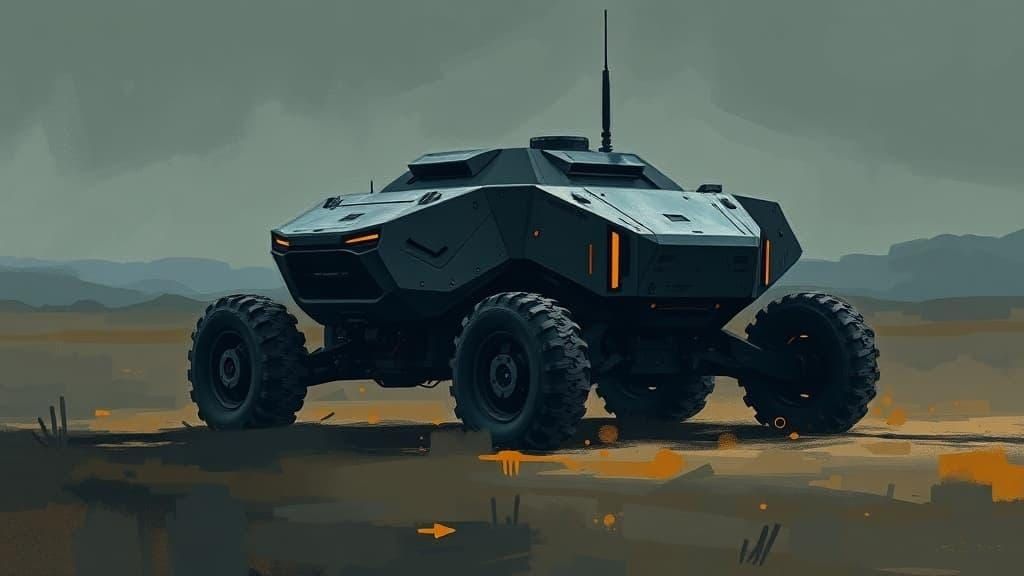
Renault Group and Belgian defense manufacturer John Cockerill have introduced Forefront Concept, an unmanned ground vehicle designed for military logistics, reconnaissance and combat support, combining automotive manufacturing expertise with advanced defense robotics.
The platform, unveiled on November 3, marks another step in Renault's growing involvement in European defense projects. It brings together the French automaker's ability to develop and manufacture vehicles at scale with John Cockerill's expertise in military systems, remote operation and autonomous technologies.
Forefront Concept is designed as a modular, remotely operated ground vehicle capable of carrying payloads of up to one tonne. Its proposed military applications include intelligence, surveillance and reconnaissance, counter-drone operations, fire support, equipment transport and casualty evacuation.
A 400-Kilometer Range and Modular Design
The vehicle features four-wheel drive, four-wheel steering and two electric motors. According to Renault, it is designed to achieve an operating range of approximately 400 kilometers, potentially extendable through a range extender.
The company also specifies a climbing capability of up to 60% gradient, reflecting the platform's intended use in difficult terrain and environments where deploying personnel could involve significant risks.
Although the architecture is being developed to support autonomous operations, Forefront remains a remotely operated concept at this stage.
Beyond military missions, the companies envisage applications in civil protection, emergency response and operations at hazardous industrial sites.
Combining Automotive Production With Defense Expertise
The industrial arrangement is central to the project.
Renault developed the vehicle platform using established automotive components and production methods intended to reduce manufacturing costs and development time. Its contribution includes electric powertrains, batteries, modular vehicle architecture and access to an established industrial supply chain.
John Cockerill is responsible for the remote-control and autonomy systems, military adaptation, mission-system integration and operational support.
The collaboration reflects a broader shift in European defense manufacturing, where established automotive companies are increasingly being considered as potential partners for producing unmanned military systems at scale.
A similar industrial approach is emerging in Germany, where ARX Robotics is seeking to expand its manufacturing capacity to 8,000 military robots annually, drawing on the capabilities of Europe's automotive industry.
Military Trials Planned in France and Belgium
Forefront was developed with input from the French armed forces and is expected to participate in military exercises and operational trials over the coming weeks.
According to French newspaper Le Monde, testing will include activities associated with France's Pendragon military robotics initiative, while exercises with Belgian forces are also planned.
The newspaper reported that neither France nor Belgium has placed firm orders for the vehicle. The manufacturers nevertheless see potential demand for several hundred units, with future production envisaged at a Renault facility in France.
For now, the next milestone is operational validation rather than large-scale manufacturing.
The project also illustrates how European defense companies are expanding their industrial partnerships as military customers assess the role of unmanned ground vehicles in logistics, reconnaissance and combat support.
For John Cockerill, the collaboration offers access to Renault's automotive manufacturing capabilities. For Renault, it provides an opportunity to contribute its engineering and industrial expertise to defense programs without becoming a conventional defense equipment manufacturer.
Whether Forefront progresses into serial production will depend on the outcome of its trials and subsequent military procurement decisions.