Rheinmetall Begins Caracal Deliveries Under €870 Million German-Dutch Order
Rheinmetall delivers the first Caracal vehicles under an €870 million German-Dutch order, with Austria's Mercedes-Benz G GmbH supplying the chassis.

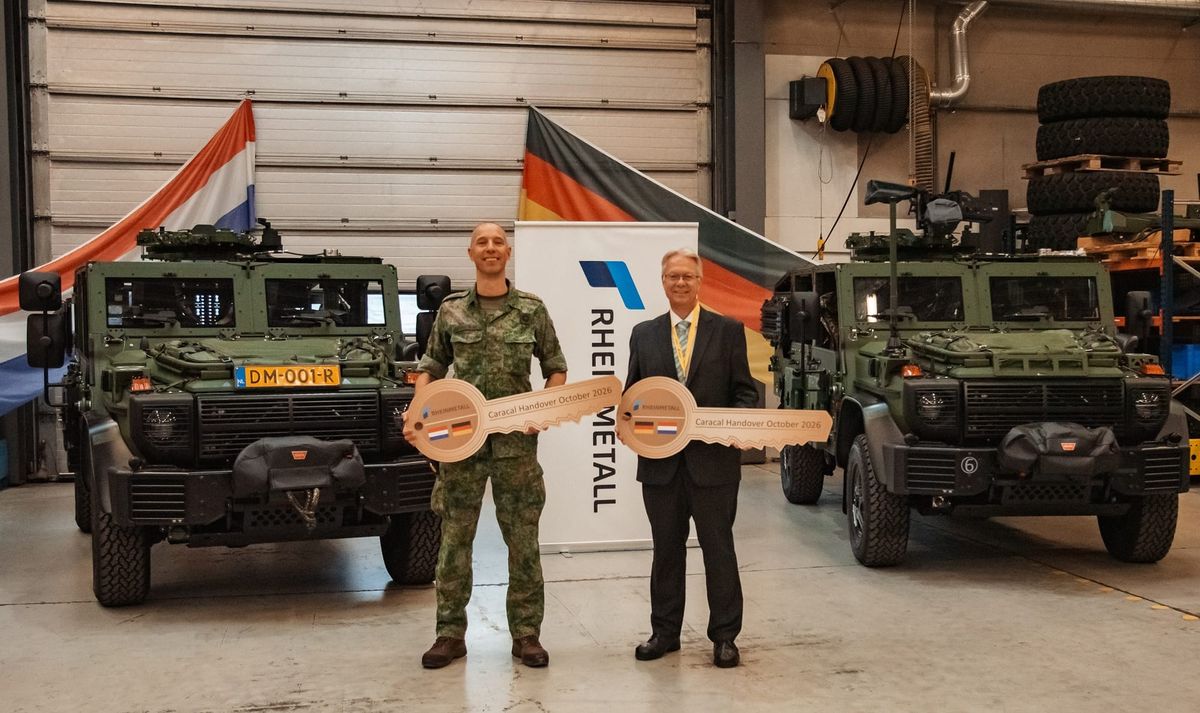
German defense manufacturer Rheinmetall has delivered the first series-production Caracal air assault vehicles to Germany and the Netherlands, marking a milestone in a joint procurement program backed by an initial €870 million order and a framework agreement worth up to €1.9 billion.
The vehicles were formally handed over on October 29, 2026, at Rheinmetall Defence Nederland's production facility in Ede. Representatives of Germany's Federal Office of Bundeswehr Equipment, Information Technology and In-Service Support (BAAINBw) and the Dutch Ministry of Defense received the vehicles, which are intended for airborne and specialized military formations.
The joint program covers more than 1,500 vehicles scheduled for delivery by 2030 and includes 20 years of lifecycle support. The Dutch armed forces had already received an initial vehicle for driver training on September 29.
€1.9 Billion Framework Supports German-Dutch Procurement
Germany and the Netherlands awarded Rheinmetall a multiyear framework agreement in July 2023 covering up to 3,058 Caracal vehicles, with a maximum gross value of €1.9 billion.
The initial firm order covers 1,508 vehicles worth approximately €870 million, including VAT. Under the wider framework, Germany can procure up to 2,054 vehicles, while the Netherlands can acquire up to 1,004.
The latest handover marks the start of series-production deliveries, rather than a new procurement agreement. Rheinmetall confirmed that more than 1,500 vehicles are scheduled to reach the two armed forces by 2030.
The vehicles will support Germany's Division Schnelle Kräfte and the Royal Netherlands Army's 11 Airmobile Brigade. The Dutch formation has operated under German divisional command since 2014, making common equipment and logistics an important part of their military cooperation.
The Caracal program is separate from the Boxer-based Schakal infantry fighting vehicle procurement. On October 30, AdriaDefense reported that Rheinmetall had confirmed additional Schakal orders worth hundreds of millions of euros for the same two armed forces.
Austria's Mercedes-Benz G GmbH Plays Key Industrial Role
The Caracal is based on the latest military Mercedes-Benz G-Class 464 chassis and was developed through industrial cooperation between Rheinmetall, Mercedes-Benz and German specialist vehicle manufacturer ACS Armoured Car Systems.
The program has a notable Austrian industrial component. Mercedes-Benz G GmbH, based in Graz, Austria, supplies the vehicle chassis, while ACS, headquartered in Friedberg, Germany, develops and manufactures modular structural components and equipment carriers.
Rheinmetall Landsysteme acts as the principal contractor, with final vehicle assembly and systems integration carried out by Rheinmetall Defence Nederland at its facility in Ede.
The production structure illustrates how a major European military vehicle program distributes manufacturing responsibilities across Germany, Austria and the Netherlands.
For Austrian industry, participation through Mercedes-Benz G GmbH connects Graz's established military vehicle engineering capabilities to a long-term German-Dutch defense procurement program.
The original contract also provides opportunities for suppliers involved in specialized vehicle equipment, integration, maintenance and lifecycle support.
Caracal Offers 28 Military Equipment Configurations
Designed for airborne and specialized forces, the Caracal is a lightweight, highly mobile tactical vehicle capable of carrying four soldiers and their equipment in its standard configuration.
Its modular construction allows the platform to be adapted for multiple operational roles. Rheinmetall says the vehicle currently supports 28 equipment configurations, providing flexibility for personnel transport, reconnaissance, medical support and other military requirements.
The vehicle can be transported inside heavy-lift helicopters or carried externally, depending on its configuration and the aircraft involved. This enables airborne units to deploy tactical mobility assets in support of rapid-response operations.
Protection can be adapted to operational requirements, with modular solutions against ballistic and mine threats. Available weapon configurations include machine guns, automatic grenade launchers and anti-tank weapons.
The Caracal's common vehicle architecture is also intended to simplify maintenance, training and spare-parts management for German and Dutch forces.
For Rheinmetall and its industrial partners, the transition to series deliveries provides a clearer production outlook under a program extending through the end of the decade. The wider framework agreement leaves room for additional orders beyond the initial contracted vehicles, although those options should not be treated as firm orders until exercised.
Sources: Rheinmetall, October 30, 2026; Dutch Ministry of Defense; ACS Armoured Car Systems.